


“Oh, that’s just semantics!”
I tried to have a conversation with a fellow consultant once. We had just been in a first meeting with a prospective client where he interrupted when the client was answering my questions. The consultant talked incessantly about himself, his background, and projects he had done in similar industries.
“Did you ever notice that a consulting project is called an engagement?” I asked him. “Think about that. It’s the same word that is used at the start of a marriage. We even formalize it with a ‘proposal’. . .”
“Oh that’s just semantics!” he interrupted me, and even when we didn’t get a second meeting, he aggressively rejected any feedback about the contribution his behavior might have had to that result.
I was an independent consultant at the time, a part of a confederation of independent consultants called Results-Alliance, which this consultant said he wanted to join. After that meeting I wasn’t sure that he was a fit. One of my colleagues gave him a second chance, and brought him along to another client meeting.
“Nope. No way! Guy hasn’t a clue how to engage!”
We’re getting engaged!
There is a reason that consulting projects are called engagements. That may be semantics, but semantics is the study of meaning, so language is important.
The relationship is a business partnership, formed to solve a problem or help make a change. It starts with some informal conversations where the parties express interest and may be formalized in a proposal. The couple, client and consultant, and it is two people, not their firms, enter the relationship with a little trepidation.
The client, may be uncertain of what the problem is or how to solve it. He or she may see this problem or change as career-limiting if unsolved. On the other hand, the client knows the business and doesn’t want to be treated like an idiot, or manipulated in any way. They want respect and an equal relationship or at least one on their own terms.
The consultant may be uncertain of what the problem is or how to solve it. He or she may need to bring in business to feed the consulting firm, or to be promoted to partner. On the other hand, the consultant may have seen similar issues before, and wants to meet the client in mutual respect.
Uncertainty, insecurity, often drive people to “power-up,” and behave in ways that sabotage an honest start to the relationship. I never went to dating bars, but my friends who did have shared numerous tales of jerk behavior and I’ve certainly seen consultants and clients behave in ways that make the other not want to work together.
What the client wants from the engagement
Clients want an outcome, a result. That may be more revenue from more customers, or more sales from existing customers, or new products. Or they may want more profit, from lower costs, better, faster, cheaper operations, or from more revenue on the existing cost base. They may say that they have a particular solution in mind, a new strategy, shortening the time to market, a new organization, reducing inventory turn, but it will behoove the consultant to get underneath that to determine the outcome, what success looks like.
The client also has some process needs as well.
- Don’t break my business.
- Don’t annoy my people.
- Don’t make me look incompetent to my boss.
- Stay on time and on budget.
- Finish this job before you try to sell me something else.
This isn’t a comprehensive list. It is rare that a client will actually say these things; it is the consultants job to uncover the perceived risks of the engagement and make appropriate ground rules to ensure the engagement process works.
What the consultant wants from the engagement
Consultants want to solve problems. They want interesting and challenging work, but mostly well-defined problems. Consultants also want to make money, so they want to be able to predict how many billable hours it will take to solve the problem. This isn’t an exact science and they need the client to understand that.
Consultants also want to get paid. When I worked for large firms, at least in the beginning, I was almost oblivious to the accounts receivable function. When I worked for myself this was extremely clear. Tracking and reporting billable hours wasn’t dirty; it was paydirt.
Consultants have some process needs, too:
- Hands-off rarely works. Please engage with the work. Let’s agree on when, and how much, you’ll be involved.
- Provide the information and internal support I need to do my job. (I’ll respect confidentiality.)
- Confront any problems quickly.
- Be sensitive to expanding scope.
- Let me know about ongoing impact of our work together.
These may not be your needs as a consultant, but whatever they are, you have to ask for them.
A tool that helps in engagement.
Relatively early in my consulting career, I attended a workshop given by Peter Block. Dr. Block went through his contracting process, delineated in the beginning of his book Flawless Consulting: A guide to getting your expertise used. I bought Peter’s book eight or nine times and gave it away. I taught the contracting process to new consultants. I used this process myself for most of my career.
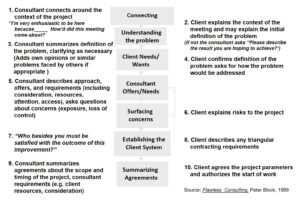
There are several things I like about the process:
- He uses the work and the reason for the meeting to connect with the client. For a non-sports fan like me that really helped with setting climate, and avoided looking for a mutual avocation to talk about.
- Both client and consultant needs are specifically covered.
- Risks and concerns are specifically raised and addressed.
- It establishes the entire client system
- Agreements are summarized verbally, making for fewer written proposal revisions.
This process sets the tone not for a marriage, but for mutual engagement and an equitable working relationship. That’s not “just semantics.”
 Traveling the Consulting Road: Career Wisdom for New Consultants, Candidates, and Their Mentors includes the tools, methodologies, and frameworks learned in a lifetime of consulting. I tell stories of my experiences and mistakes and draw conclusions on how to get hired and promoted, how to start a consulting firm, whether to become an independent consultant, and how to find and serve clients.
Click here to read more



This one reminds me of a similar situation, Alan. MY then boss, and I had an in-person meeting with a global buyer at a pharma company. As soon as we sat down, he launched into his experience, his company, his achievements, and how great he was.
I watched as the prospect’s eye’s started to glaze over. At one point, he stopped to take breath, and the woman turned to me and said, “Don’t you have anything to say?”
To which I replied, “I like to listen first before I start talking. Thought I might learn something.”
She laughed. Soon became a client for several years.
That is soooooooo spot on, Bob!
Thanks for the story and your support.