


I recently attended a writer’s conference in Florida. Florida in February sounded like a really great idea. It was 35° Fahrenheit. The conference was great; the people were great. We hugged a lot. Two days after I got home, I came down with a cold.
“Oh,” said my friend, “You probably didn’t dress for that Florida cold snap and you got chilled.”
I’m pretty sure that my friend knows that my “cold” is caused by a virus. Being generous, perhaps he thought that walking a half mile to and from the conference in just a sport coat lowered my immune system and made me more susceptible to the virus. More likely, his head was filled with what both our mothers told us as children. “Bundle up, or you’ll catch cold.”
I know I caught the virus from other people, or an undisinfected surface, at the conference, in the airport, or on the plane. I know I haven’t been around people as much this winter, so my immune system is out of practice, but when he said that, I just shook my head smiling.
“Nope. Didn’t pack a topcoat.”
It’s just too easy to fall into common misconceptions, even when we know the truth.
Bats aren’t blind. Napoleon’s height of 5’7’’ was average for a Frenchman of his time. The color red doesn’t anger bulls. The Great Wall of China isn’t visible from outer space. Fortune cookies were invented in Japan and are rarely eaten in China. Vikings never wore horned helmets and “discovered” North America hundreds of years before Columbus, and found a native population that had been living here for tens of thousands of years.
Misconceptions about the Consulting Road
I don’t think people use that phrase much anymore, but in the Northern UK where my first project was, I often heard, “so, what made you choose the consulting road?” I sometimes answered, “a passionate interest in business,” or “problem solving.” My answers never produced much more than a “Hmmmm.” I wasn’t speaking to the client’s problem.
I might have said “I like helping people find new revenue,” or “increase profit.” I also didn’t speak to the concern most client system people have about consultants, “they work for the boss; they’re going to steal my ideas and not give me credit.” Or as one hard-bitten factory superintendent said through his thick Strathclyde accent,
“Consooltnt, eh? Gud mooney fer auld rope.”
I had many misconceptions about consulting when I started, which I write about now for those who are traveling behind me, to save some painful lessons I learned over my thirty-seven years consulting:
- Glamour: Consulting isn’t glamorous; intensive travel and being prepared to say something of value to someone who has worked in an industry you’re just learning about is hard work.
- Big Money: Sure, the starting salary will help pay off student loans, but the real money is reserved for those who acquire new clients, either by direct sales, or creating new service offerings.
- Smart Information: Consulting’s not the “advice business,” or “research;” it is about increasing revenue or profit, and that means helping to change people’s behavior.
That last one, seems obvious to me now, but in the beginning I didn’t get it. I started out doing market feasibility studies. They were largely about doing research, providing information in the form of recommendations. It was the client’s responsibility to either take or reject the recommendations and make whatever change was necessary.
In my first consulting project, our team did lots of research, and made recommendations to a UK truck manufacturer who was known for heavy-duty “articulated lorries,” called tractor-trailers or “semis” in the US. They took our advice and built the eight wheel truck they were looking at, but didn’t build the “box van,” where there was a penalty for the extra weight of “heavy-duty.”
My second project, was also research, “which of the following developing world markets is ready for automatic transmissions in buses.” We looked at twenty some markets, determined which had the right mix of city, country, and city-to-city routes, sufficiently modern fleets, and consolidated ownership, to be viable target markets. We recommended eight in a priority order. That client did nothing with the information. Why?
It took me a while to realize that they didn’t have anyone who could spearhead the international sales and service. They didn’t have the manufacturing infrastructure or systems to expand internationally. Most importantly they didn’t have a divisional executive (our client) who was committed to change.
Perhaps, if he was, he would have engaged with us more. Maybe, he would have asked us to look at internal capability. Perhaps, he would have structured the project to be less content-oriented, getting information, and more process-oriented, making change happen.
Misconceptions about Change
I had misconceptions about change, but even after I’d overcome some of them, I’d run into others who were steeped in these:
- I heard both consultants and clients underestimate the difficulty of change. I saw the “change-by-single-executive email” fallacy. I saw the underestimating customer reaction, “Is anyone old enough to remember “New Coke.” I saw the conflicting measurements blunder, “Yeah, I know we’re supposed to solve problems, but my bonus is based on average call handle time.” Change isn’t quantum physics, but easy-peasy it is not.
- Get the “Right Leader.” The idea that you can fire an executive and hire a new one and change will magically happen, reminds me of the sixties when we envisioned the perfect commune. “You just gotta get the right people, man.” Leadership is critical, but location, infrastructure, measurements, process, all contribute, and even then there are false steps and restarts.
- People fear change. This one refuses to die. If all people feared change, no one would get married, move, change jobs, have children, or many other life-shattering changes they choose every day. That’s the point. They People don’t fear change; they fear loss, loss of job, loss of status, and mostly loss of autonomy or agency, the right to choose to change. So, they are not resisting change, they are resisting your change, the one you are imposing on them.
Overcoming misconceptions is a matter of bringing new information, but it’s also a process of helping people internalize that information, and choose to take new action based upon it. That is often the job of consultants.
If you like steep learning curves, doing engaging work, with smart, interesting, and (mostly) nice people, then I can recommend the consulting industry.
However, the consulting industry and all businesses are going through the enormous upheaval of artificial intelligence (AI). My books won’t teach you anything about that.
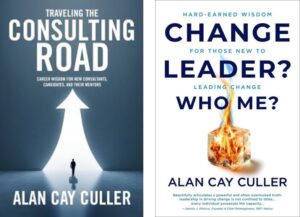
What they will teach you is the history and context of consulting and how to succeed at the skills that AI won’t replace, how to help change people’s behavior to innovate (new stuff), improve (better-faster-cheaper), or integrate (move a team or an organization as one to) a solution.
I write for those who disprove a misconception: “the young won’t listen and the old don’t read.”
Do you know someone like that? Click here.



Good Morning Alan. I love these bullet points from your story:
Get the “Right Leader.” Unfortunately, this one is multi-factorial and so many factors affect a leader’s ability to lead a change initiative. I am reminded of Deming’s quote – put good people in a bad system and the bad system wins every time.
People fear change — Yes! Another good one. They fear the loss of control.
Keep writing brother!
Good morning, David
I appreciate your continued appreciation of my writing. Of course, I will continue writing and so should you.
I, too am a big fan of Dr. Edwards Demming and his 14 points. Especially:
5. Improve constantly and forever the system of production and service, to improve quality and productivity, and thus constantly decrease costs.
8. Drive out fear, so that everyone may work effectively for the company.
14. Put everybody in the company to work to accomplish the transformation. The transformation is everybody’s job.
Alan, your insight into consulting misconceptions is inspiring. Having worked in the consulting role long ago, I admit there were many “opportunities” I missed. Your insight will surely help both newbies and wizened practitioners.
Now then, to your opening story: I loved it. It fit sort of like a glove (nope, not a topcoat). I have to hand it to you, your style is informative, but even more powerful (to me) is your ability to engage. Thank you!
Hi Ed
Thank you so much for your comments.
I look forward to speaking with you on your podcast The Water Trough in April
https://open.spotify.com/episode/59BCZE7fOvWpmKah9zzBl5