
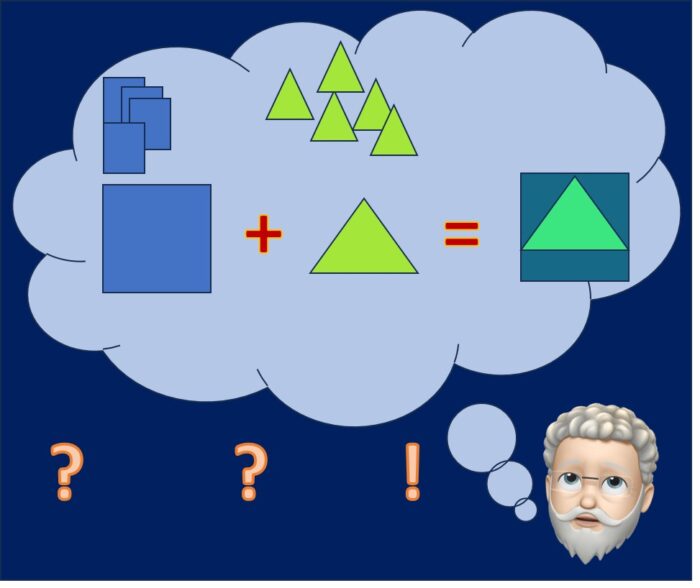

“You are a conceptual reductionist.”
The speaker was Dr. Richard Taylor and we were training continuous improvement (CI) coaches together in Hong Kong. It was at the end of a long week and we were packing up.
“What?” I tilt-head-sneered. I really was not in the mood for snarky banter from Ric.
Kelly, a mutual client, had put Ric and I together to design and deliver four weeks of training to a cadre of internal coaches for a CI initiative to improve safety at an international oil company. We were incredibly different people. Ric was a professional engineer, who held multiple graduate degrees in advanced statistics and mathematics. I was an organizational development consultant who specialized in the people side of change. We almost killed each other the first week, but soon developed a grudging respect for each other’s specialties. We described ourselves to our training participants as “two halves of a whole person. So if it has to do with math ask Ric; if it has to do with people ask Alan.”
And we developed the kind of sarcastic humor between us, that guys sometimes do to avoid the discomfort of admitting that they actually like each other. So my exasperated “What?” was in anticipation of the zinger I knew Ric was about to deliver.
“No, really. It’s what you do. You take a complex concept and simplify it to it’s essence so people can take it in and act on it.”
“Huh? And…?”
“That’s it. You know, like the leadership and management stuff and capability. I just realized. you’re really good at it.”
“Oh. Thanks.” I was left a bit unbalanced, still waiting for a punchline, but Ric paid me one of the nicest compliments I’ve ever received.
I don’t know why I woke up thinking about Ric early this morning. It’s been more than five years since he passed. Then, David Ford PE, MBB, a LinkedIn connection, an executive coach, a participant from a Lean Six Sigma Initiative, a friend, posted about Ric and me training together. Synchronicity! Can’t ignore that.
So in memory of Ric Taylor, and in gratitude for his compliment and our time working together, I thought I’d share some conceptual reductionisms.
Leadership and Management
There has been much written about the difference between these two skillsets. It is confusing because they are often required in the same person in different circumstances. My over-simplified differentiation of managers and leaders is:
Managers:
- thrive in a relatively steady state
- are accountable for getting work done, and
- Develop people to ensure they are capable of getting work done
Leaders:
- thrive in abnormal circumstances such as change, emergencies, war
- are accountable for giving direction, “This way!”
- attract followers, “Follow me!”
These days everybody wants to be called a leader and never a manager, or worse, “the Boss,” (except of course, Bruce Springsteen). To me they are different roles with different objectives, requiring different skills.
Capability
There are several words that get thrown around indiscriminately, sometimes interchangeably, that confuse what it takes to learn. I put these words in a particular progression that communicates a learning process for an individual or an organization.
- Knowledge is what to do and how to do it; Skill is developed by practice doing it.
- Education develops knowledge; Training develops preliminary skill. Skill is mastered by repeated practice focused on improvement.
- The combination of knowledge and skill is Competence. We often hire for competence. The absence of competence, in individuals and organizations can cause unsafe behavior and errors.
“Did you not know how to do this or have you not practiced enough?”
- Competence is rarely enough. We work to support individual and organizational competency with habits and systems that ensure we do the task so well that others can instantly recognize a Capability.
“That’s just semantics!
True. Semantics is the branch of semiotic science concerned with meaning.
I understand that some people see competence and capability as interchangeable words. I want to draw a difference in meaning between being “good enough,” and a “recognized master.”
I also think one of two secrets of success in life is the development of capability.
Connections
The other secret to success in life is connections. Nobody succeeds completely on their own. Every successful person has help.
This has been bastardized into “it’s not what you know it’s who you know.” Some people suck up to people they despise so they can ask for favors later. That is not what I’m talking about.
I’m talking about building competence and capability the way that musicians get better playing together, or the way it is easier to learn computer software sitting next to someone else, “How do you…? …Oh, thanks.”
I’m also talking about being open to a possibility of a shared interest, when meeting strangers. How would you know, unless you ask, “What are you interested in?” (So much better than “What do you do?”)
Sometimes “out of the blue,” someone offers help. All to often in my life, I missed that offer until I thought about it later, slapping the now-flat-spot on my forehead with the heal of my hand. I had many people help me, but I was never easy to help. I often didn’t get that a connection might see something I didn’t. I was too often “stuck in my own head.” My internal governance systems were too self-referential.
Governance
A new division head once said to me, “Tony (the CEO) told me to focus on governance. What the hell does that mean?” I had talked with Tony and I knew he thought my client was “too nice. His people just walk all over him. Nobody does what he says.” I didn’t tell Art that.
We worked out this definition of governance:
- Information flow: What are the systems, processes, management practices that ensure that the information you need to make decisions arrives in an accurate and timely manner? How do you make sure you get “bad news” early so you can correct it? How do you make sure you hear disagreement or see divergent data? How much information is too much? What honest filtering do you need from others? What guidance must you give to ensure that filtering doesn’t become unhelpful.
- Decision process: How do you make decisions? – a balance sheet, facts and data, pros and cons approach? Or comparing decisions to firmly held values about people, customers, suppliers, staff, the community? Which under what circumstances? How do you let your people know your decision process? What decisions are yours alone? Which need to involve others? Which should be made by others either informing you or not.
- Action: How do you move people to act on decisions? How are you and they accountable for those actions?
In the end, this simple definition helped Art and improved Tony’s view of him. Or as Tony said, “I have to admit I’d do things differently, but stuff is getting done and I am not going to complain about that.”
Conceptual Reductionism
I suppose Ric was right. I often started my work with leaders and teams by agreeing a simple definition for complex ideas. I found that if we agreed on meaning, the rest of the work became easier.
So, thanks, to the late Dr. Richard Winslow Taylor, for the compliment, for your insight, and for ten wonderful years of working together. I miss you, man.
I write books for the exceptions to the rule: “The young won’t listen and the older don’t read.”


Hi Alan,
I’m finally getting around to catching up on your blog. I’ve bookmarked it on my browser bar so I can periodically check in for your new stories. Ending ATI was not an easy decision, but I’m now much more comfortable reading and sharing your stories and those of others with my network on LinkedIn. In some ways, I suppose I used a bit of my Lean Six Sigma thinking to arrive at that conclusion.
I really enjoyed this story about you and Ric. I also agree with what Ric said: “You are a conceptual reductionist.”
I especially appreciated your line: “I often started my work with leaders and teams by agreeing on a simple definition for complex ideas.” That step is so critical, yet so few of us actually take the time to do it when working with others. We often assume everyone shares the same understanding of what we’re talking about and that’s a very flawed assumption.
As a practicing engineer and later as a Six Sigma Master Black Belt, I’ve struggled to simplify ideas. Engineers tend to explain not only the time, but also how the watch is built; I have the t-shirt to prove it.
That said, I’m working to use fewer, more impactful words. My wife Donna, an English and History major, has helped my communication style since 1980, especially my wordiness. I’ve improved but remain a work in progress.
Thank you as well for mentioning me in your story. I remain deeply grateful that our paths crossed—yours and Ric’s. It’s truly sad that he passed far too soon. There was still so much unfinished work he had ahead of him to help make this world a better place.
Hi David
Thanks so much for your kind words and continued support or my writing.
I miss your aggregated newsletter All Things Interesting (ATI), but I get the time challenge of putting something like that together.
Underlying assumptions and definitions of terms -wouldn’t the world of work and , in fact the world be a better place if we paid more attention to those?!
I am grateful for you engineers -you build stuff and generally make the world work. I’d make you take Shakespeare though. One time Ric paused after saying “Tomorrow…
I filled in with “…and tomorrow and tomorrow creeps in this petty pace from day to day to the last syllable of recorded time. And all our yesterdays have lighted fools the way to dusty death. Out! Out brief candle. Life’s but a walking shadow, a poor player who struts and frets his hour upon the stage and then is heard no more. It is a tale told by an idiot, full of sound and fury signifying nothing.”
And he said “Huh?”
And I said “Macbeth. Didn’t you have to memorize that? And he’d say “I think I cut that class.”
And I said, “I dropped Calculus.”
And he said, “You DROPPED Calculus?”
And we both cracked up.
I miss him a lot.
Thanks again -we ought to be careful if we ever meet face to face again, not to let Donna and Billie spend too much time together -the gathering of English majors is unlikely to be good for us.😉