

Some readers might remember that I occasionally write songs. In the fall of 2019, I wrote five songs that I have done nothing with since. I don’t do my own musical notation and several times since then I have thought, “I really should have Doug (a musician friend) transcribe those songs so I can copyright them.”
For some reason, transcription was a perpetual ‘C’ priority on multiple to-do lists. I don’t know why I felt no urgency for the last six and a half years, or why last week, I made simple recordings of those songs and one I wrote last year and sent them to Doug to write them up in lead sheet form, melody chords, and structure (tempo, feeling, etc.).
My sister Connie had passed away in August 2019, so it’s not surprising that many of the songs were either sad, or edgy humor about lost love. Revisiting one of the songs, “Identity Prayer,” was unexpectedly emotionally tough. It told a story of my emergence from being unsure of who I was to understanding my values.
“I feel the best when I’m helping others; I finally learned to sing my own song.”
This transition was very old news in 2019 and is older now, but I had a hard time getting through the recording without tearing up. I joked to my wife that “maybe, at 78, I’m going through an identity crisis… again.” I’m still working on why that song struck such a deep chord now.
Today, the songs are all in Doug’s hands, and I’m wondering where did this “Be Helpful” value, which drove my consulting work, come from. I defined my business as “Helping leaders make strategic change.” I have now written two books intended to be “helpful,” Traveling the Consulting Road – (helping new consultants), and Change Leader? Who Me? (helping those new to leading change).
Where did “helpful” come from? Boy Scouts? “Trustworthy, Loyal, Helpful…” Maybe. My parents? Probably.
I do remember when I studied Organizational Development at Teacher’s College, Columbia University, that Dr. Warner Burke had us read, “The Helping Relationship” by Carl Rogers. This article had an enormous impact upon me.
The late Dr. Rogers stated that a helping relationship was founded upon “at least one of the parties’ intent of promoting learning and growth.” He was speaking to therapists and advocating for client-centered therapy, but he believed that the helping relationship had applications between parent and child, teacher and student, all kinds of counselors, and “administrators with their staff.”
Rogers defined the helpful relationship as first beginning as helping myself. “Can I be trustworthy, dependable and consistent?” “Can I be expressive such that I communicate who I am?” “Can I be myself in this relationship?” Many who trained therapists in Rogers’s day and many who teach managers and leaders today, promote “professional distance,” but Rogers insisted on “being real.”
Dr. Rogers recommended “unconditional positive regard,” suspending evaluation and judgement and actually looking for reasons to “like your client.” I wish more leaders and more consultants practiced “unconditional positive regard.”
“Can I be secure enough to maintain my separateness, but respect his separateness and receive him as he is?” “Can I listen completely, not just to the words but to the meaning from the inner experience of the whole person in front of me?” This is hard to do as a consultant, as a leader, as a parent, and in any relationship really, but the world would be a better place if more engaged in this practice.
I used Rogers ideas in leadership development classes. I used them in consulting skills training. In rereading this piece I realized that many of the “quotes” I used do not actually come from the article, but likely came from class discussion of it.
“Help is defined by the recipient.” What I might intend to be helpful might be perceived differently by those on the receiving end. I’m reminded of the quip by Ronald Reagan at a 1986 press conference.
“The nine most terrifying words in the English language are:
‘I’m from the government, and I’m here to help.’”
People need to be able to receive help. I once was interviewing a farmer for research into the effectiveness of farm radio. We were interrupted by a young man from a local university agricultural extension, “here to tell you about new methods.” The farmer exploded,
“New methods?! Good Lord, don’t teach me any new methods. I’m only farming half as well as I know how, now!”
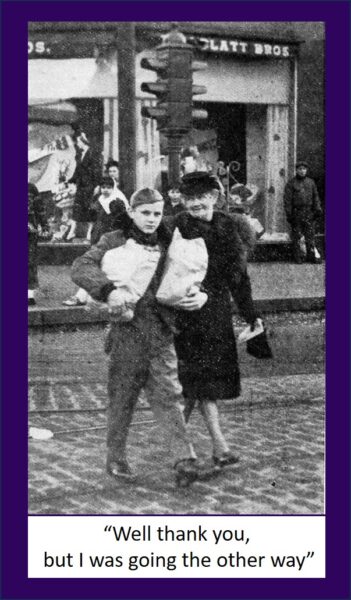
“Help must be asked for. Help that isn’t asked for is rarely seen as help. It is more often seen as interference.” How many times have we found ourselves listening to someone vent and jumped in with many suggestions from our own experience that were not received well. Did we ask, “Do you want ideas or would you prefer that I just listen?”
How many leaders hear a good problem statement, “The materials delivery is three days late, which will slow the delivery of the final product,” and jump in with a dozen well intentioned suggestions, not understanding that they are received as “He thinks I’m an idiot. Of course, I’m checking the secondary supplier, and parallel processing to make up the time.”
You can’t fake Unconditional Positive Regard or real connection. We all know leaders who have learned the verbal cues method of listening ̶ “Mmmm.” “Good.” “Uh-huh.” They rarely fool anyone.
Rogers talks about a piece of research (Lindsay 1956) which followed the principle of operant conditioning pioneered by B.F Skinner where a “chronic schizophrenic can be placed in a ‘helping relationship’ with a machine. The machine, much like a vending machine, can be set to reward a variety of behaviors.” In the short term, patients engaged in rewarded behaviors, but when rewards were removed change evaporated.
I wonder what will happen to AI chatbot therapy results or to leaders who overuse AI to communicate.
“Can I meet this other individual as a person who is in the process of becoming, or will I be bound by his past and by my past?” Roger’s last question in “The Helping Relationship” seems especially important for those leading change. Do we expect that those who are just learning about a change will have internalized the “Why” in the same way that the leader who has had much more time with this insight? Do we expect them to instantaneously understand “Why not changing is NOT an option?” Leaders and followers are at different stages in a dynamic process and recognizing that, is helpful.
Is your Leadership helpful?
Carl Rogers concludes, “It would indicate that if I were interested in creating helping relationships, I have a lifetime job ahead of me, stretching, and developing my potentialities in the direction of growth.”
That kind of perpetual growth was one I embraced as a consultant and change leader. Now in retirement, as a writer, I am farther removed from the helping relationship. The redemption line of my “Identity Prayer,” “Help me know who I am, love and help those I meet” seems amorphous, harder to put into daily practice, or to know if I’m being helpful.
What about you? Is your leadership helpful?
I write books for the exceptions to the rule, “The young won’t listen, and the older don’t read.”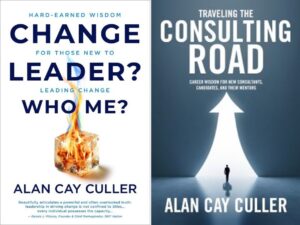


0 Comments