

“She asks me why
I’m just a hairy guy
I’m hairy noon and night
Hair that’s a fright
I’m hairy high and low
Don’t ask me why
Don’t Know!”
Flat tops and DAs
I’m approaching my sixtieth high school reunion. Yikes! I pulled out my Class of 1965 yearbook, thinking “this is not, in any way, a good idea.”
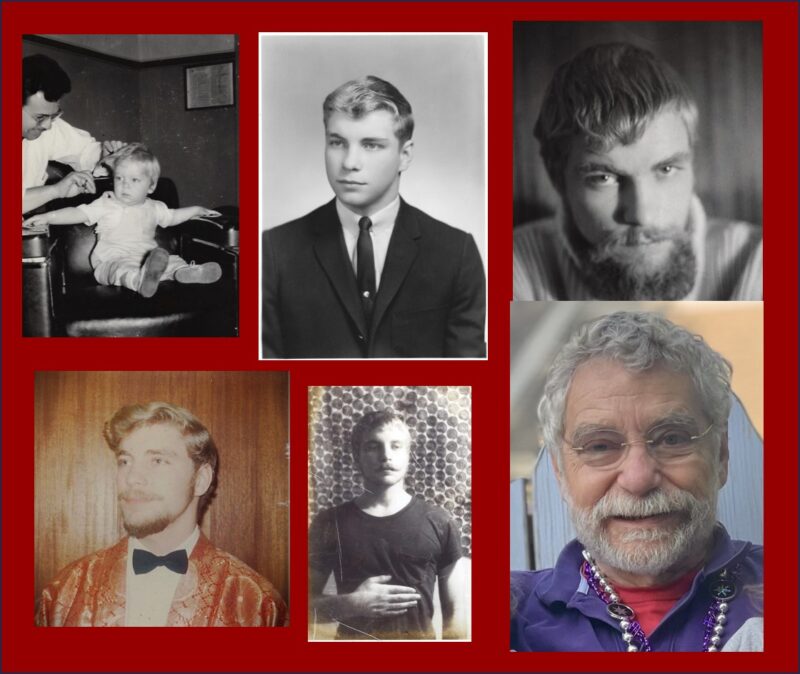
My first impression was – Hair. Our hair then was all flat tops and DAs for the guys and Big Hair and flips for the girls.
I read an article about how hair was an indicator of social class. It pointed out that prep school guys, like Tucker Carlson, combed their hair down, and greasers swept their hair back, think Henry Winkler’s Fonzie of the Happy Days TV show. There it was in “The Spirit of ’65,’ the Lexington High School year book.
Now don’t get me wrong, Lexington, Massachusetts is pretty bougie, as my grandchildren say. It was an upper middle class Boston suburb even then. But we had a semblance of social classes, some “old money” kids, some children of executives, doctors, professors, and 128 computer engineers. And we had children of construction company owners and building tradesmen, truck farmers, and retail store managers. Like every high school of all time, there were cliques. Some were based upon interests, sports or chorus, cars or calculus. Some, however, were based upon what your parents did for a living and what part of town you lived in.
Apparently, that also played out in hairstyles.
My own “social class” was mixed. I lived “down the street from the dump.” My father was a printer, who’d had his own shop in Florida, but then set type for a newspaper. My mother was a math teacher who turned computer programmer when I was eight. Early on, I hung with the Lexington “punks” and combed my hair in the up and back winged style of “Kookie,” the car-valet-turned-private-investigator, played by Edd Byrnes in the TV show “77 Sunset Strip.”
Later, I discovered musical theatre, joined the chorus, and left my fist-fight and petty vandalism buddies behind. I also changed my hair.
I tried to do a flat top. Man, I really tried, but no matter how much of that stick pomade I put on, the front would just flop down. I looked like a Cupie Doll with spit curls. I ultimately settled on neatly trimmed on the sides and a little wave in front.
Hair as fashion statement
When I was in high school, classical musicians were called “long hairs.” I still remember a Jack Parr quip to a pianist describing his art as “long hair,” “What? Longer hair than the Everly Brothers?”
The Beatles arrived on the scene and destroyed the hair paradigm. The mop-top hair style apparently drove girls wild, and you can see some of that style in my yearbook. I don’t know that I noticed the hip guys who had moved toward Beatle-mania, when I was wearing a bald skull cap to play the King in the “King and I.”
I went to college in Kentucky because the only two other schools that accepted me were in Boston, and expected me to live at home, which at seventeen, I was definitely not interested in doing. Kentucky hair trended behind Massachusetts hair. Absolutely no mop-tops, no DAs, all flat tops and mini waves for guys and mostly flips for girls.
Hair and politics
You’ll notice, I’m only talking about white people’s hair. There were two African Americans in my high school class of around seven hundred. The percentage was higher in college but still slim numbers, so I was unaware of the problems of styling black hair, and the discrimination and racism that, I’ve since learned, goes along with that experience.
You’ll also notice that I am also not talking much about women’s hair. I am now aware of how much sexism surrounds “acceptable” hair for women, and how much resentment my daughters feel because King Gillette doubled the razor market in the 1920s by promoting shaving of underarms and legs. I have never shaved body hair, though I once flirted with a smooth chest in the days when Arnold was Mr. Universe.
I grew my first beard, a Van Dyke, in my sophomore year for a role as one of the knights who murdered Thomas Becket in T.S. Elliott’s verse play “Murder in the Cathedral.” I don’t remember much about the role except a speech at the end justifying murder to keep religion out of politics.
I do remember the reaction the beard caused. The barber shop didn’t exactly refuse to cut my hair, but they kept me waiting for almost two hours while barbers and customers heaped on abuse. After two such sessions, I started going to the black barber shop across town, which played blues music, and was generally a lot more fun.
After the role, I didn’t shave my beard right away. I took a lot of abuse on campus for that. My oldest sister, who was in a fragile state at a family funeral, told me, “You can’t be my brother and look like that.” She has since gotten over it. I eventually shaved for roles in summer stock.
Senior year I grew a full beard. I was “radicalized” about the Vietnam War, and Civil Rights, at least, “radical” by Kentucky standards. I wore a jacket and tie to campus protest marches. The head of the theatre department, a World War II vet, came back from sabbatical just to stop a pay increase when I stepped in to be scene designer/tech director of the college theatre. I didn’t get the message, and kept naming him as a reference, as he had suggested. I got married after college and was turned down for a lot of jobs before someone showed me his “recommendation” that called my beard a “badge of my degeneracy.”
The beard was a bit more accepted in Boston than Kentucky. I shaved it when I went for my draft board interview as a conscientious objector. That was a mistake. Without the badge of my degeneracy, I looked like a common variety draft dodger. A little later, my lottery number of 294, allowed me to be a de facto C.O. I regrew this beard, which has been with me since.
As a booking agent for celebrity speakers, I let my hair grow, till it was mid-back length. My beard reached my belly button. I wore a 1920s raccoon coat in winter and was a mass of fur.
My hair ̶ myself
Then one day, for no apparent reason I stopped “letting my freak flag fly,” trimmed everything to the level it is today.
The next day, there was an announcement for auditions for the touring company of the musical “Hair.” I went down, but my neat hirsute visage was turned down, despite my pleas. “It’ll grow back.”
“Next.”
I moved on, following some contemporary hair trends. I got a Bee Gees perm in the 70s. I’ve been tech-scruffy, and banker trim. I have kept this beard for fifty-six years.
Beards aren’t a political statement today. The Vice President wears a beard. My hair is longish or short depending on where I am in the four week haircut cycle
A little while ago, my young granddaughter told me a joke.
“You’re driving a big city bus and many people get on and off the bus. First, three people get on, a blond woman and two children, then a bald man gets off, then six more people get off the bus, one is a plumber, and there is. . .” She went on for about three minutes telling me the numbers and descriptive details of everyone getting on and off the bus. Then she asked:
“What color is the bus driver’s hair?”
I was confused. Then I remembered that she said I was driving. “Blond-gray,” I said.
She was clearly disappointed that I hadn’t been fooled, but recovered quickly,
“Blond? Grampa, the blond has left the building.”
I accept that I am no longer “shining, gleaming, steaming, flaxen, waxen,” but I do still have some hair.

0 Comments