Sipping coffee long ago
“Elixir of the gods!” exclaimed William.
“My sire would cringe to hear one so name this drink, young Starke. A drink he only e’er referred to as that “foul Arab mud.’”
“And yet you dost drain your cup unto the dregs, Weston,” laughed young William Starke.
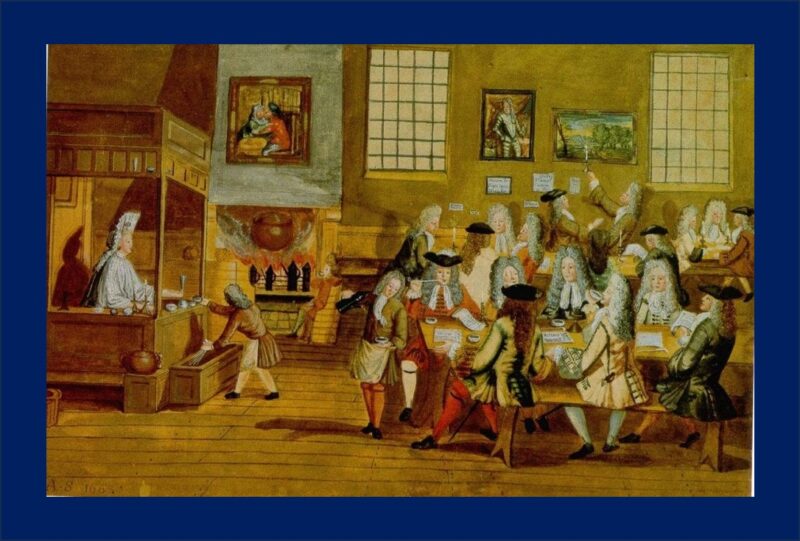
After the Great Fire, coffee houses were among the first buildings rebuilt in London. Coffee houses were often called “penny universities.” They were places for tradesmen and traders to find both stimulating conversation and information vital to their trade. Sea captains and sailors, ship owners ad merchants gathered in this particular coffee house on Great Tower Street.
“Another cup then, Mr. Weston?” inquired Edward, the enterprising proprietor.
“What ails old Tudway? He keeps staring at his cup.”
“Perhaps his ‘wind cooling his cup puts him in mind what harm a wind too great might do at sea,’” laughed Josiah Kirke loudly.
“And ‘tis only you would quote the Bard’s play about the Jew,” snarled Richard Tudway. “Mayhap you have no ships at sea this fortnight. Alas, I have seven. Ye dost never know.”
“Seven at sea and sure to lose one then,” mourned Kirke. “’Tis a shipload of Africans to the deep, I fear.”
“I have three ships sailing now,” said Jacob Weston
“And I four,” said young William Starke, bleakly. “A wager then. Shall we each put in some gold and who we think the Fates will disfavour, and a fortnight hence we’ll meet to see who wins the poole.”
“Nay, ye blackheart. I’ll not bet on another man’s ill fortune nor taunt the Fates to turn on me,” said Tudway
“A different kind of poole then? smiled Starke. We each put in some gold, and distribute it to him whose fortune old Neptune deigns to swallow.”
“Why should my good fortune fund your ill?” whined Kirke.
“No, wait. The stripling has a thought. ‘Tis like the general average, when the captain must unload cargo in the storm, all shippers share the loss. We’ve done thus since the Romans.”
“Tudway, you have more ships at risk. Should not you offer more gold?”
“”Twould be juste.”
“What if a fortnight passes and all ships come to port unscathed?”
“Why then the poole would but carry forward.”
“Edward!”
“Edward Lloyd! More coffee, all around!”
Insurance
It’s a silly dramatization, perhaps. But this is how history describes the invention of maritime insurance. At Lloyd’s coffee shop in London in the late 1680s, merchants and ship owners collaboratively contribute to a pool to protect against potential loss. Shipping, and global trade was a risk-laden business. Ships and their cargoes could be lost to uncertain navigation, storms and pirates, and this group decided to mitigate that risk by pooling it and insurance was born.
Soon it was clear this was a business unto itself. Insurance is a bit like a casino, because if the pool is large enough, “the house always wins.” The pool takes in more than it pays out and so “carries forward.”
Today there are many kinds of risk mitigated through the purchase of insurance policies. The condo behind me had a serious fire recently. Once it was clear that all the residents and pets got out safely the neighborhood conversation turned to “I hope their insurance is up to date.”
It is, but home insurance only pays to clean up, temporarily relocate the family, rebuild and replace stuff. It doesn’t pay for trauma and lost memories. “At least no one was hurt” only goes so far.
We insure against a lot – our own property loss, injury, or loss of income due to disability and our liability of inadvertently causing loss to others. We insure our life, so that we don’t leave our families destitute should the breadwinner meet an untimely demise.
“We know you’ll miss him. But if he goes, we’ll buy you two Mercedes and a beach house.”
Like the moaning Josiah Kirke above, people who perceive that their risk is lower complain about funding those of higher risk. The healthy young complain that they fund health insurance for the decrepit old, until the shoe is on the other foot. Some people who voluntarily put themselves at higher risk, like Tudway above, or smokers, drinkers, and mountaineers who buy health insurance, agree to pay greater premiums.
For insurance to work, as a service to policy holders, and as a business, the risks must be relatively predictable “on average”, and the pool must be large enough to cover all individual loss. Insurers employ actuaries to pour over reams of data and predict the probability of risks. Then they insure many to spread the risk of the few.
In the early part of this century, combining many high risk subprime housing mortgages into Collateralized Debt Obligations (CDOs) meant that the risk wasn’t spread in the way investors assumed. Credit Default Swaps, an insurance policy on debt, were meant to mitigate this risk, but this instrument could be written by anyone for anything, and created an unsustainable bubble of their own. These instruments’ combined losses caused the Financial Crisis of 2008, when, the day after I closed on my new house, the US Treasury Secretary Hank Paulsen went to Congress and said “I need $700 billion right now or the whole system will crater.”
This is why I tell friends, “You can insure yourself against investment loss, by watching what I do and doing the opposite.”
Some people are risk takers; some are risk averse. Sometimes the community gets together and mandates insurance for all, as a way of balancing risk takers and the risk averse. Banks require home insurance to protect their mortgage investment and collision insurance to protect auto loans. Most state governments here in the US require automobile liability insurance. However, a health insurance mandate in the Affordable Care Act, “Obamacare,” was terminally unpopular.
What else is insurance?
“Did you use protection?”
This question could be two teenage boys talking about condom use or two rock climbers discussing pitons drilled into a rock face to hold ropes. Insurance in both cases, against STDs and pregnancy, or against breaking your body and splattering your brains.
A savings account is insurance against emergencies. A 401k is insurance against a time when you might not want or be able to work for income.
There is a personal trainer who advertises his services to people in their fifties:
“Just like you make deposits into your 401k to provide financial health in your eighties, to insure you can travel and play with your grandchildren, the investments into your fifty-year-old body will determine your physical health in your eighties, to insure you can travel and play with your grandchildren.”
Government is insurance.
Think about that. Government is protection from risk. We pool our money, taxes, and pay to protect ourselves from:
- Attack by other people – military (Defense) spending, law enforcement
- A lack of infrastructure, roads, airports, power grids
- Poor use of shared environment resources – clean water, air
- Natural disaster
- Poverty, poor health,
Like everything else, there are some willing to take on these risks individually, and some who believe these are risks to be pooled. The risks government mitigates can be pooled, locally or regionally, or in the widest possible pool, nationally or internationally, depending on the size of the risk and how much the insured wants to be able to control the administration of mitigation.
Leadership behavior is insurance
Trust is a leadership currency. We make deposits into a trust bank account, against the need for future withdrawal, when we ask followers to change. Perhaps we ask followers to act as one (integration or alignment). Perhaps we ask them to improve. Perhaps we ask them to change radically, innovate.
We build our trust 401k by:
- Showing humility – sharing credit
- Showing gratitude – appreciating the sacrifice others make to follow
- Sharing information that people need to do their jobs. Transparency is inclusion and people follow what they are part of.
- Sharing how we make decisions and the reasons we take action. There is a reason we hear “I trust her judgement.”
- Always, always doing what you say you will do. Promises made must be kept or, when circumstances intervene to prevent that, this must be communicated immediately.
Insurance. Pooling resources. Banking trust. Because “ye dost never know.”


0 Comments