


I know things are bad. The RE words are back.
I have lived a long time. I hope not as long as I will live, but long enough to have witnessed several reiterations of the RE Word Rerun.
Pick up a newspaper or a business magazine. Wait. Whoops. That was revisiting an earlier reality. Sorry.
Go to your favorite podcast or TikTok feed or wherever you get your infotainment or reality distortion field, or just listen to conversations on your two days in the office, and you will hear a lot of words that begin with the prefix RE.
Reanalyze, reanimate, rebound, reclaim, redistribute, redouble, redundant, reengineer, (No, wait, no one says that anymore), refocus, reframe, refresh, reform, reinvent, reinvigorate, rejuvenate, reiterate, remodel, renovate, replace, restore, retool, restructure, review, revive, rework.
Remember when renewal meant the library gave you two more weeks to enjoy your favorite book? No, of course you don’t. And you haven’t experienced the relief when renewal means the DMV supplies you with another license by mail without you having to redo the eye test or driving test, (but you will when you’re a geezer like me).
The prefix RE means “again, for a second time, anew, in a new or different form, looking back or backward.”
I’ve noticed that RE words show up in times of change. They are the first indicator that what we are doing now isn’t working.
I first noticed the RE words during the 1991-2 recession. I had experienced the reinvention of British Airways, from unprofitable nationalized airline with the worst customer service rated by J.D. Power, to profitable carrier with the best customer service rated by the same service. BA called it a renewal.
I had also experienced an attempt by General Motors to “rediscover itself,” after a restructuring project that reduced cost, but removed the network connections that made the 850,000 person organization function. GM’s attempts to reengage the networks, and restore efficiency and effectiveness were underfunded in terms of money and more importantly in terms of senior leadership attention.
I wrote my first large article on change, called “The Renewal Process: Principles, Process, and Techniques.” The article was published in the Journal of Business Strategy in 1994. There were ten principles including:
- Urgency, speed, energy, and critical mass
- Active creativity
- The primacy of customer needs
- Leadership, but shared responsibility
- Personal change
Without knowing it, I created a change model that combined two predominate types of change models in use today: Process step models (Like Kurt Lewin’s unfreeze-change-freeze) and requirements models, (like Mary Lippitt’s 5 and John Kotter’s 8 ). Step models are You are Here maps, Requirements are what capabilities and actions you need to change successfully.
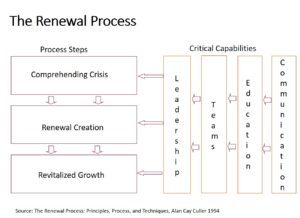
In this article, I commented on the RE words, noting that “… these ‘Re-‘ words have become immensely popular: revisit, refocus, restructure, rethink, reengineer, recreate, reinvent. In some cases, they have become euphemisms for unpleasant actions. ‘Restructuring’ usually means layoffs.” (This is also why people say process improvement, or Lean Six Sigma and not reengineering.)
This is a perennial problem with human language. We humans lock on to a simple way of saying something, then we use the words to cover a despicable action. We don’t fool anyone and the word takes on a new meaning.
At this time I did a process improvement at Heinz, called Focus on Productivity (FOP). Their were FOP signs everywhere. Then the newspaper carried a story of the CEO’s huge stock bonus, $37 million. FOP quickly became “Fatten O’Reilly’s Paycheck,” and the change initiative was cancelled.
RE words are like that:
Reframe – used to be let’s change the way of thinking about the product so a circus goes from torturing elephants to stand on one leg to colorful costumes and acrobatic artistry. (Cirque du Soleil) now it means “sales are down and we missed our profit numbers so let’s show our trade show awards and how we changed the name of DEI programs to “resource balancing.”
Reanalyzing – used to mean less gather different information and change the context for analysis; now it means change the scale on the graph to make the decline look less.
Rejuvenate used to mean let’s bring in some fresh perspectives and new ideas; now it means let’s hire younger cheaper people.
The problem with RE words is that, in times of rapid change, going back, redoing, may not be the best strategy.
If your company, like many, expanded into a lot of unprofitable new products and markets, then maybe refocusing on your profitable core products and customers might be a good first step. If on the other hand, your old core doesn’t work anymore, then you may have to reinvent yourself, like Ball Jars (glass canning jars) becoming Ball Aerospace, Netflix moving from mailing DVDs to streaming, IBM from hardware to consulting and cloud services, Microsoft from software to cloud and hardware, Lego from bankrupt kids block maker to global entertainment brand.
The real problem with RE words is that they tend toward simplicity, and so get in the way of the deep thinking required to change. Change is hard work. It is work best shared across the organization, the community, the nation and the world.
If leaders refuse to reflect and refine,
if they inspect and expect, without any respect, people may just reject.
Or if leaders exist to insist, people may just resist.
So if you have been asked to lead a rebound, receive input with gratitude, recreate, but save time for recreation, reenvision, but revere the values that got you here, and remember, NOT to rely solely on RE words.
But don’t ask me. I’m retired.


Great Reminder
Alan, I couldn’t help smiling through your “RE Word Rerun”, equal parts wit and wisdom. You’re right: every wave of disruption seems to bring a new round of “re” words, yet real transformation isn’t about repeating what’s been done before.
Lasting change comes not from catchy prefixes, but from genuine reflection, collaboration, and courage.
Very True Cynthia 😊
Thanks, Mary 😊