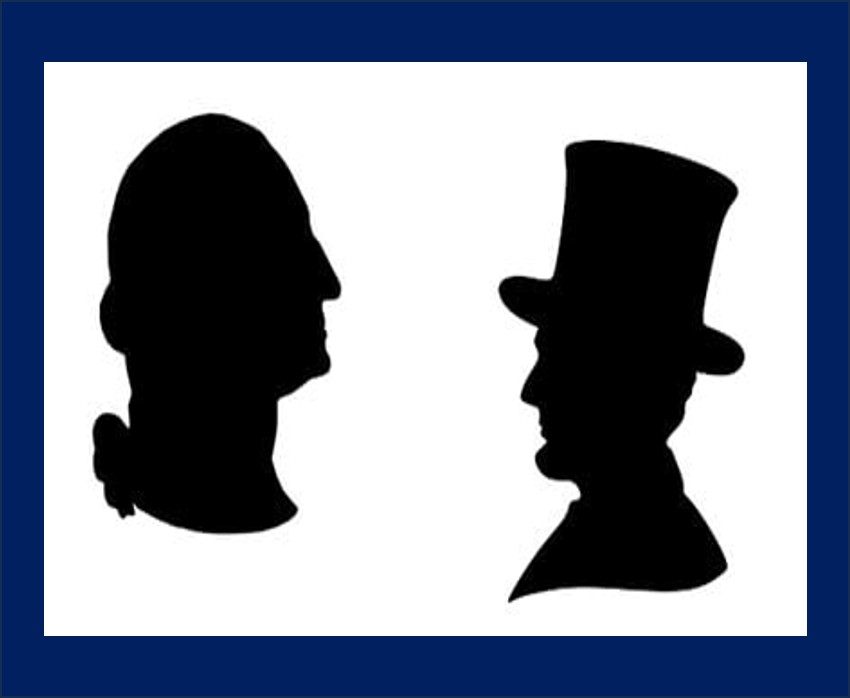

“Grampa, did you have to cut out these pictures for Presidents Day?”
I guess that’s a thing now in some pre-K and kindergarten classes. It trains fine motor skills while celebrating the holiday.
“I didn’t do that. There was no Presidents Day then.”
“You were born before Presidents Day? You are really old.”
My grandchildren are nicer than this fictional conversation, but I really was a kid before there was a Presidents Day.
I remember celebrating George Washington’s birthday, February 22nd, and Abraham Lincoln’s birthday February 12th, separately. Maybe we only got Washington’s birthday off from school, but we did the full-on American hero stories on both presidents.
You know,
“George, who chopped down that cherry tree?” “I cannot tell a lie, Father. It was I, with my little hatchet.” And
“Honest Abe” who read by candlelight and walked miles to return a book.
It turns out the first story, boy George chopping down the cherry tree, but declining to dissemble, was made up by Mason Locke Weems for his 1806 biography Life of Washington, which may very well be the book that Honest Abe walked miles to return.
We were told plenty of myths about both men in elementary school, which I’ve since learned the truth about.
George Washington was not the greatest military general of all time. He single-handedly started the French and Indian War (called the Seven Years War elsewhere), by preemptively attacking the French in what became Pittsburgh, and lost many more battles than he won during the Revolutionary War.
Washington didn’t skip a dollar across the Potomac. He never lived in the White House, but in presidential mansions in New York and Philadelphia. He is buried at Mount Vernon and not in the Capitol crypt, although there is a Capitol crypt. George Washington did wear dentures but made of human and cow teeth and not wood.
We were not told that Washington owned over 200 slaves nor that he refused to free them after the Revolutionary War despite their service, even when the British took former American slaves, which they had freed strategically, back to England.
Despite rumors to the contrary, Abraham Lincoln never owned slaves, nor did his father nor his wife, Mary Todd. However, Honest Abe was not an abolitionist until shortly before his death. The Emancipation Proclamation was a military strategy and did not apply to slaves in the border states of Delaware, Maryland, Kentucky, and Missouri nor to what became West Virginia, nor Tennessee, his Vice President Andrew Johnson’s home state.
Abe’s whole homespun-rail-splitter-to-White-House image was political positioning. While he was self-educated, he was a corporate lawyer and politician before running for president. The Lincoln-Douglas debates were for a Congressional seat not the presidency. Unlike his portrayal in the John Ford biopic, Lincoln never faced down a lynch mob saving two men, and unlike another movie, he never fought vampires. Lincoln is buried in Illinois not in the Lincoln Memorial.
The Gettysburg address was not written on the train on the back of an envelop; there are five progressively polished drafts available in the National archives. Abe was not the featured speaker at Gettysburg. John C. Fremont was, and Abe wasn’t received all that well at the time. Mostly people were just grateful that he was brief, as Fremont spoke for two and a half hours.
Still, Washington was our first president and he held the newborn country together. He believed in the Constitution but also that it would be improved. We were just starting out as a country and there was nowhere to go but up.
Perhaps unbelievably, he resigned both his generalship after the war and his presidency after two terms, an act that prompted King George III to say he was a “leader for the ages.” In his final address he warned us of regional factionalism, the divisiveness of political parties, and about foreign entanglements, not allies, but those who would turn the young nation into their puppet state.
Abraham Lincoln held the Union together, when some argued to let the South “depart in peace.” Abe did everything to win the war including suspending habeas corpus, using the military to detain anti-draft rioters in New York and disloyal individuals in Maryland without charge.
In his second term he fought for the 13th amendment (abolishing slavery) though he didn’t live to see it passed and ratified. After the war, when we again had nowhere to go but up, he spoke enthusiastically about reconciliation, in an oft-quoted way “with malice toward none and charity for all.”
Lincoln authorized the first transcontinental railroad and signed the Homestead Act of 1863, which gave interior land for free. The Homestead Act had many negative unforeseen consequences, both for the Native American population and ecologically, but it expanded the country geographically and economically and may be the single piece of legislation responsible for the “American Dream” of home ownership and social class mobility.
So despite the myths, George and Abe probably deserve the spotlight. Washington’s birthday was made a complete Federal holiday in 1885. It became Presidents Day in 1971 placing it on a Monday between Washington and Lincoln’s birthdays, making it a three-day-weekend.
It’s interesting to me that it’s called Presidents Day, not President’s Day. That means to me that we honor the two men for whom it was created and also the office and all who have held it.
The US constitution specifies three co-equal branches of the federal government:
- The executive branch, including the presidency, and executive agencies, to execute the laws, administer public policy, conduct diplomacy and foreign policy, be responsible for national defense and military policy. The president is the Commander-in-Chief of the armed forces.
- The legislative branch, House of Representatives and Senate, who make the laws, confirm executive appointments (Senate), finance and control the federal budget, provide oversight of the executive branch, declare wars, ratify treaties, and generally reflect the will of the people who elect them to represent their best interests.
- The judicial branch, including all Federal Courts and the Supreme Court, interpret the laws, resolve disputes and determine the constitutionality of all laws and executive actions.
So, when we created Presidents Day do you think those in the know wanted to:
- Honor all presidents living and dead, who take on the tremendous responsibility of serving the public and protecting our country, or
- Smush Washington’s birthday and Lincoln’s birthday together and give everyone a three-day-weekend.
Recently comedian Nick Bargatze hosted Saturday Night Live and performed a skit which poked fun at Washington’s dream for America:
“I dream that we shall have a word for the number twelve.”
“What other numbers shall we have a word for, sir?”
“None.…”
“… We will have two words for animals, one when they are alive and another when they are food. So cows will become beef, pigs will become pork.”
“Chicken, sir?”
“That one stays….”
“… I must admit this is confusing.”
“Don’t worry, soldier, in our great nation we will have schools that will teach our children our ways.”
“How many years of school, sir?”
“Twelve.”
“Oh, so a dozen years?”
“No. We don’t use it that way….”
“The children will not have to go to school every day. We shall have our own holidays, Fourth of July, Flag Day, and Presidents Day.”
“And what shall we do to honor our leaders on Presidents Day, sir?”
“Buy a mattress, of course.”
(You can watch this entire skit here.)
So after the GIANT PRESIDENTS DAY MATTRESS SALE ends, and when the chaos of school vacation is over, spare a thought for George and Abe, who helped us define American leadership, flawed, well-intentioned, and mostly moral, and who helped us build something great.
Or as Washington said:
“Citizens by birth or choice of a common country… the name of American, which belongs to you in your national capacity, must always exalt the just pride of patriotism more than any appellation derived from local discriminations.”
And let Lincoln’s words from his second inauguration and Gettysburg inspire us:
“ …let us strive on to finish the work we are in, to bind up the nation’s wounds…”
such that:
“…government of the people, by the people, for the people, shall not perish from the earth.”


0 Comments