

“You have power over your mind — not outside events. Realize this, and you will find strength.” – Marcus Aurelius, Meditations
“Between stimulus and response there is a space. In that space is our power to choose our response. In our response lies our growth and our freedom.” – Viktor Frankl, Man’s Search for Meaning
“Nothing in the world is as soft and yielding as water. Yet for dissolving the hard and inflexible, nothing can surpass it.” – Lao Tzu, Tao Te Ching
Each of these quotations above suggests that if we get control of our mind, our actions will follow. Roman emperor, Marcus Aurelius, and Holocaust survivor Viktor Frankl, the stoics, suggest that we stop, take a beat, and use our reason to control our emotions.
The Taoist Lao Tzu wants us to stop, take a beat, feel the natural energy flows of our emotions and let them pass like ripples in a river, and seek a balance through wu wei, effortless action and non-resistance.
By either path we manage our thoughts and avoid what Daniel Goleman, author of Emotional Intelligence, calls an amygdala hijacking, when our lizard brain, which controls our emotions overcomes our rational pre-frontal cortex and makes us do stuff we regret later.
“I’m sorry. I shouldn’t have done that. I wasn’t thinking.”
In 2015, I wrote an article called “Thinking About Thinking;” I posted it on LinkedIn, you can still read it on BizCatalyst 360° published by Dennis Pitocco, his wife Ali and now a whole team. This online magazine, video production studio, and community of writers has been quite gracious in publishing and responding to my writing. They are dedicated to redefining humanity and improving the world.
I included a version of the original “Thinking About Thinking” as Chapter 45 in my book Change Leader? Who Me? in the section called Preparing to Lead. My central premise was that leaders should spend some time understanding and improving how they think.
This week I am attending Encounter 360°, a two-day conference produced by Dennis and the BizCatalyst 360° team. That is my Call to Adventure in the Hero’s Journey and so I decided to prepare, to spend some time thinking about my thinking. I read works by three writers, educators, consultants and coaches, who will also be attending this conference this week:
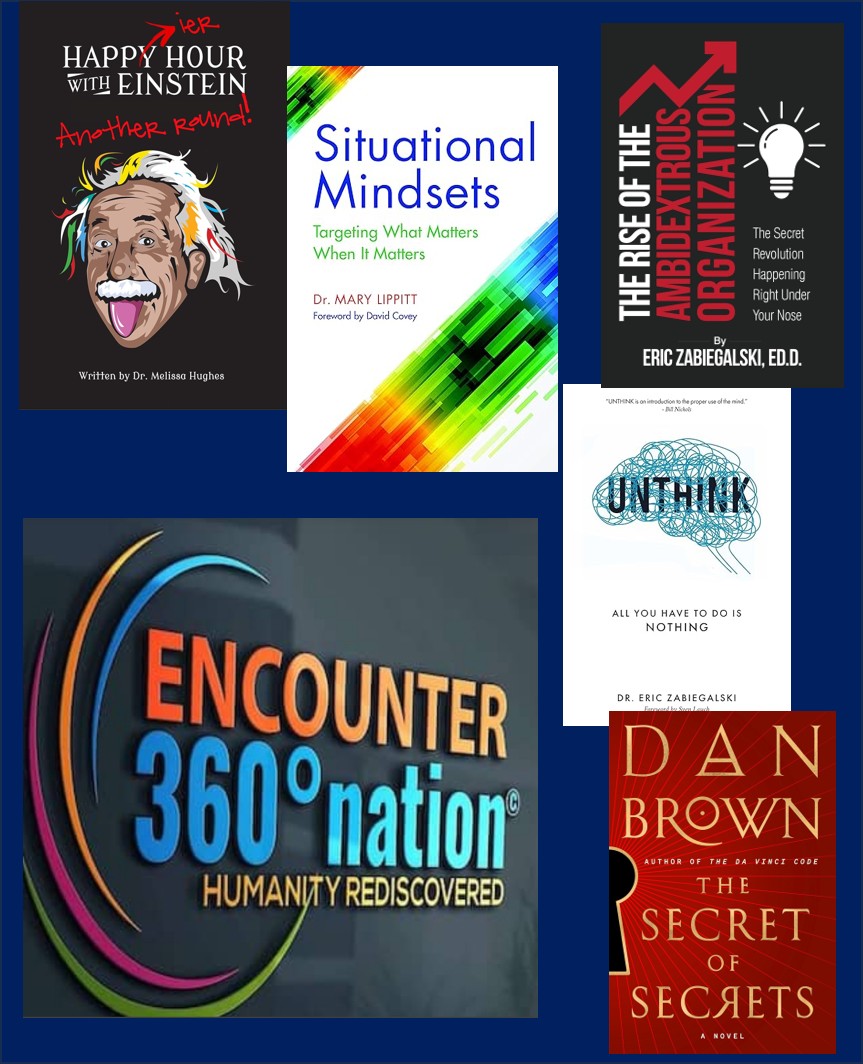
- Happier Hour with Einstein: Another Round by Dr. Melissa Hughes
- The Rise of the Ambidextrous Organization: The Secret Revolution Happening Right Under Your Nose, by Dr. Eric Zabiegalski
- Situational Mindsets: Targeting What Matters When It Matters By Dr. Mary Lippitt
All three authors, each in their own way, talk about developing a kind of flexibility of thinking styles and focus that would allow an individual, a leader, or an organization to be more effective by judiciously switching mindsets.
Happier Hour with Einstein
Dr. Hughes, who describes herself as a “self-proclaimed neuroscience geek,” starts from the brains parts and functions, the prefrontal cortex, responsible for focused analysis and evaluation, the amygdala, our oldest brain which holds the fight or flight response, critical to our survival, and other brain parts. She quotes research about how the brain works, how the limbic system carries chemicals around the body, dopamine, serotonin, endorphins, etc., each with their own purpose.
Dr. Hughes first addresses the issue of flexible mindsets around something we all assume is are unchangeable personality traits, the optimist, the pessimist, and the realist, the outlook toward the partially filled glass. I remember my first exposure to the glass, came from my middle school science teacher, Mr. Brown, who held up a partially filled glass and expounded:
“The optimist sees this glass as half full. The pessimist sees the glass as half-empty. The scientist brings a graduated cylinder.”
I suppose Dr. Brown was describing the realist, who brings “just the facts” to the equation, but in my experience people who self-describe as realists, are often defensive “Debbie Downers”, “I’m not a pessimist, I’m a realist.”
Dr. Hughes goes on to describe the brain reactions during optimism and pessimism, and how to raise children with optimistic outlooks. In her appeal for flexibility, she notes the different uses of an optimistic outlook in creative endeavors and a pessimistic worldview in risk assessment.
This reminded me of the late Dr. Edward Debono’s Six Thinking Hat methodology of switching mindsets during problem solving.

Later in the book, discussing gratitude she gives one of my favorite of her observations:
“How full or empty you see the glass depends on how grateful you are for the glass.”
Dr. Hughes described the work of Dr. Carol Dweck of Stanford, showing the difference of a fixed, unchangeable mindset, represented by the punctuation point “period,” and a growth mindset, flexible, adaptable, represented by the “comma.” Mindset affects how we learn.
There is so much more in Happier Hour with Einstein, including lots of fun quotes attributed to Albert Einstein, but in the interest of space-time, let’s move on.
The Rise of the Ambidextrous Organization
Previously, I read Dr. Zabiegalski’s second book Unthink, where his message is that during times of intense change and instability we need to stop, unthink, and balance our rational and intuitive minds.
Dr. Zabiegalski uses Einstein quotes too:
“The intuitive mind is a sacred gift and the rational mind is a faithful servant. We have created a society that has honored the servant, but forgotten the gift.” Attributed to Albert Einsten, by Bob Samples, The Metaphoric Mind: A Celebration of Creative Consciousness.
I think if Dr. Einstein were still alive he might quote the famous Yankees baseball team catcher, Yogi Berra:
“A lotta the things I said I never said.”
In The Rise of the Ambidextrous Organization Dr. Zabiegalski lays out two organizational mindsets or thinking styles. The most prevalent is an alignment mindset he calls “exploitation,” concentrating on removing obstacles to efficient, (profitable) implementation of an idea. The second is “exploration,” what Carol Dweck might call a “growth mindset,” concentrating on coming up with new ways of doing things, innovations, and using divergent thinking techniques.
Dr. Zabiegalski points out that most organizations and leaders are oriented toward an exploitation mindset, but that this fixed outlook doesn’t work in times of change. He uses examples of people and organizations that use a flexible approach and organize around it.
Again, there is a great deal more in Dr. Zabiegalski’s books, but I’ll move on so I can post this before Encounter 360°.
Both Drs. Hughes and Zabiegalski describe the work of the Hungarian-American psychologist, the late Dr. Mihaly Csikszentmihalyi, (pronounced MEE-hy CHEEK-sent-mee-HAH-yee), whose work centers on the Flow state. Flow, is a quasi-mystical, state of intense focus, what athletes often describe as being “in the zone,” wherein time slows down and everything just works. Flow may not be a mindset per se, but achieving it may require the growth mindset, and/or the Taoist wu wei, effortless action and non-resistance.
Situational Mindsets
Dr. Lippitt expands the mindset flexibility theme of my little pre-Encounter research substantially. She includes six separate mindsets:
- Inventing – focusing on the new
- Catalyzing – focusing on the market, customers and competitors
- Developing – focusing on plans, policies, systems to deliver goals
- Performing – focusing on improving results, quality
- Protecting – focusing on the engagement and collaboration of our people
- Challenging – focusing on the renewal or reinvention process, challenging assumptions
Dr. Lippitt uses a case to introduce these mindsets. It is a very engaging story of Kate, an Iraq war vet, who takes over the sales department of Davis Printing. Through the story, Dr. Lippitt shows how these mindsets can be used to determine what is most important to individual customers of the firm, and to the other Davis managers with whom Kate must collaborate to turnaround sales at the firm.
After the story reaches its happily-ever-after conclusion, Dr. Lippitt goes on to explain how disciplined flexibility of mindsets can expand organizational and individual capability. She goes on to show that the six mindsets follow the natural life cycle of an organization:
- Birth – inventing
- Growth – catalyzing
- Stature – developing
- Prime – performing
- Maturity – protecting
- Renewal – challenging
This is similar to the cycle I described in Chapter 4 of Change Leader? Who Me?”
Innovate – Integrate – Improve – Integrate – (Repeat)
There is a great deal more in Dr. Lippitt’s book and her mindset model has some more detail, but our thinking is aligned.
The End of the Beginning
I began this “research” as a way to expand my thinking, and as an introvert’s way of approaching the petrifying adventure of meeting new people. I read books that I already had explored some of the thinking, so I hope I haven’t engaged in the “confirmation bias,” or finding what I was looking for.
However, I feel that each book expanded my thinking and gave me new mindsets to explore.
As an act of pure serendipity and synchronicity, I am pleasure-reading Dan Brown’s thriller, The Secret of Secrets. Symbologist Dr. Robert Langdon is embroiled in a conspiracy to suppress noetic science research about non-local consciousness, which would allow humanity to control events by controlling – wait for it – our thinking. Who’d a thunk it?
Now if the snow will hold off, I’ll fly to Tampa for this conference produced by my benefactor Dennis Pitocco and the team at Biz Catalyst 360°. Watch this space for the next step in the Hero’s Journey, the Gathering of Companions.
I write books for the exceptions to the rule: The young won’t listen and the old don’t read.


0 Comments