

“I might learn something.”
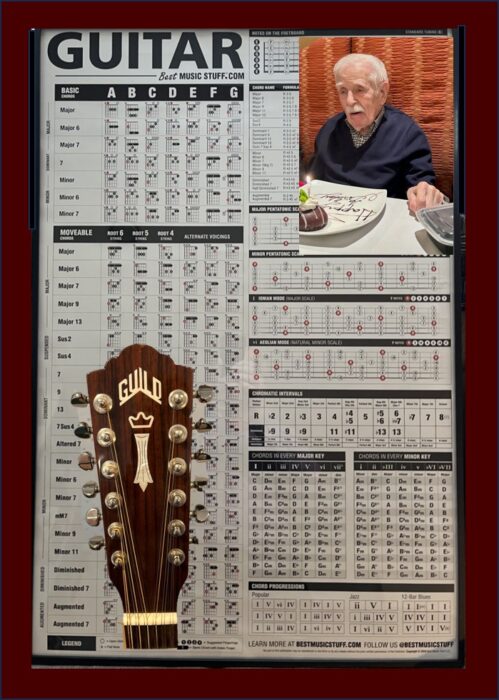
Robert H. Schaffer, pictured upper right, turned 100 last week. That is freaking amazing! Happy Birthday, Bob!
I came to know Bob Schaffer, first from his book Breakthrough Strategy, which I read when I became an independent consultant for the first time. The second time I ventured out on my own, Bob’s partner Ron Ashkenas, who I’d met at a mutual client, offered me a much-needed subcontract role implementing the methodology described in their book Rapid Results. I met Bob face-to-face then, and took his workshop, High Impact Consulting, based upon another of his books.
Bob’s methodologies and his values had a huge effect on my consulting career, so three years ago when I was writing my first book, Traveling the Consulting Road, I asked him for feedback. I reorganized the book based upon his helpful advice. At the time, I thought Bob might have been twelve to thirteen years older than me. It turns out he is twenty-two years older than me!
Bob’s inspiration has me thinking about how I might live to the century mark.
When I was tracking down Bob’s contact information to ask for his help with the book, I talked with his son, David. I inquired after Bob’s health and whether my request was inappropriate.
“I won’t speak for him, but he likes to keep his hand in – no harm in asking.”
Bob was gracious. “I might learn something,” he said. I doubted that, but he dug into the book and was direct and constructive.
Maybe “I might learn something” could be a precondition for becoming a centenarian.
Guitar and me
My exposure to the guitar was the folk music on Nonesuch Records that was seemingly always playing at a friend’s house, when I was in junior high. There I first heard Lester Flat, Doc Watson, Dave Van Ronk and Odetta.
There was an inexpensive steel string guitar in the house. My friend Jim played a little, but his younger sister Suzy taught me my first chords. I picked up the guitar every time I went over there. I remember asking Jim if there was a way to make my fingers hurt less. “Build up calluses,” he said.
“But I only play when I come over here. Is there a way to do it other than playing?”
“Maybe run your fingers over a knife blade constantly.”
At my next birthday, (13? 15?) I asked for a guitar. My mother played piano. My dad sang in the Handel Hayden chorus. They had indulged my experiment with trumpet – I attempted to instantly play like Harry James with no attention to lessons and zero practice. I think my father was less enthusiastic about another such experiment, but my mother took me to a music store.
I remember a salesman discouraging an inexpensive guitar saying “if it hurts to play, he’ll just give up.” The guitar we settled on, was a Regal six-string acoustic. It cost $85, not cheap in early 1960s dollars.
The dreadnought guitar is spruce top, rosewood back and sides, solid woods not laminates, and made in the USA. To get that today would be north of $1000.
I still own and play it.
I played a lot in my teens. I learned Bob Dylan’s “Don’t Think Twice,” and “Blowin’ in the Wind,” though I thought that was by Peter, Paul and Mary. I never took lessons, but got reasonably proficient at simple I-IV-V chord progression songs.
I took the guitar to college, frequently singing Gordon Lightfoot’s “Early Morning Rain,” in the airport gate area when I got bumped from my “student-stand-by” seat. That song had a simple chord progression, but I could never sound like Lightfoot. No one dropped coins in my open case.
The guitar traveled to college in Kentucky, summer stock in Montana, and California, to business school in London, and to Pittsburgh. Often the guitar sat alone in her case in a closet. I’d take it out, play enough to get as good as I was when I was fifteen, and put it away again. My playing never progressed much. I said “I play at guitar,” so no one would ask me to play.
When I got divorced and spent more time alone, my guitar was a comfort. I wrote a couple songs. I played more frequently and noticed I got better with practice. Soon the work and travel of my consulting career meant I played less. I reverted to the relearn ̶ quit ̶ relearn pattern, and my playing never improved.
One day, I retrieved the Regal from the back of the closet. I opened the battered cardboard case and was shocked to find that the bridge had blown off the guitar. I had stored her strung in a closet with steam heat pipes running through it. I despondently stared at the jumble of strings with the flapping bridge, closed the lid and put the broken Regal back in the closet, resigning myself to throwing the guitar away.
Two days later, I thought, “Maybe it can be fixed?” I found a local luthier, who replaced the bridge, reset the neck, and adjusted the action so the guitar was easier to play than ever.
I played more. I bought a new case. I wrote some more songs and had Doug, a musician friend of my daughter’s put them into lead sheets. I copyrighted them. I played more. I even began, slowly, oh so slowly, to get better than my fifteen-year-old self.
My son made me a cigar box guitar. I retired and played more, now on the Regal and the CBG. As Covid projects, I made two more cigar box guitars. I played more and got still better, still not great, but better.
Then as I focused on writing and published two books, I played less. Lo and behold, I stopped progressing much on cigar box guitar and my six string playing plateaued.
My wife gave me a poster with all guitar chords and scales. Family members bought me Guitar Center gift cards. I bought some tuners, a small amp with effects for the CBGs. Then, for some unknown reason, I started looking online at twelve-string guitars.
I’ll spare you the tortuous six-month process of deciding to buy and which one, but two weeks ago, I bought a used Guild F1512e acoustic electric twelve-string, solid wood, spruce top, rosewood back and sides. It was made in China, but what the hey. I am playing more, and not just my new toy. I’ve learned that the reason I could never make “Early Morning Rain” sound like Lightfoot is that he played it on a twelve-string. Oh, and because he was Gordon Lightfoot and a better guitarist than I am.
I figured out that I’m getting better and I am having fun. The chiming and harmonics of the twelve-string sounds like an orchestra. Yeah, it’s hard to tune. I now know why they say,
“Twelve-string guitarists spend half their time tuning and the other half playing out of tune.”
I’m going to make an appointment with Doug to scribe some new songs. Maybe I’ll take some lessons. Am I going to start a music career at eighty? Probably not, but who knows?
Bob’s longevity and the twelve-string…?
No, I don’t think Bob Schaffer is a guitarist. I mean, I don’t know, maybe he is. Maybe he is an accomplished musician, in addition to making a huge impact on the consulting industry and his clients. But his attitude, “Maybe I’ll learn something,” has to be one part of his longevity.
Aging is a privilege, denied to many. And sure, our health is a result of our DNA and the care we take of our bodies, but attitude, continuous learning, and continuous engagement with the world, counts for a lot.
“You can’t jump a jet plane, like you can a freight train.
So, I best be on my way, in the early morning rain.”


0 Comments