
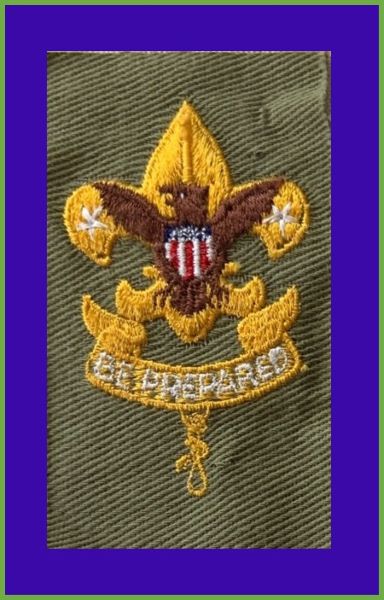

Campfire to Boy Scouts
At my mother’s funeral I started my eulogy saying, “Hi I’m Alan Culler, Nan’s son and I was a Campfire Girl.” I went on to describe how my sisters were both active in Campfire Girls and Mom was a Campfire Leader and we didn’t have money for a babysitter so I went to Campfire Girl meetings till I was six or seven. I learned all the songs, and the recitations. I remember Wo-He-Lo, work -health-love, and as my mother was passing I led my sisters in “She’ll be coming ‘round the mountain (when she comes).” I think she liked that.
Then came Cub Scouts and I think Mom started out as a leader and decided it was too much with the Campfire meetings and the fact that she was going back to work. Probably dealing with ten eight-year-old boys was a little much too. I remember being extra proud of those blue uniforms with the yellow neck scarf with the bright brass clasp with the embossed wolf on it. I wore mine to school on meeting days because it was half a mile to the Den Mother’s house and in the opposite direction from home. I remember walking because we weren’t allowed to ride bikes to school after some kid’s bike was stolen. (Why didn’t they just require locks?) So I wore my uniform to school and just took the ribbing from the kids and the teachers. I was that proud.
I don’t remember much about Cub Scouts, except always having to wash Elmer’s glue off my uniform and finishing the pledge with “ . . . and to obey the Pack Law.” I don’t think I knew what the Pack Law was -something to do with wolves and really “neat” being “cool” came later, as did “wick-ed” and “wick-ed awesome”. When I was eight good things were “neat” or “neat-o.”
I stayed in Cub Scouts till I was eleven when “I could hardly wait”: to join Boy Scouts.
Boy Scouts was no longer a neighborhood thing. There were boys in Troop 172 from all over town. We met in the basement of the Congregationalist Church in the center next to the green.
Fifty or sixty eleven to fifteen year old boys is a management challenge. The organization structure was a little military. Scout Master Mr. Hoxie, had the Dad Council. We called them by Dad and their last name Dad O’Brien, Dad Hagman, etc. I know that Mr. Hoxie’s first name was Ed because the Dads used first names.
The boys were organized into platoons of ten with one of the boys named as platoon leader. The first leadership task I observed platoon leaders attempt was getting the group quiet for announcements and maintaining order during fire drills. When asked to by one of the adults a platoon leader simply raised his right hand with the three fingers used for the scout salute. It took a while at first, but we all shut up. The first ones to notice elbowing their noisy platoon mates in the ribs to be quiet.
We lined up in lines by platoons. We practiced some marching because we marched in parades on Patriots day (April 19) and the fourth of July. (Cub Scouts marched in the Patriots day Parade too, but you can imagine what that was light.)
At every weekly meeting there was a presenting of the colors, reciting the Pledge of Allegiance, and singing “My Country ‘Tis of Thee.” (The National anthem was determined too hard for young boys. We also played games, tug of war, Red Rover, a kickball version of baseball, and dodgeball.
There were activities on weekends, day hikes and overnight hikes in spring summer, fall and winter (Yep sleeping in your sleeping bag outside on a pine Bough bed in two feet of snow in the White Mountains of New Hampshire). Sometimes fathers went along. My dad declined the honor of attending the Eskimo hike.
Mr. Hoxie
Ed Hoxie was an interesting man. He wore what I’d describe today as techie-retro glasses, black plastic top of the frame and ear-pieces, wide ‘U’ shaped lenses held by chrome metal rims and nose band. Hoxie smoked a pipe when we were outside and wore a Scottish Tam Black with a red and white checked band. Troop 172 ultimately had over one hundred boys in it (Baby Boom Generation) and he knew everyone by name and usually something about them to start a conversation. He may have had a boy in scouting at one time, but not in the Troop when I was in it. He was a little older than most of the Troop 172 dads, not as old as my dad, who’d had me at age forty-four, but almost.
He was not very tall maybe 5’8” or less. He had a quiet presence. The Dads on the council did most of the day to day management of the boys. Hoxie chaired the council and floated around, having one-on-one conversations with individual boys, giving a word of encouragement here and there. During breaks in the action you’d see him with a small group of boys talking..
We always announced boys who achieved a rank or got a merit badge. When that happened the Dad in charge of your platoon sent you up to the front to shake Mr. Hoxie’s hand. When I got my cooking merit badge, he said
“Alan I’m not sure I believe this; I saw how you cooked bacon and eggs on the Eskimo. If your mother had served you that you might not have eaten it, but it says here you made a stew and bread over a campfire, didn’t burn it, and it was actually pretty good. Everybody can improve. Let’s hear it for Alan”
There was some laughter at my expense, but the encouragement and the applause felt shirt button-popping good.
Hoxie was a quiet man. He rarely raised his voice. Most of the other dads did the discipline, broke up the push fights that always happened with boys that age. Once there was a real bad fight brewing, pushing had moved to fists raised, and punches swung. Boys had circled up and were cheering one or the other combatant on.
Somehow Mr. Hoxie was in the middle of the circle. No one saw him come in. In his low voice he called each of the boys names. First one dropped his hands. The other boy wasn’t ready to stop fighting and reflexively started to push Mr. Hoxie away when he lightly reached out to touch his shoulder. The collective gasp from the ring of boys quickly made the boy drop his hands and mumble “Sorry Mr, Hoxie.”
He took both boys away for “a talk.” We thought they’d get thrown out. “Naw, he just had both of us explain what the beef was and we had to listen to each other without interrupting. It seemed like a dumb fight when you said it out loud. Then he made us shake.”
Ed Hoxie played a six string flattop guitar performing and having sing-alongs at campfires at Jamborees and camping trips. I still remember that he introduced me to the songs of Tom Lehrer, like the Hunting Song:
“There are ten stuffed heads in my trophy room right now, two game wardens, seven hunters and a pure-bred Guernsey cow.”
I didn’t realize it then, but Ed Hoxie was my first glimpse of a servant leader. He cared for people and encouraged them. I still remember when I made first class rank. Publicly he joked that I’d come a long way from Tenderfoot and shook my hand. I was promoted to platoon leader. My big task was to keep people lined up and quiet for fire drills.
Hoxie made more of the role, talking about the responsibility for safety and the first eyes on a problem with any of the boys. He encouraged me not to yell, but to be an role model:
”People don’t follow your voice prints, they follow your footprints. . .
and don’t be afraid to ask for help. . .
You can do anything alone except build character.”
This was more than sixty years ago. I’ve written these words down before. I said the first in leadership training dozens, scores, maybe a hundred times. I’ve just remembered the man who dark brown eyes were locked on mine when I heard it for the first time. Servant leader, Boy Scout Troop 172 Scoutmaster Mr. Ed Hoxie.

I’m guessing it’s because we are the same age, and may have somewhat similar backgrounds. But, this story is another with which I can relate. While I was never a Cub Scout, I was a Boy Scout. It’s where I learned a lot about myself. It’s also where I learned to smoke (rolled up corn silk obtained from a field in a nearby a farm during a campout). It’s where I learned about the fundamental elements pertaining to the female anatomy from “Tony.” Who always seemed to know about a lot of stuff in general.
I believe the lessons learned in Boy Scouts helped me later in life at Basic Training. It was the whole “Be Prepared” thing.
My Scout Dads where similar. Just a bunch of nice guys who wanted to help their kids and other kids to do and be their best.
Like yours, my Troop also had a fair number of boys and we all got to know one another well. Many of us went to junior high and high school together. In fact, whenever my wife and her friends from high school get together and talk about guys from high school, it always seems that I chime in with , “Oh yeah, he and I were in Boy Scouts together.” Over the years it’s become sort of a joke. My wife will say a name, followed by, “I guess you were in Boy Scouts together?” 99% of the time, the answer will be . . . “yes.”
I can also relate to your “servant leader” remark and Mr. Hoxie. The Scout Dads in my Troop followed the same path and set the same examples.
Lastly, the Scout Oath and the Scout Law made an impression on me. Still do.
To say my experience in the Boy Scouts was good, would be an understatement.
Thanks for your comment, Bob.
Boy Scouts were pretty cool. I went to Boy Scout camp during a couple of summers.By age 13 I had pretty much had all I could take of Boy Scouts or so I thought with the chip-on-my-shoulder stupidity of my teenage years.
At fourteen I joined DeMolay, in which I was pretty active up to the point when I was cast in a musical sponsored by the Rainbow girls. Rehearsals for the DeMolay championship ritual team conflicted with the rehearsals for Carousel, where I was cast as Billy Bigelow, the male lead. The head of the ritual team flexed his muscles and said if any of HIS ritual team was going to Carousel rehearsals instead of the State Champion ritual team rehearsals then he could leave right then. I left. Chip-on-the-shpoulder-Alan never did well with ultimatums.
Perhaps all of our experience wasn’t dead similar, Bob. I never went to Basic Training for example. But we did live through the same time so there has to be some overlap.😉