
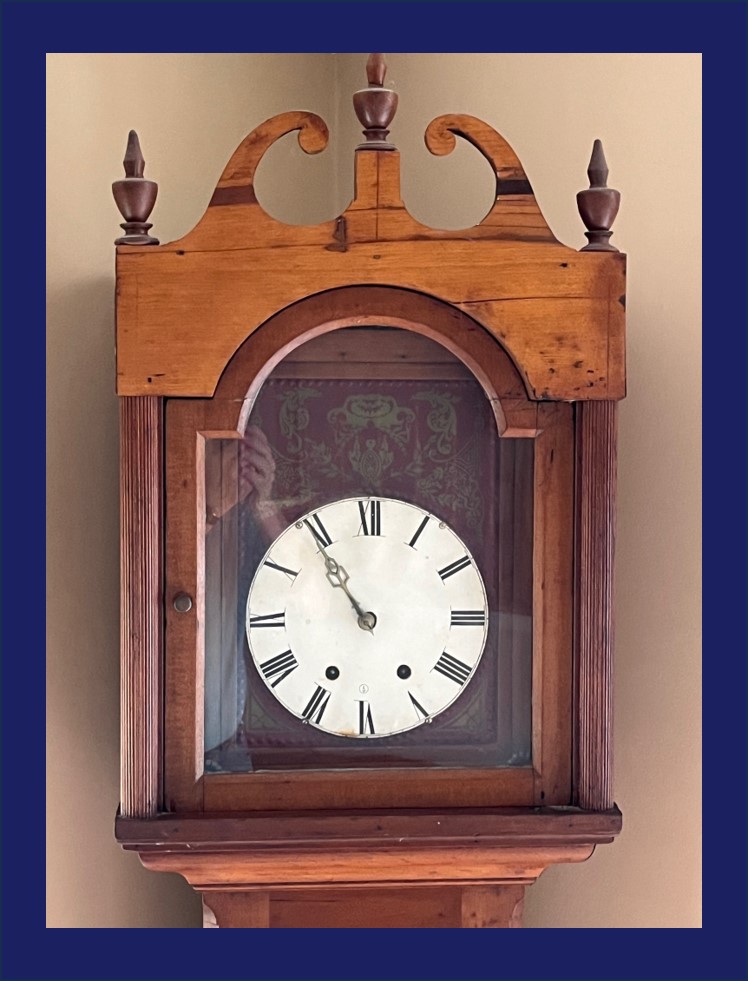

“Ask me, ‘What’s the secret of good comedy?’”
“Oooohkayee, “Whaaats da secret of goooood Comedeeee?”
“Not like that. Ask me like you really want to know.”
“Oh all right. What’s the secret of good com-“ “TIMING!”
That was one of my annoying fifteen-year-old jokes; now it’s told by annoying ten-year-olds. Evidently, in kid-comedy, the jokes don’t change, just when kids think they’re funny.
For the record, no one I ever told that joke to thought it was funny; I thought it was hilarious. When the ten-year-old told it to me, I played along and chuckled, while she guffawed enough to lose her balance.
When matters.
I hate to wait. Pre-9/11, if I arrived at the airport and didn’t have to rush down the jetway to knock on the closed airplane door, I thought I was wasting time. More than once, I learned empirically that they don’t allow you to do that anymore.
I married my wife that same year, and shortly afterward said, “Oh, no, I’m going to be early for the rest of my life.” The only plane I missed since was when I flew with a colleague who hadn’t empirically learned the lesson “Close time is twenty minutes before flight time, sir, even if the plane is just sitting there.”
When matters in deliveries. Do I really need two-day delivery? Not really for most things, but if I forgot my grandson’s birthday and you promise me a short delivery time, so I can correct my error, and you fail, I will use your hidden customer service phone number to express my displeasure.
When matters in doctor’s appointments. When you call Friday afternoon to confirm my Monday 11:00 am appointment, when you know it was made six months earlier for 9:00 am, saying, “well, if you can’t make 11:00 the next available is in four months,” you shouldn’t be surprised that I will be annoyed.
When matters in business.
A product based upon innovative technology that arrives late is suboptimal at best.
“Oh, we’re not really a market leader. We’re more of a ‘fast follower.’” My response: “How far behind?” This client didn’t have the processes to follow quickly. They had produced a series of unprofitable “me too” copies of others’ new products. Then they launched an innovation initiative that produced some market-leading products.
When matters, if you are “ahead of your time.” The so-called “bleeding edge” of innovation arises because innovation precedes customer acceptance, like the AT&T video phone or the Apple Newton. Perhaps the firm innovates without knowing when it would have the bandwidth to market innovations, like the Xerox Palo Alto Research Center (PARC), which produced the graphical user interface that became the basis of the Macintosh computer and Microsoft Windows.
Technical innovators are often naturally “Field of Dreams” strategists, named for the catchphrase from the 1989 Kevin Costner movie, “If you build it they will come.” In the movie Ray, the Costner character built a baseball field, and long-dead players came to play, and the general public came for miles to watch games. As a strategy, this kind of customer-ignoring, product-driven culture often doesn’t work. Asking, “Who will buy it, and when?” is a good discipline for innovators.
When matters in giving feedback.
“The difference between helpful advice and unwanted criticism is largely a matter of when it is given.”
There is a little-known piece of research by behavioral psychologist B.F. Skinner on this subject. Dr. Skinner did a great deal of his research with rats in mazes, and, while I can see the relevance of much of that study group for the inhabitants of factories and cubicles, this research was done with experimental and control groups of real people, performing a complex, mechanical and computational task.
Skinner discovered that the purpose of the feedback should drive when it is given. If a manager wants to affect the workers’ motivation to repeat the behavior, then feedback should be given directly following the behavior. “Good job,” “Nice work,” or “Don’t do that again, it’s dangerous!” affect motivation to repeat the behavior or not.
If a manager wants the worker to change the behavior, so-called corrective or formative feedback, the feedback should be given prior to the worker doing the behavior. “This time, try just picking up one piece of stock.” “This time, please put the data supporting each part of your research in that place in the report rather than at the end.”
Skinner advocated splitting feedback with different purposes, ideally separated by a lot of time or at least breaking the conversation with a change in topic. This flies in the face of the usual HR-approved performance appraisal “sandwich.” “I really like your work, BUT it has the following FLAWS. You’re still a nice person, keep trying. You’re getting there.”
Split feedback is hard to do, but Skinner found in his experiment that by splitting feedback he was able to increase productivity fifteen to thirty percent.
When matters in leading change.
To make change, every leader needs a vision. Vision is at the top of most of the requirements for change. A vision is a clear, inspiring picture of the desired future state. “The land of milk and honey,” is what has come down to us as the vision promoted by Moses to the Israelites. It’s a lovely vision. “Come, we are going to a place where our goats can graze, and have so many kids we’ll have lots of milk left over, and we’ll put beehives under our orchards and have honey with our rugalach in the morning.”
But I bet Moses didn’t start there. He first had to get the Hebrews to make the exodus. “Hey, this Pharaoh guy is bad news! He is killing us. We never have enough to eat. We can’t go on like this.”
So the compelling case for change must come first. People have to internalize it. Then they have the feel the urgency –“We can’t go on like this!” Then they have to know who is leading them. “Come on, you know me and Zipporah, and Aaron and Elisheba. We’re’ all-in for this change.”
Then followers have to choose change and commit to follow. When is the time for the vision? When people have internalized the case for change and feel the urgency. Can the vision be the reason to commit? Sure. Can it be built by followers? Sure. If and WHEN they are ready.
In many fields of endeavor, WHY may be more important than WHAT or HOW. But think about WHEN, sooner rather than later, because WHEN matters.
Change Leader? Who Me? Hard Earned Wisdom for Those New to Leading Change will be published in a few weeks. The book is a collection of stories and essays about what it takes to lead change. There are concept essays from my almost forty years “helping leaders make strategic change,” including descriptions of change “levers,” tools, models, methodologies, and skills to help start or accelerate organizational change. There are some unusual examples ( e.g., a Ritz Carleton shoe shiner, Genghis Khan, and Bruce Springsteen).


I can relate to your example of Xerox being ahead of the curve. I worked for Xerox and saw the GUI interface demonstrated about two year before Gates and Jobs saw it demonstrated it.
It seems to have worked out well for them.
Timing is everything.
I remember that.
Thanks for your continued and perpetual support, Bob