
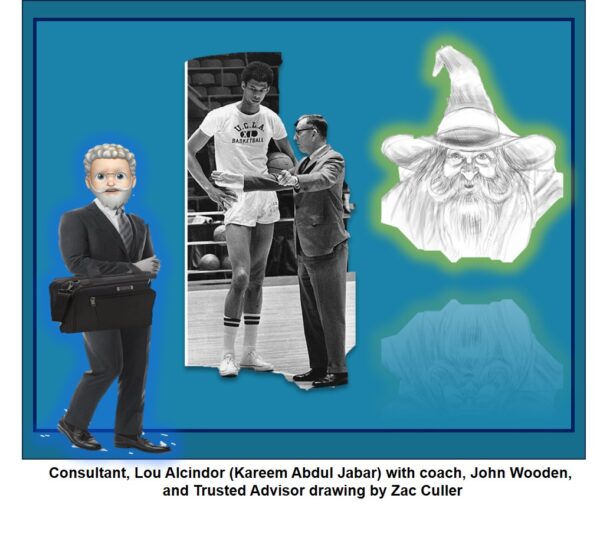

These are three terms you might find on a business card, consultant, coach, advisor. Are they the same job? Does anyone use business cards anymore?
When I was deciding to become a consultant in the late 1970s, no one would have suggested I might become a coach instead. John Wooden and Vince Lombardi were coaches. Today, if you search LinkedIn you might find more coaches than consultants.
I wasn’t aware of anyone calling themselves an advisor, though I might have heard the term, if I met Marvin Bauer, the man who turned James O. McKinsey’s accounting firm into the hallowed McKinsey & Company. Senior partners were sometimes described as “of counsel,” or advisors to CEOs and Chairmen of the Board. Since 2000, when David Maister, Charles Green, and Robert Galford published The Trusted Advisor, that role has become the vision of every aspiring business coach and consultant.
These terms evolved during my consulting career, and are likely to evolve further as Artificial Intelligence shapes the business world. It might be useful to start some discussion of these terms as I understand them.
Consultant
Webster calls a consultant, a “professional who gives advice.” Consultants often describe themselves as “problem solvers.” Some middle managers have been known to call consultants “arrogant, overpaid [jerks] who steal my ideas and sell my boss on paying for their project by firing people.” The industry does have more than a normally distributed population of [jerks].
Clients do hire consultants to solve a business problem. Clients may want more revenue, new customers, new products, greater share of the customers wallet, etc. They may want more profit, reduced cost, more efficient operating processes, including technology enabled operations. In my experience, clients also hire consultants for “people problems.”
This “people problem” often arose because in the view of the leader “stuff wasn’t getting done,” a new strategy wasn’t being implemented fast enough, known inefficiencies weren’t being eliminated, etc., and so the people needed to be reorganized, trained, aligned, their conflicts resolved, their teamwork developed, their incentives readjusted, etc.
In my view, it’s all “people stuff.” Consultants are hired to help people change, do less of something, more of something, or do something different or differently.
Content and Process Consulting
There are two different types of consulting, that are defined by what the client wants and how the consultant goes about their work.
Content consultants provide specialized expertise, information, and answers to a question, that the client doesn’t have the resources to determine on their own. The project starts with a framing of the problem done in a meeting between the hiring client and senior partner, and ends with a recommendation. Content consultants do the research and analysis necessary to determine the answer. In pure content consulting, implementation of the consultant’s recommendations is exclusively the client’s responsibility.
Process consultants help the client implement a process. They may bring expertise, but they teach the client how to build that expertise in-house. They teach the client how to do the research and analysis, and remove obstacles to implementation. Framing a process consulting project often starts with wider participation across the client system, aiming for more ownership of the problem and the solution.
Content consultants tend to work more in strategy, marketing, and technology architecture; process consultants tend to work in operational improvement, organizational development, and systems integration, though both approaches can be applied in any discipline.
I started out in content and migrated to process consulting. I also worked in four firms that tried to combine the two types of consulting, which was never very successful, because the approaches attract different people, each with little patience for the other’s orientation. I remain hopeful that someday someone will make this combination work.
Coaches
A coach has more in common with a process consultant, but is focused upon the development of the individual or sometimes the team. The coach works in the context of a goal, which might be increased revenue, or profit, but it might also be a career goal, like a promotion to a new role.
The coach, may or may not have deep experience in the role coached, but must be skilled at observation and delivering feedback that will be acted upon. Organizations often hire coaches for individuals or teams when they are new to a role or objective.
Coaching, like mentoring, works best when the coached person chooses the coach. I have seen some disasters when a senior executive or the board chooses a “remedial” coach for an individual without consulting the person to be coached.
During my career, coaching emerged as a change management methodology. Rockstar executive coaches like Marshall Goldsmith, created coaching certifications, and provided teams of coaches to help manage large scale change. I worked developing internal coaches for continuous improvement (CI) methodologies. When it worked well, the internal coach increased CI adoption and improvement. When it didn’t work well the CI coach became the doer and improvement dwindled.
Advisors and Trusted Advisors
David Hussey, the managing partner of Harbridge House Europe, described the challenge of managing consultants.
“Consider a group of people educated to the point of substantial ego, who actually believe that people should pay them for their advice, not for doing anything, mind, but for their advice. Now imagine managing such people. It is an oxymoron, a complete and utter contradiction in terms.”
Who wouldn’t want the job of trusted advisor? I mentioned the book The Trusted Advisor earlier. I have recommended this book many times to mid-level consultants, because Maister et al do a wonderful job of describing how to attain the pinnacle role in consulting. They describe how to build the broad expertise, the track record of successful solutions, and how to build the credibility, reliability, and client focus, to form these deep relationships.
Perhaps I’m a little jealous of the best seller status of this book. I don’t disagree with these lists of characteristics and actions, I just think achieving trusted advisor status is harder than the authors make it seem.
In thirty-seven years in consulting, I count my own such relationships on one hand. I did meet a few trusted advisors. They often had a unique gift. One was good at analogy with different industries. One was good at seeing unintended consequences. They each had a great coach’s ability to observe and to give tough feedback that would be acted upon. They were unafraid to say “I don’t know,” but would often follow with an idea for finding out.
I think either a coach or a consultant can become a trusted advisor. There is a great business development advantage to such a role, increased project opportunity and reduced sensitivity to fees, more referrals, etc.
The danger of such a role is that it may lead to “substantial ego,” to abuse the trust that underpins it, to build dependency in your client, to sell a project in your firm’s but not the client’s interest.
This danger exists for consultants, coaches and advisors at all levels. Many believe that sounding confident, when you are not, is a key to success in the field, and they must demonstrate they are smarter than the client by spewing such complexity they will get follow-on work.
I read that conquering Roman generals asked a slave to ride with them at the tribute parade whispering in their ear, “all is vanity.” So, whether you call yourself consultant, coach, or advisor, I would recommend whispering to yourself: Their needs – not mine.
If consultants, coaches and advisors did this, they it might reduce the number of [jerks] in the industry.
If you liked this article scroll down and leave a comment. For look here for more on coaching, or here for more on advisors or here for more on trust. Or scroll through the archives.
I write books for the exceptions to the rule “the young won’t listen and the older don’t read.”



Good Morning Alan – I hope you are doing well. Your story says what needs to be said – especially these words “I would recommend whispering to yourself: Their needs – not mine.” Too many times, we fall prey to our desire to glorify ourselves instead of understanding what the client needs and how can we fulfill their needs. Our ego is a powerful thing…
“Our ego is a \powerful thing” – you got that right David.
Thanks for your comment and continued support.