

Fixin’ Bessie
“What is that?”
I was in the corner end of our basement that was my father’s “workshop.” Under one of those 12”x18” two pane cellar windows, sat my father’s hand-built workbench, vise on one end, grinder on the other.
The rest of the workshop consisted of floor to ceiling shelves on one wall and around the corner on the other. The shelves were stacked with George Washington pipe tobacco cans full of nails, bottles full of screws, wooden boxes full of tools, or “just-in-case” spare parts or might-fix-something-with-that bits and bobs.
I was about ten, and hanging with my dad hadn’t yet turned into something I was way too cool to do. I was looking at a half circle of black-painted steel on a bottom shelf, in a box with some other stuff I hadn’t noticed before.
“Oh that’s from ‘Bessie.’”
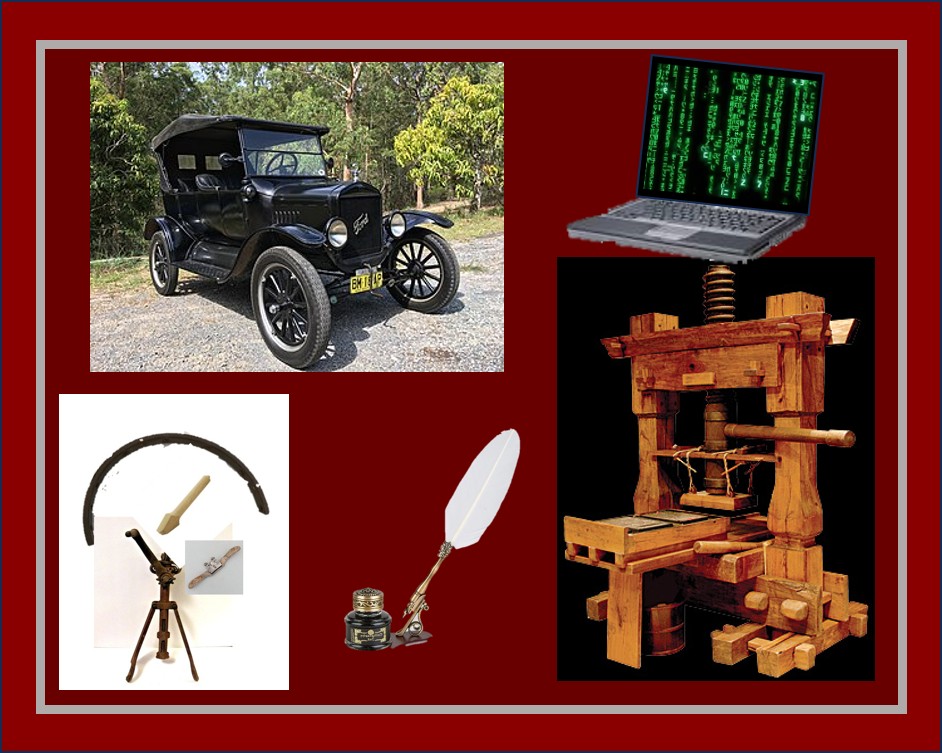
“Bessie” wasn’t some long lost relative, but my father’s first “Tin-Lizzie” or Model T Ford. Bessie was originally my grandfather’s car, but my dad inherited it to do “missionary work,” which is what he called sales calls looking for business for Culler Printing, aka “the shop.”
“What was it used for?”
My father wasn’t by nature a patient man, and he didn’t like being interrupted when he was working in his workshop, but this time he stopped and pulled the box off the shelf. He took out the black steel half circle.
“This is a rim-truer,” he said and when he saw the clueless expression on my face, he continued. “When the Model T came out, there were no filling stations with mechanics on every corner. If something broke, it was pretty much up to the driver to fix it. The Model T came with a toolkit, but this wasn’t in it. This, my father had made at the blacksmith’s in Ocala.”
The shop was in Lakeland Florida. I heard the names of surrounding towns often enough that I didn’t question this. Now knowing that Ocala is 90 miles north of Lakeland, I wonder if there wasn’t a closer blacksmith, but North Central Florida was sparsely developed in the early twentieth century.
“And there were no paved roads like today. Every road was dirt or all mud when it rained, and it rained a lot in Florida. So roads were washed out, or full of holes, or full of rocks that somebody put in the holes. When you hit that with a wooden-spoked Model T wheel, the balloon tire would blow, and a spoke would break, and you’d put a rock shaped dent in the rim.”
He pulled out a couple of other tools.
“Maybe you had a spare wheel and tire with you. Bessie didn’t come with a spare, but after a while I got one. If you didn’t have a spare then you fixed the wheel right there by the side of the road.”
My dad went on to tell me about making a new spoke, showing me the spoke shave in the box.
“Most people carried spare spokes when you could get them, or at least a piece or two of hickory or oak.”
He went on describing the process. He showed me a rim-splitter but I can’t remember how that was used. Soon, my ten-year-old attention span expired and Dad went back to whatever he was working on.
Looking back at lost knowledge
My father had knowledge and skills that I never even thought of learning. When he died we threw away eight refrigerator or washing machine motors that he had rebuilt. I guess he’d replace the motor and then rebuild the old one? Why? Because he could, and you never know when an electric motor might be needed.
New technology replaces old knowledge and skill:
“Don’t use that calculator, Alan. Those things rot your brain.”
My mother was a math whiz. When I bought my first house, I was unsure I could afford the monthly payment. The bank hadn’t given me a number yet. My mother asked me interest rate, down payment, taxes, and in under thirty seconds spit out my payment. Thirty year compound interest, which I later found out was accurate to the penny, done in her head.
She was right about calculators, as I occasionally find myself using a calculator to divide by ten. I don’t always remember the times-tables and squares I memorized.
My “typing” is limited to three or four fingers, but because I use a keyboard now, my never-great penmanship is atrocious.
There was a time when penmanship was a career. In the early 1400s, any document was written by a professional scribe. The scribe would write the document in your choice of script, and make several exact copies. Because scribes worked for Royalty, the rich, and the Church, the Scribe Guild was quite wealthy. It was a ticket to class mobility.
In 1452, the Gutenberg press and moveable type destroyed that trade. In 1886, the linotype machine, hot metal type setting, eliminated manual type carvers and type setting. In 1972 computer typesetting replaced the linotype in most newspapers.
A more recent example:
My last house had steam heat, with single pipe radiators, such that the steam created by the boiler could be pumped to the radiator intake through the top of the pipe, flow through the radiator and condense into water that flowed out through the bottom of the same pipe.
When we moved in, these radiators offended my picture-straightener way of being in the world, and I went around with a level removing shims that made them slanted. Our heat stopped working and after one plumber was stumped, I found an old guy who understood the design.
“The slant is so the water flows out; you’re just filling up the radiators with water which is blocking the steam.”
“Why didn’t the other plumber tell me that?”
“Because the guys who designed these systems are all as old as me or dead.”
What knowledge was lost in prehistoric times?
Oral storytelling was the foundation of ancient culture. The shamans, druids, bards, or priests, were storytellers who told the origin myth, history, and genealogy of the clan. They had prodigious memories, and much ancestral wisdom. Then came written language. What was lost with the coming of the scribes, when only the few could read, and children no longer sat around a fire learning the roots and connections of those who came before them?
I am intrigued by megalithic era monuments, Stonehenge, New Grange and Knowth in Ireland, and some Stone Circles in Scotland, which are often oriented to the Winter or Summer Solstice, with a precision that is difficult to reproduce even today. These structures are built of huge stones that came from far away, at a time when the wheel wasn’t available to the builders.
How did they do that? Archeologists speculate that they floated huge stones on barges and rolled them over logs for hundreds of miles. They imagine projects carried out by multiple generations.
What if these builders knew how to reverse the polarity of the Earth, such that, instead of gravity, they created a mag-lev surface, like turning two magnets to repel rather than attract? Or perhaps, they created a quantum environment to do “spooky stuff at a distance” with stones that weighed tons?
Yeah, I know. That’s just crazy.
I create this fantasy to highlight what ancient knowledge might have been replaced by new technology, fallen into disuse, and thereafter lost to memory.
Looking forward to lost knowledge.
What knowledge and skills are we losing to Artificial Intelligence (AI). People tell me “It’s just a tool.” Yeah, so’s a calculator, a computer, the printing press, etc.
There are five or six tech oligarchs who are spending billions and driving their companies toward Artificial General Intelligence (AGI). That’s right, the makers of Chat GPT, Claude, Gemini, xAI all want to colonize the world with AGI. Why? Because they can, and owning this kind of far-reaching infrastructure technology is the source of the power of empires.
We could ask what are the unintended consequences of AGI? We should ask what will be the impact of knowledge and skill lost in the transition. Torches and pitchforks? Robot armies fighting Tech oligarch imperial wars?
Regular readers will know that I am fascinated by apocalyptic stories and films. The second Mad Max film, “Road Warrior,’ ends with the new tribe discovering an old city. The young woman narrator says,
“We see that those who came before had the knowin’ an’ the doin’ of things far beyond our ken.”


Good Morning Alan. I share your concerns about AI and AGI. Handheld calculators such as the HP-35 and TI-SR10 had just come out; they were expensive devices -$400 and $100. I purchased my TI-SR-10 at the Dillards in Padre Staples Mall in Corpus Christi in August 1974. To put things in perspective, my off campus apartment rent was $75 a month.
I remember one of my friends at Texas A&I (we were both EE students back in 1974) asking Dr. Calusio during a class session. The subject that day was the software on the IBM360 mainframe that could model and electrical circuit. My friend asked – if we use this program we will quickly lose our proficiency in doing the same calculations by hand with sliderule or calculator. Dr. Calusio’s reply was golden – As practicing engineers we must never relinquish control to the machine; at the end of the day, as practitioners we must understand the methodology to confirm that the printout from the IBM360 is accurate. I don’t want to sound like a modern day Luddite, but I think we are losing that skill…
Great story, David
In business school, I bought a TI-42, which did IRR calculations, some calculations for economic metrics, and some other stuff. That calculator is long gone and I no longer remember those formulas.
Thanks for your comment and continued support.
Excellent article Alan! I agree about AI dangers. Like David Ford above, I experienced both the introduction of the first handheld calculators, and personal computers. I still own my original engineering slide rule (hanging on the wall in my garage), but today I no longer remember how to do more that multiply and divide with it.
When I was in the US Army in the early ’70’s, I was an Artillery Fire Direction Specialist. We had to rapidly (by hand) calculate azimuth, distance (range), and corrections for both the spin of the shell, and any wind or other meteorological affects, in order to give the precise firing settings to the cannon battery. Using basic math, and special slide rule – like slipsticks, we could usually do this in less than a minute after getting the “Fire Mission!” call. Later, the army came out with the FADAC (Field Artillery Digital Automatic Computer). The thing weighed about 250 lbs, as did the accompanying generator. We were much faster, and just as accurate with the sticks. During this period (maybe 1972?), I remember the FD sergeant would stand behind us and try to check our work using one of the first TI calculators. He never could beat us either in accuracy or speed.
I’m sure that today, all of this has been computerized.
Your article was very well written, and illustrates the point of “lost knowledge” very well. Thanks for this.
Great story, Dennis
My ongoing joke when on the phone with a CSR who is waiting for the computer screen to load: “Computers save us time, right?”
It always gets a laugh.
Computers do save us time and improve safety. Sometimes it takes about five years to reproduce human knowledge and skill, but in the end it is better. You may have seen the old ads of the guy controlling the pour of molten steel in a Flat rolled steel mill. It was a very dangerous job, but the human used sight for color, and viscosity, smell, and the “feel” of the heat. Computers do that job now, and that saves lives, but it to a full five years.
I read that companies are reducing staff “In anticipation of as yet unrealized productivity gains” from AI. What might go wrong with that?
Thanks for your comment, kind words, and continued support.
Great essay Alan! I have wondered about the same lately. I’ll admit that I’ve become quite enamored with AI, but at the same time I’m wary of it. The more I use it, I’m finding that I’m becoming more lazy in applying my writing skills, as I dash something off and then let AI check it for grammar, punctuation and clarity. Now I’m noticing that my writing skills aren’t quite what they used to be.
I was just musing the other day as to how AI will affect my field of Instructional Design. I’ve seen examples of how easy it is now to pull together instructional information almost without thinking. Will that eliminate the need for IDs? I’d like to think that there is still a need for someone to identify the learning needs and implement adult learning theory, but, with the right prompts, the AI tool of choice could probably do that as well. Perhaps my temporary retirement may become permanent like so many others being replaced by AI.
As with all technological advances, hopefully we will find a way to live peacefully together with “the machines”–without becoming dumber in the process.
P.S. This was written without the help of AI…LOL
Hi Reina
Thanks for your supportive story and comment and for writing it without AI. 😉
We lose our knowledge and skill (competence) without practice and without the combination of competence and supports (systems, processes, measurements and habits) that is capability.
And life happens and labor saving is a good idea and then in the words of the Denny Zager song, “In the Year 2525,” ” Your leg have got nothing to do. Some machine’s doing it for you.”
That’s probably too morbid.
Use the tools but find a way to stretch your capability anyway.
(Spelling and comma faults corrected with Grammarly or whatever bot Bluehost uses).
Thanks again for reading and joining the conversation.