Flathead moments
I went to business school to become a consultant. I spent thirty-seven years in the field. I am so embarrassed about how long it took me to learn that I was in the change business that I won’t put the number down here.
Duh. D’ooooh. Yep, that long, a flathead moment, (the flat spot caused by repeatedly hitting my forehead with the heal of my hand).
I finally got it. I studied organizational development, and worked with some of the stars of change consulting. I worked with leaders and their teams to help them innovate, continuously improve, integrate and align systems and processes.
Some of my clients were successful at changing themselves and their organizations, others not-so-much. The positive feedback I got from individuals, senior leaders and those change leaders lower in the organization, made it a rewarding career.
Then I got old enough that most of my clients either retired or died. I stopped and reflected on my situation. I decided that retirement sounded better than death.
But I didn’t really retire. I started another career, my fourth ̶ actor, booking agent. consultant, writer. So, now I’m a relatively new writer in an old body. I don’t really need my new career to support me financially, but I still may have earned more money than I did as an actor, and I haven’t fallen back on waiting tables, tending bar, or driving a cab, like I did as an actor in my twenties.
I am new at this writing stuff. I am learning a lot. I read books on writing and publishing. My wife, who earned her living as an editor, edits my books. I’ve started listening to her more because, when I hire external editors and writing coaches, they tell me a lot of the same things she has been trying to tell me for years.
Duh. D’ooooh. Yep, another flat head moment.
Matt, my writing coach told me. “You want to get better at writing? Write More.”
“Wait, what? I write a lot. I post here once a week. I post on LinkedIn, Biz Catalyst 360°, and Medium.”
“Let’s try to expand your presence on Medium. Write more. Post some of what is on your blog, with more editing, on Medium.”
“I’m thinking about an article on scams targeting self-published authors.”
“Stop thinking. Stop talking. WRITE.”
I’ve been doing that, but it took a YouTube video on improving guitar skills as an older adult to make me realize what I got wrong about change.
Guitar and the inadequacy of change models
I used a simple model to talk with leaders about change: Insight—-Action—-Results.
First, get agreement on the “Why change?” and the “Why Change now?” and the “Why Not changing won’t work.” Then when people choose to change they can act and get results.
Over my years as a change consultant, I used this model repeatedly because it was so simple; it didn’t really seem like a “framework.” It didn’t need to be drawn with boxes and arrows, which I came to understand is counter to the way most non-consultants think.
Tony Polecastro, who made that YouTube video, teaches guitar to older adults, people who, like me, have been playing since they were thirteen, picking up the guitar they’ve owned since then occasionally, getting as good as they were at thirteen, and then putting the guitar back in the closet.
Recently, I’ve been practicing more and find myself surprised by my improvement. I am also painfully aware that their have been other periods in my life when I made progress only to stop and lose those gains. So, I’ve been cruising around YouTube and stumbled on this video, 10 Rules for Learning Guitar as an Older Adult, by Tony Polecastro.
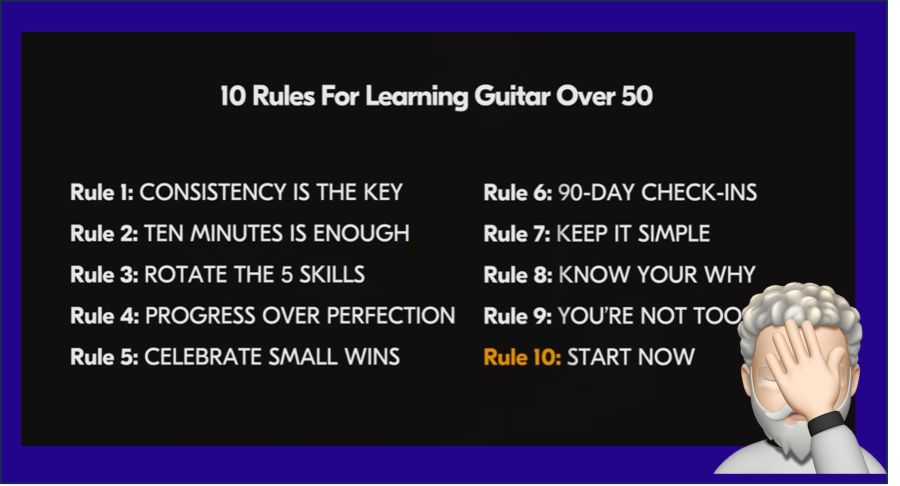
If you look at Tony’s rules in the picture above you won’t find anything that is cognitively earth shattering. Consistent practice, small amounts, a big concept broken down to individual skills, progress not perfection, focus on what has improved not what hasn’t. This looks like what I did in a disciplined way to prepare for my first marathon at forty.
What gobsmacked me is that Polecastro doesn’t get to the Why until Step 8.
“Wait. What? That can’t be right. He should start there, right?”
Then it hit me. I compared Tony’s idea, the Why at Step 8, to what Matt, my writing coach said, “Stop thinking. Stop Talking. WRITE.”
Action, even the smallest actions, builds commitment. The way regular reps build muscle in weight lifting, action builds change muscle. Tony waits for the Why until it will resonate.
“What experiences do you want from guitar? How do you want the guitar to help you grow? How do you want the guitar to help you give back.”
Tony places the Why before “Step 9 You’re not too old.” When he talks about Step 9 he is discussing the negative self-talk that arises when improvement or change gets hard. He puts the Why at a place where it functions not as the penultimate driver but as an accelerant.
Duh. D’ooooh. Yep, another flat head moment.
An adjusted change process
It isn’t that I didn’t emphasize action. Every leadership group I ever facilitated had an action chart. I was so rigorous about actions, schedule and accountability, that one client called me “Action Alan.” Another described my work as R.H.F.U. (relentless hounding and follow up). Another called me PITA (pain in the ___).
Sometimes though I think the actions I encouraged the most were building consensus on insight, rather than the change actions themselves.
I did some mini innovation workshops and some what might be called strategy pilots, built on Robert Schaffer’s Rapid Results methodology. I encouraged leaders to do a continuous improvement project themselves, so they’d learn Six Sigma, Lean or whatever the methodology their people were using. Several times in my career I sent leaders out to interview customers, or gather data on competitors, to drive home the need to change, but I saw it as insight building as opposed to action learning.
Kurt Lewin, who invented the first change model I learned, “Unfreeze—-Change—-Freeze,” also invented the term “action learning.” He advocated conducting experiments at each stage in his change model. Leaders as well as their people were to get their hands dirty, try-evaluate-and fix-try again.
Earlier in my career, I worked for a company that had a “change readiness” survey. I admit to being shaped by that concept. First you build readiness, gain agreement on insight, then act.
I still believe there is benefit to that approach, but you can waste a lot of time waiting to be “ready.” For the changes that now occupy my time, (writing, weight, guitar) I will follow Tony Polecastro’s Step 10, START NOW.
Alan, you bring genuine wisdom, but just as important, you always bring me a smile. I APPRECIATE YOU!
I appreciate your appreciation, Ed.
Glad my wiseass ramblings make you smile. Who could ask for anything more.