


Is this my last consulting post?
On Valentines Day in 2022, I started Wisdom from Unusual Places, sharing wisdom I had stumbled upon in three categories, Consulting, Leading, and Living. I was seventy-five, had worked in consulting for half my life. I started in content consulting, doing product-market research in the automotive industry and evolved into process consulting, the “people stuff,” organizational change.
Initially, I thought consulting was decision support. I was providing insight.
I came to realize that insight was the first step in change. People needed a reason to change, but insight had had to be internalized by everyone. Then they had to take action and achieve a result. The decision to change was not just the leader’s it was everyone’s.
And change is fragile. Insight—Action—Result is almost never a straight line. People individually choose to change at different rates. Some need more insight than others or give up at the first failed action or result. Organizational change requires the commitment of leaders at all levels to a complex, iterative process.
But now, consulting as we know it has been completely upended by the introduction of artificial intelligence, (AI). The hordes of smart ugrads who analyzed data have been replaced by a few savvy prompt writers and AI agents. Big firms openly list the number of AI agents alongside their workforce numbers,
I am a “late-adopter” of technology. My experience with AI is limited. I also retired from consulting now eight years ago. As a working consultant said to me recently, “the consulting industry has changed completely.”
So, maybe I should stop posting about consulting, but before I go, let me hypothesize a few things about how AI is changing in consulting and what consultants, managers and partners might do about it.
Artificial Intelligence and its Consulting Consequences
(Caveat: These are not facts, but my hypotheses about industry changes.)
- Consulting isn’t going away; Delivery mechanisms will change. Clients will still ask for help increasing revenue or profit. The up front analysis of existing market data and internal company data will be done by, or assisted by artificial intelligence agents. Artificial Intelligence is good at looking for patterns in large data sets. It can identify trends in data, project the probabilities of next stages based upon history. It can compare results against a known success model. With specific detailed prompts AI agents also will be able to display data, and draft reports and PowerPoint presentation slides. This was some of the work of the army of analysts in consulting firms and support personnel used to do.
Implications for new consultants:
If you want one of the remaining analyst jobs, you will need to be very familiar with all the various AI agent builders. You’ll need to understand and have built research protocols using the prompt framework, Role, Task, Context, Format. You’ll need to know how to iterate and test research.
Consultants have always needed to learn fast; AI accelerates this, which means understanding how you learn best (See David Kolb’s Learning Model and others). You need understand how people might use your insights to change. This was the manager or partner’s job, which you would have time to learn, but consultant development trajectory will condense.
Implications for managers and partners
Hiring analysts, and new consultants just got a lot harder. You used to battle investment banks for the top grads of universities and business schools who were a little insecure, so they’d work really hard. You were going to wash out a fixed percentage of them within two years anyway. You are now looking for analysts who understand AI and “people stuff,” with the Emotional Intelligence Quotient to build trust with clients and the judgement to pick what will work.
- Process consulting may grow faster than content consulting. Content consultants produce insight and a plan of action, e.g., a new strategy based upon a competitive advantage, and instructions how to implement it. The client has the responsibility to act and owns the result.
Process consultants teach the client a process, e.g., how to formulate a strategy, and make the decisions necessary to implement it. Process consultants might facilitate the insight creation, and share the implementation to a pre-agreed hand off. The client owns the results.
These are two different consulting methodologies, the history of which I outline in consulting post #1 and #2 on this blog.
Content consultants sell insight, expertise, and answers. Process consultants sell questions, decision processes, and action. Content consultants often work in strategy, marketing, and technology, and process consultants work in human resources, organization change and operations disciplines.
The consulting process used by both methodologies has different responsibilities as is indicated in the diagram below.
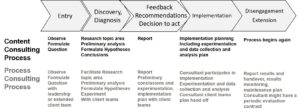
Content consulting provides insight, research and data, I think more of those functions will be done by AI agents and so headcount will grow more slowly. Process consultants work more with people, and change, so I think those will grow more rapidly.
Implications for consultants
Regardless what kind of consulting you do learn about change and the people side. Learn the skills of facilitation, conflict management and change. Consider working for process consulting firms.
Implications for managers and partners
From what I hear and read, there is a surge in demand for organization development and change management disciplines .Even as a retiree, I still get job notifications by email, and LinkedIn at a rate of three to ten a day.
At the same time I observe on LinkedIn many experienced organizational development and change management professionals who have been out of work for a while. Is there a disconnect between demand and available experienced hires?
I haven’t done mutually exclusive collectively exhaustive data collection, nor take a statistically valid sample, but there appeared to be proportionately more experienced women and people of color in these change specialists looking for work. Does this discrepancy exist in more complete data? If so, why? Is it the anti-DEI culture war? Is it partners who grew up in content consulting looking down on process consultants?
I don’t know, but I think If you are a hiring for a consulting firm you’ll need an inclusive mindset to succeed.
- AI will create a consulting sales bonanza. This might seem counter-intuitive, as much of the insight production that big content consulting firms were known for will be easily taken inside by clients, utilizing their own artificial intelligence agents. But I base this on several trends:
- Creating AI agents will become a service offering in itself. This will be a huge opportunity for technology based firms and systems integrators. It will also be an opportunity for small start-ups with the know-how. New technology democratizes distribution.
- AI agents will lower costs creating new markets. Big firms will be able to go into the middle market, middle market firms will be able to go after small business enterprises. More partners and managers will leave to start small firms or become independents as AI replaces firm infrastructure, leveling the playing field.
- New models of billing will develop. Most consulting firms have billed based upon billable hours. Some like Bain Capital have taken positions in firms and made money on average gains. Some have experimented on a percentage of dollars saved or revenue generated. I expect to see more risk and reward sharing in the future.
Implications for Consultants
Learn to sell. Business development, new client acquisition used to be the sole province of partners who either developed trusted relationships over time or attracted new clients by brilliant research and new service offerings. An AI agent might be able to write a superb pitch letter, but it can’t develop trust by always operating in the client’s best interest and delivering consistently.
AI might help, but it won’t frame a problem in a way the client understands or suggest the perfect consulting project. AI won’t “Help leaders make strategic change.” You’ll have to do that. And that will be the ticket to success.
Implications for Managers and Partners
As General Patton said, “Lead, follow, or get out of the way.” Think about what’s in your head that is your advantage and share it. Will you get all your knowledge into others or into new AI service offerings? Probably not, but the dispersion of innovation and tacit knowledge will be the competitive advantage of the future.
Will AI Unleash Consultants? Or vice versa? I really don’t know, but there is always danger and opportunity in change. I intend to learn more. Maybe you should too.
Will this be my last consulting post? Maybe I’ll still have something to say. There will still be a lot of change work out there, and that work will be different and similar. It will change those who do it as it changed me. Or I may just increase Living posts.
Maybe others have ideas to share? Let me know.
Additional reading:
Matt Shumer on X: “Something Big Is Happening” / X
Justin Oberman The last AI newsletter you’ll ever need to read
https://hbr.org/2025/09/ai-is-changing-the-structure-of-consulting-firms
And, of course: 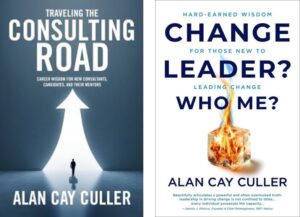


Good morning, Alan. Your story took me back to the early 1980s, when I had just finished reading John Naisbitt’s book Megatrends. One phrase from that book has stayed with me ever since: “High Touch.” His point was simple but powerful. The more high technology we introduce into our lives, the more we will long for authentic human experiences.
You captured that idea perfectly when you said — AI might help, but it will not frame a problem in a way the client understands or suggest the perfect consulting project. AI will not “help leaders make strategic change.” We will have to do that. And that will be the ticket to success.
I think that is exactly where we are headed. AI is a tool. A powerful one, but still just a tool. In the hands of an inexperienced practitioner, it will not automatically produce good results. I have a power saw, but if someone asked me to frame a house with it, I would struggle. The tool may be capable, but the experience, judgment, and craftsmanship still have to come from the person using it.
Great story, David! I was tremendously influenced by Naisbitt’s “Megatrends” as well. Many of those trends have held up.
Humans will have to use these tools well.
Thanks for your comment and your continued support.
Alan,
I agree high touch/process consultants will have more security than content based. I would just add that process consultation will require more business savvy than ever before. Process consultation will need both AI and business savvy to be effective.
Mary
Hi Mary
You are absolutely correct. High touch with a lot of business savvy. Great points
Thanks.
“An AI agent might be able to write a superb pitch letter, but it can’t develop trust by always operating in the client’s best interest and delivering consistently.”
Totally agee, Alan. Trust is a key component in developing ongoing relationships, and delivering sustainable mutually-beneficial revenue generation.
So True, Bob.
There is the trust developed by getting to know someone, but more importantly the trust built upon transparent information exchange and a track record of doing what you promise.
Not sure that AI Bots get that. 😉
Really thought-provoking piece about AI and consulting. Your point about insight-action-result being a fragile process is spot on. AI can accelerate the insight phase dramatically, but the human element of choosing to change remains irreplaceable. As someone working in AI-powered tools, I see this dynamic play out daily. Thanks for sharing your consulting wisdom!
Thanks for the confirmation, David
I think AI tools are terrific, but if firms are not training people on pattern recognition and gradually growing their people skills, how will the next generation of seniors develop judgement and client management?
Really thought-provoking article about AI and consulting. The balance between automation and human judgment is something we think about a lot at our AI music startup. AI excels at pattern recognition and generation but the creative direction and emotional resonance still need a human touch. Your point about augmentation rather than replacement really resonates with our experience.
Hi Tom
Thanks for your comment. Sorry to be late in responding. I absolutely agree about the balance between machine pattern recognition and analysis and human judgement.
Not sure what your AI music start-up is. My son summarized this site in an imitation of Dylan’s “I don’t wannna work on Maggie”s Farm no more.”
https://wisdomfromunusualplaces.com/ai-songwriting/
Really thoughtful analysis, Alan. Your point about AI agents replacing the “army of analysts” resonates with what I’ve been seeing in the SaaS industry too. The shift from insight delivery to change facilitation is exactly where the value is heading. As someone working with AI-powered image enhancement tools, I see the same pattern — the technology handles the execution layer, but human judgment about when and how to apply it remains irreplaceable. Thanks for sharing these insights!
Hi Jason
Thanks for your engagement, support and for helping to confirm my hypotheses. These are strange times for business in general and consulting in particular.
Years ago, systems consultants equated change management with end user training. It’s nice to hear that things have changed.
It took me a longe time to understand that consulting is about change and change is always about people doing something different or differently.
Thanks for sharing your thoughts. You give me hope for the future.