

Retiring to write
After years of consulting, I call myself a writer now.
I still feel self-conscious saying that, despite the fact that I have self-published two books, and have a third coming out soon, and have over two hundred articles published here, on Medium, LinkedIn, and BizCatalyst 360°.
Writers for me are Shakespeare, Dickens, Hemingway, Steinbeck, or even King, Bradbury, and Vonnegut. Despite the fact that I have written for much of my life, I am just now getting serious about the craft of writing.
Getting serious is writing more, editing and rewriting much more, and reading writers talking about their craft, and, (how 2026), watching YouTube videos of writers talking.
Recently, I watched a video of David Sedaris, bestselling author of Me Talk Pretty One Day, and other collections of personal essays and memoir stories, the genre of my next book. Like me, Sedaris writes about his family and people he meets, but unlike me, his family (Amy Sedaris) is famous, and his family is definitely weirder, and he is skilled at juxtaposing the normal with the absurd, and much funnier. On this YouTube interview he said,
“People say to me,
‘I’ve wanted to be a writer my whole life. I have some very funny stories. Now that I’ve retired, I have time to write. I can’t wait to publish.’
Can you imagine? That is so insulting. I’m 69. I have been writing since my twenties. It took me fifteen years to get my first article in the New Yorker, and before that I would go read at coffee shops to find out what audiences thought was funny. I still do that two or three times before a piece is ready, and she is going to ‘retire to write,’ Really!”
I don’t have the runway left for the dues-paying Sedaris describes. I am comfortable calling myself “a new writer in an old body.”
Retiring to consult
I do understand David Sedaris’s reaction, because, not infrequently, I meet people who say something similar. The conversations start with, “What do you do?” If I say “I’m retired,” they ask “What did you used to do?”
If I say I write, they ask “What do you write about?” Either way the conversation ends by revealing I was a change consultant for almost forty years. Some people say, “Oh, that’s interesting,” and move to refresh their coffee. Some tell me consultant jokes, or regale me with how consultants messed up their workplace.
Some tell me that they are “nearing retirement, but not quite ready to hang it up. I thought I might retire to consulting. Maybe part time ̶ a few hours a week ̶ just to keep my hand in, and bring in some cash.”
I try not to be as prissy as David Sedaris, “Can you Imagine?” I think of myself as a helpful guy, and so, if they ask, I tell them that the only part-time consultants I know are either very famous with multiple bestselling books, or have a day-job like business school professor, or are not counting marketing time as working.
Some press further. If they are serious, I schedule some time to explain the industry, the realities of independent consulting, and how one might start up a new career in the field after leaving full-time employment in another.
The Consulting Road
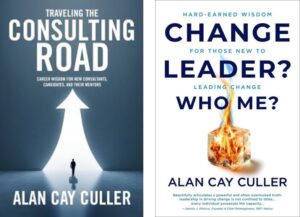
I recommend they read my book, Traveling the Consulting Road: Career Wisdom for New Consultants, Candidates and their Mentors. Or at least scan the consulting stream archives of this blog. Then I give them the Cliff Notes version:
- Consulting is a trillion dollar global business. While industry news is dominated by about twenty firms, there are thousands of firms in second and third tiers, and millions of small firms and independent consultants.
- Consulting is about helping people and companies change. Typically those changes for businesses are more revenue, more profit, or “people stuff,” which should be aligned with either revenue or profit, but are frequently described with words like integration, alignment, organization, or resolving conflict.
- A simple model for understanding change is:
- Insight – the “why” of the change, which may include research and analysis.
- Action – what to do more of, less of, or differently.
- Results – How you’ll recognize success, and measure being on track during the process.
- There are many kinds of consultant, but two approaches define the work:
- Content consultants – “Answer people” who provide expertise, research and analysis (Insight) and some direction on action and results, but are typically “hands-off” in those areas. Typically content consultants are found in strategy, finance, and marketing. Output is often a report.
- Process consultants – “Question people” who work with the client to build the processes to solve the problem. They are more “hands-on.” They are often found in organizational and operational work. Output is intended results and the ability to maintain them.
- In addition to consultants, two other roles bear mentioning:
- Coaches, – who typically focus on individuals or teams to help them improve organizational results. Coaches are most similar to process consultants. There are organizations that provide coaches to organizations, who train and subcontract to retirees.
- Trusted Advisor – this role was traditionally the senior partner at the major firms, who had built a lifetime of consulting contacts, and was seen as a generalist guru. Since the publication of the Maister, Green, and Galford book The Trusted Advisor, everyone wants to be this. It only works if you have many people calling you out of the blue to ask for your wisdom. If you figure out how to get there without putting in a career’s worth of work, please tell me. Maybe I’ll come out of retirement.
How could you become a consultant in retirement?
I realize this background may not be helpful to a potential retiree, and I get it, it’s a tough transition, from going to a plant or office every day, having specific things to do, being surrounded by people, who support your work and provide some of your social life…
… to… ?
And that’s the point, isn’t it?
Consulting seems like the perfect transition. People call you up and ask for your wisdom, and if you’re fishing or traveling, they’ll wait to you have time and want to work. Yeah, ‘cept you know that isn’t likely, right?
Some large company managers, with well-defined expertise, do come back to their old companies for some meetings on a new initiative. Some might train people, or coach new managers up to speed. Some are hired as contract workers to do work they did years ago.
That could work, if they have recognized expertise and great relationships at their old companies. It is a way to “keep your hand in,” and have people around you. Many executives find this difficult because people don’t listen to them in the same way now that they’re not the boss.
Some, who have worked across many companies in an industry and are active in industry or trade groups can parlay those relationships into consulting contracts.
What’s important is consultants have clients, and you can’t be a consultant without one.
The part-time thing is more problematic. Clients want you when they want you, and unless you are “The One,” if you aren’t available, they find someone else for this project and every one that follows.
You could write a book, or have a ghostwriter write it for you. Many independent consultants have the “one pound business card,” that helps them develop business.
But writing, and more importantly, selling your book(s) is a whole new career.
“Can you imagine?”


Good Morning Alan. As always – I love your stories and your sharing of your journey.
Spot on as usual. The other use of the word “consultant” is a person between full time positions..
Ha,ha too true, Mary. Thanks for your comment
David Thanks for your comment and continued support