In a New York City taxi
“Where are you from?”
“I used to live on the Upper West Side, but I live in Jersey now, West Orange.”
“You like it? My wife’s sister lives in Bloomfield, she’s always trying to get us to move out there, but I got a half hour commute from Brooklyn and Jersey’s a schlep.”
“It’s all right. Bloomfield’s close to us, not a great train, though.”
Being a cab driver in New York City is a tough job. The traffic never lets up. The weather is not your friend – on nice days everybody walks, when it’s not nice everybody wants a cab. Costs are out of control; a medallion is $200 K, down from a million in 2013, before Uber and Lyft.
Most drivers don’t own their medallion, but daily lease costs reflect the cost of the medallion and maintenance, and cabbies have to deal with the ride-sharing competition and pay for fuel.
And then, there are the customers. New Yorkers get a bad rap. When I lived there, I observed New Yorkers were nice and helpful, especially if you asked for directions. Drivers blow their horns, but I’m told those people are from Jersey, and “should have taken the train, or underestimated the traffic, and are late.”
New Yorkers do get impatient with tourists who stop without warning to gawk at the skyscrapers, and they hate it when they can’t find a taxi.
The net of all that is I’m especially nice to cab drivers. If they start a conversation, I engage, but if they need to not talk, I don’t bug them. I just give them my address, say “please,” and then “thank you” when I leave.
This guy was chatty. He looked Mediterranean and the last name on his Hack license ended in a vowel so I asked if he was Italian?
He made a noise that could have been a laugh or a fake spit, pttsh.
“Nah, right side of the Adriatic. I’m Albanian.”
I told him I didn’t mean to insult him.
“There are two kinds of people in the world,…” he said, a little louder than I thought was necessary.
“Oh?”
“Yeah, there are those who believe there are two kinds of people in the world and those who don’t.” He laughed.
I laughed, relieved.
He went on telling me that on some days he thought there “are billions of different kinds of people in the world, and some days, I think there is just one. We eat, we breathe, we love, and we bleed, all just the same.
Two kinds
“People who believe there are two kinds of people in the world and people who don’t.”
I collect little wisdom sayings like that. I wonder if my Albanian cab driver friend knew that phrase was written by Robert Benchley, American humorist writing in “Vanity Fair”, early in the twentieth century.”
Groucho Marx said something similar, ‘those that think the world can be divided up into two kinds of people, and those who don’t.” That’s a little different because Groucho used the word divided.
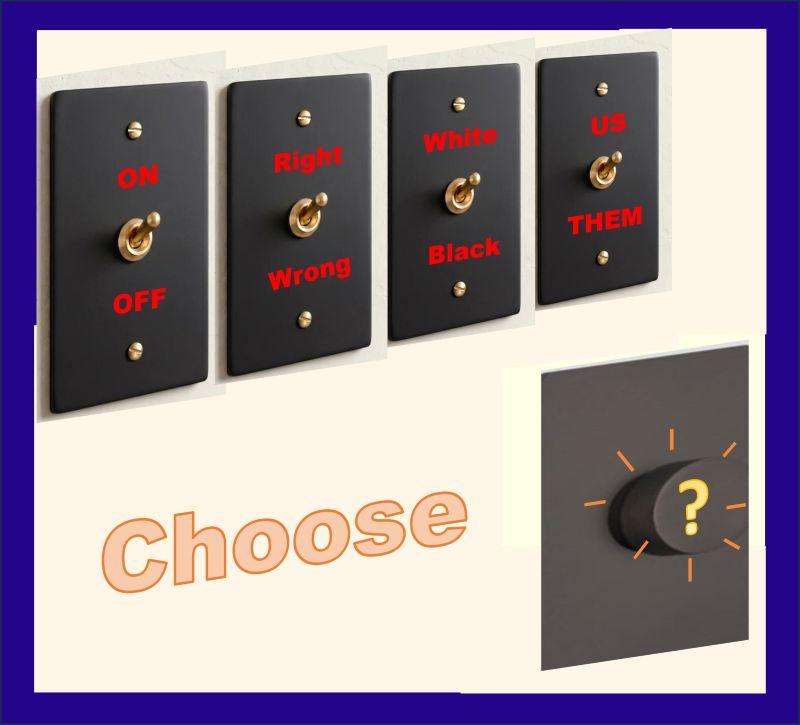
Human beings seem hardwired to the binary choice:
“either… or”
“On or Off.”
“black or white”
“Right or Wrong.”
When we created computers, we made a language for them based upon binary code, “1 or 0.”
People like binary decisions so much that sales people are taught to close a sale by framing a binary choice.
“Would you like the red or the blue?”
“We can deliver this next Friday, or this week if you’re in a rush.”
Of course, there are an abundance of colors to choose from, or delivery dates, but forcing a decision between two options, ends the buying process without presenting the real buying decision, “Yes or No?”
Us and Them
One troublesome human trait is our penchant to see the world as composed of people like us, and everyone else. Maybe this goes back to clans of hunter-gatherers, who thought people “not like us,” might be a threat.
We started out as searchers. Then our ancestors carved out hunting grounds and gathering territories to settle in. Settlers grew crops, and feared searchers who might “gather” what we worked all season to grow. Walls went up. Inside the walls were Us; outside the walls were “barbarians,” or Them for short.
We drew lines on maps. You couldn’t see the map lines on the ground, but you knew this side of the river was for us, for our kind of people. Gods only know what those people on the other side of the river are like. They might even worship different gods ̶ infidels, heathen, unbelievers ̶ Them.
In the 1970s we all believed that this only applied to Middle Eastern and European peoples. Native Americans didn’t practice ownership of the land. True, but there are still many indigenous tribes whose name for themselves translates into “the People,” or some variant:
For example, Diné (Navajo), Anishinaabe (Ojibwe), Inuit, Hinono’eino (Arapaho) and Nuutsiu (Ute) all mean “the people.” Lenape means “the real people. Gaigwu (Kiowa) translates to “Principal People,” and Illiniwek (Illinois) translates to “The Best People.” Where I grew up in Massachusetts, the Wampanoag, whose name means “People of the First Light,” probably meant something other than Easternmost.
There are some peoples who have a unique name for “not us.” I would be called a Gringo across Latin America. My Jewish and Mormon friends would refer to me as a Gentile or Goy in Yiddish. I am a Gweilo in China, a Gaijin in Japan, and Haole in Hawaii. I don’t know any Romani, but if I did they would call me, Gadjo, which means “house dweller.”
These names for “not us” get ugly in war or in other forms of extreme discrimination. We hype up our young to fight by dehumanizing the enemy. I won’t repeat those names here, because attaching hate to the name for another human is despicable.
Leading Innovation, Improvement, Integration and Change
Some leaders think they can build group cohesion with forced binary choice.
“My way or the highway.”
“You’re either with me or against me.”
“Yamaha wo tsubusu!” (“We will destroy Yamaha!”)
Honda Motorcycles’ famous Yamaha War in the 1980s was successful for a while, but created industry overproduction and massive quality problems, which contributed to the rebirth of Harley Davidson.
Every decision isn’t a toggle switch. Envision a dimmer dial, a volume knob, and the hot-cold mixing shower valve. Visualize a music studio equalizer console.
Innovation and improvement come from many options, and from a both/and view of the world.
Division and forced binary choice is the antithesis of long lasting leadership. What a change leader hopes to create is not blind followers but more leaders, better innovators, continuous improvement that happens without direction. The integration or alignment that makes change happen, forms slowly, organically, as each person chooses to change.
As my friendly Albanian cab driver said, “some days billions of different kinds of people; some days only one.”
That doesn’t sound like a binary choice.

Why do we quickly label others? Maybe toddlers are told they are good and bad people but we should have outgrown that simplistic thinking.
So true, Mary
I do think it is getting worse.
Perhaps this is an artifact of the combination of communications and entertainment technologies -what is true becomes – what seems true or theatrical truth i.e., suspension of disbelief) and the introduction of binary computer language 1,0?