


“Yikes!” or “I’m so sorry.”
They didn’t tell me about this in business school.
Afterwards, working for five consulting firms and for myself in several different independent consulting structures, I heard this conversation a lot.
Sometimes it was from an up and coming leader who was up for a big promotion to a line management job, and didn’t get it. He or she was asked to lead an initiative in innovation, or continuous improvement or post-acquisition integration.
“A change project?”
It seemed like a huge career path detour or a pity-driven-staff-job-consolation-prize.
Worse, if the firm had a poor track record with change, it seemed like a death sentence.
This isn’t paranoia. According to multiple research studies, across all industries, seventy percent of change initiatives fail to achieve their objectives..
Acquisitions fail to achieve combined value higher than the value of the two previous firms. Continuous improvement initiatives fail to reduce cost, increase safety or increase customer satisfaction. Innovation initiatives fail to create a single new product or process. Huge amounts of money and time seem to be wasted, and the people who run these change efforts leave or hide in a corporate backwater.
However, thirty percent of change projects succeed, and often the people who lead those initiatives end up in senior positions, sometimes running the company.
What differentiates the 30%?
In my career as a change consultant I saw a lot of different kinds of change projects. I saw my share of failures. And I’ll own most of the failures, because I was young, stupid, slow to learn, and frequently wrong, but never in doubt.
The successes I saw, for the most part succeeded because initiative leaders had certain characteristics, and the process was disciplined.
Change Leaders
The successful change leaders had a kind of personal power. When they spoke people listened. Sometimes that was because they came with deep knowledge and track records. A leader who has made a change in the past, or failed at a change and takes ownership, is believable.
Sometimes, their track record was because they were open, caring or good listeners and most importantly shared credit. Rarely though, were these leaders nicey-nice. They were GSD people. They “got shit done.” They would say what needed to be said to superiors, candidly in private, or diplomatically in public, in order to get the resources that they needed..
Change Process
Improvement, Innovation, and Integration initiatives all have unique and particular process methodologies to them, which I will talk more about in a minute. They are, however, all change projects. That means for them to succeed people have to do
- More of something,
- Less of something, or do something
- Different, or differently
People, including the leader, must change.
I came to talk about change in a simplified way: People make a choice to change.
They choose to change because:
- They have an insight, ̶ People understand that circumstances have changed. Expenses have risen faster than revenue, or competitive pressure requires a technology differentiator, or an acquisition is required to add unique value.
- People are then able to translate the change in circumstance to a change in their own behavior.
- People become committed to the change.
- People take action, ̶ the action may start with learning new methodologies. They may try on new ways of working. They may start with small steps and they may have false starts, and “try it-fix-it-try it again.” But they take actions consistently.
- People measure the change, ̶ They measure the results from their actions, and if they do not achieve as expected they try again. They measure upstream process indicators, like measuring materials inputs, or labor, to be sure the process is on track. They institute systematic measures to avoid backsliding.
In my experience, change initiatives fail because the leaders under invest in the insight phase of change. People must understand the “Why” of the change to commit to it fully, or any obstacle in actions or measurement will stop them. This is true individually, and for the critical mass of the organization that provides the momentum for the change.
Innovate, Improve, Integrate, (Repeat)
Change initiatives are called many things, and naming them can be fun, and brand building can accelerate change. They can also be “too cute by half,” and destructive. I believe that all change efforts are some variant of three kinds of change:
- Innovation ̶̶ big change, step change, completely new stuff, and reinventions, new products, new processes, new technology.
- Improvement ̶ Cheaper, faster, better, smaller incremental change, that works best when it is a continuous process.
- Integration ̶ combining, or melding, two different products, processes, organizations, or technologies.. The obvious example is combining two companies in an acquisition, but any two elements in combination requires integration, including combining new products and processes from innovation and improvement with the existing business.
Each of these types of change has unique methodologies. My brothers in business academia and consulting firms have literally hundreds or thousands of “branded versions” of these methodologies, e.g., Design Thinking, Agile, Lean, Six Sigma, LSS, Stage-Gate PMI, Quadrant Synergy Search, etc. If you choose to use a brand, stick with it. “Changing horses mid-stream” is a recipe for change failure. Here are some more generic processes that cover the basics:
Innovation process: Understand the objective and metrics, generate ideas, test and evaluate ideas (lab, prototype, market), Implement/market innovations, measure, and improve, (repeat).
Improvement process: Clarify process and metrics, define issues, problems, measure where you are, improve, measure where you got to, standardize (repeat)
Integration process: ̶ define objective and metrics (e.g., symbiosis – one combined company, product, process, interdependence, two with shared benefits, or separate but equal). Analysis, communication, planning, testing (measurement and improvement), implementation, measurement and improvement, (repeat).
I hope three things are apparent:
- Each process is relatively complex, and some training may be required.
- Process discipline will be key.
- Each process has a continuous component (repeat).
Also, put together in this order these three processes represent the life cycle of a business:
- Innovate (come up with a new idea)
- Integrate (operationalize innovation)
- Improve (make it cheaper, faster better)
- Integrate (operationalize improvements)
- Acquire other (businesses, technologies, suppliers)
- Integrate
- Repeat
So, far from being a career detour, being asked to lead a change initiative is training for senior management, business building, and entrepreneurship.
Two further words of caution:
This is a hands on process; you can’t delegate change. So learn alongside those you are leading. Take actions on your own, and get those above you to engage as well.
Change will change you. You aren’t just asking others to do more, less, or differently. You’ll be doing that too. You will succeed in proportion to how much you grow, as a leader, and as a person.
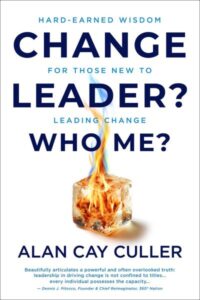
For more on this subject: https://1link.st/alancayculler.author

0 Comments