

Remembrance

Leadership

As a writer, I try to simplify, to summarize, to capture the essence of something in a phrase. I don’t always succeed, of course; I am too often wordy, loquacious, distracted and meandering. In my upcoming book, Change Leader? Who Me? I repeatedly describe the difference between  management and leadership:

Managers:

  • thrive in a relatively steady state
  • are accountable for getting work done, and
  • Develop people to ensure they are capable of getting work done

Leaders:

  • thrive in abnormal circumstances such as change, emergencies, war
  • are accountable for giving direction, “This way!”
  • attract followers, “Follow me!”

It is a simplistic distinction. Management and leadership skills are often embodied in the same person. One of the ways leaders attract followers is to take an interest in their peoples’ development. Are they managing then or leading? Still, in the book I hammer this nail repeatedly.

On this Memorial Day weekend, I find myself thinking of the ultimate “abnormal circumstance,” war. This may be why the military talks more about leadership than management. When bullets fly, lives are saved by ”This way, follow me!”

The war of my generation

A couple of weeks ago, I attended a military funeral for a Vietnam Veteran. I only met John a few times at family weddings and funerals. He was the older brother of my sister-in-law. Funny how we don’t have a word for that.

In one of our early meetings, the fact came up that he was in the war of our generation and I wasn’t. I don’t remember how. I do remember we didn’t talk about it again. I probably said something like, “I was carrying signs in the streets, when you were in the jungle getting shot at.” It was the kind of thing I said to stop uncomfortable conversations about the Vietnam War.

I was a conscientious objector, at least I tried to be. When my CO application was turned down, I appealed, and then the lottery came along and my number was 294, and my appeal became moot. I always felt that was too convenient, but I quit my hospital orderly job and went on with my life.

I never wanted to talk about Vietnam after that. There were too many from my high school, and the blue collar neighborhood I grew up in who didn’t come home. I knew too many who served and came home drastically altered. The Vietnam War was also a subject upon which Americans, were then, and are still, divided.

Then I attended John’s funeral, at the Vietnam Veteran’s cemetery.

The funeral

The rituals of a military funeral surfaced many of my long-buried emotions. Round after round of rifle shots echoed off the surrounding hills. The lone bugler behind us played the haunting “Taps.” The uniformed soldiers folded the flag in triangles with the deep respect I was taught in Boy Scouts, and presented the folded flag to my sister-in-law.

My sister-in-law told a story of writing a poem for her brother, who was sixteen years older, when he was deployed. Her grade school teacher was so moved that he called the principal to share it and comfort her.

She also told a story, that most who knew John knew by heart. Early in John’s time in-country, as a sergeant, he lost a member of his platoon while on patrol. Vinnie was missing-in-action and never found. For the rest of his life John counted the number of “days since I lost Vinnie.”

Leadership values

At the cemetery and at the pub after,  as happens at funerals, people told John stories. He treasured his family. He was active with the local Vietnam Veterans and always willing to help a brother. He was on the board of Education for decades.

Several spoke of how he remembered and memorialized Vinnie.

I used to “train” leaders. In a corporate change project, I would stand at the front of the room and facilitate discussions on empathy and service. Sometimes someone who had served in the military would give an example from their service. It always hushed the room.

There is a part of me that holds on to pacifism, to the belief that war and the death and destruction it causes is wrong, and should be avoided. Even if war allows leadership values to emerge in a few, the cost is too great. I hold on to the hope that this idea will be adopted by humanity. As John Lennon sang:

“You might say I’m a dreamer, but I’m not the only one.”
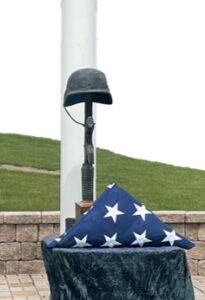
Folded flag and helmet sculpture

Until that time, let us honor the Vinnies who served and lost and the Johns whose lives are forever lived in remembrance.

Please join the conversation by leaving a comment below.

If you enjoyed my writing, please click the button below to subscribe to receive 1-2 posts per week, no ads, no affiliate links and I will never sell, trade or otherwise distribute your information. You can unsubscribe at any time by clicking unsubscribe on the email.

A Friday Some Years Ago:

9:00. Phone rings.

“Hello? Oh, Hi Ken…”

12:00 noon. Phone rings.

“Hi Ken, what’s up?”

4:45 p.m. Phone rings.

“Hi Ken… Say Ken, Are you checking on me?”

“Well, actually, yeah. When I work from home I only get about two hours of work done all day. What with the kids and the dog, trying to work from the kitchen counter, and the TV, and computer games. It’s very distracting. We pay you quite a lot and I was just trying to see if you are actually working.”

“OK, Ken, I get it. But I’m in my office on the second floor of my house. It has a desk, phone, files and computer. There’s no TV. I have no games on my computer. My kids are grown and don’t live with me. The dog is old and goes out before work and after. Besides Ken, I only charge you when I’m actually working. We can review the training I wrote today if you’d like.”

“Well, I’m headed home; can you email it?”

“Sure.”

My client was new to the job and he had inherited a consulting team. To him it was easy to see us working when we were on site, but given his personal experience working from home, he couldn’t imagine us working productively on Friday, when we weren’t on site.

In fact, for certain kinds of head-down individual work, I got a great deal more done on Fridays than I did during the week, when I had to attend meetings with clients and build commitment to change. However, I understood that many managers in offices shared Ken’s experience and the concerns that arose from it.

Then Came Covid

Durin the coronavirus pandemic, workers in factories, healthcare, first responders, retail, and food service risked their lives and office workers learned to be productive “working from home.” Office productivity didn’t suffer as expected and office workers liked the flexibility, the lack of wasted commuting time, and not wearing pants on Zoom calls.

I retired in 2018, so this really didn’t affect me directly. I heard about it from my kids. One time consulting colleagues called to ask how I worked as an independent consultant. People asked about my home office and what the IRS required to deduct the set-up of a home office, (dedicated space, documented use, and expense receipts). I started to see jobs advertised as “remote,” or “hybrid.”

Some people figured out they could work from anywhere and you saw magazine articles of people working from the deck of their beach house. I was always jealous of that because I didn’t have a beach house.

Some people complained about the isolation of Covid-time. As the pandemic died down, some people reminisced about standing on balconies of city apartments banging pots in support of first responders and healthcare workers. Covid was something that affected us all, a unifier after a time of division.

Then Covid was (finally) over

Well, not really over. Covid is still around. We’re just done with it, over it; Covid is so four years ago. For the last four years, there has been a discussion building.

“OK everybody, it’s time to return to work.”

That one pissed off all those workers in factories, healthcare, first responders, retail, and food service who risked their lives.

“We never stopped working.”

So R-T-W became R-T-O, “return to office.”

Some were enthusiastic; some were less so. Sure, there would be less isolation, but more colds and flu (and Covid whispered the risk averse). And then there is wasted commute time. And then there is the flexibility of working when I want. And then there is the fact that I don’t have to stay late because Mary bent my ear about her mom, and Ted just had to relive the highlights of the big game, etc.

“OK, well, what about two days per week?”

“Maybe.”

“Three?”

“I don’t know.”

It’s been a long four years.

This conversation has been slowly accelerating. I must admit that, Boomer dinosaur that I am, I wasn’t particularly won over by the Gen X, Y, Z, Alpha whines about commuting costs and cleaning bills for the pants they would now have to wear. I also thought that some workers were being clearly unreasonable in their demands.

My nephew runs a retail food business and told me about job applicants who asked if they could “do the retail floor job remotely.” Some jobs require face time.

Culture is built by being together. Teams function best if they actually know each other. I began to hypothesize that introverts would want to work at home but extraverts would want to return to the office. It turns out there is no evidence of that.

I have had more and more conversations recently with office workers, people I respect for their intelligence and projected competence, who say, “If they insist on 5-days-in-office, I will leave.” Or “OK, I’ll come in for 9:00 and leave at 5:00, but there is no working till 7:00 and no calls on nights and weekends.”

There have been some famous CEOs who have gone public “R-T-O or else!” At a recent cookout, huddling under a canopy during an inconvenient downpour, I was engaged in conversation with the manager of administration for the board of directors at a money center bank.

“My CEO is friends with another CEO who has drawn a very public line in the sand, but my colleagues, my boss and three quarters of my staff will walk if he enforces the RTO mandate. Most of the board are off site and 90% of my work is email and phone. I have to be here for board meetings and two or three days a week is reasonable. Five is a hard “No!”

I began to think that managers, even CEOs, who insisted on a 5-day RTO mandate, might be driven by their own convenience  ̶  “I want to turn around an give someone a job directly. I don’t want to find out they’re ‘shirking from home’ and have to call them.”

Then, in today’s New York Times, I came upon an article by Adam Grant, et al, at the Wharton Business School, that quotes research, that demonstrates that:

“ One: Return-to-office mandates don’t increase profits by weeding out people who lack commitment. They motivate the most talented people to jump ship. Two: As long as people are together for half the week, remote work isn’t isolating. And three: Hybrid work isn’t bad for performance, innovation or connection. “

Grant et al go on to describe how adamant RTO mandates are most often pushed by narcissistic managers that require constant attention, as demonstrated by the size of their pay packages, offices, and their photos in the annual reports.

So where does that leave RTO?

It depends. There are clearly some jobs that require presence, just like first responders, and retail workers, if your job has a face to the public, well, you gotta face the public. If your job has more individual than team work, you might have more of an argument for remote or hybrid work.

If you are a manager, who just can’t get over the fact that, “Hey, I got up every day and went into the office. I sucked up to my manager and now its my turn,” then maybe look in a mirror. Get over yourself, and see how you can lead change three days a week or on Zoom without any pants.

You may also like. . .

Sacrifice

Sacrifice

My Memorial Day verse was not published the first time I tried, seems I’m cursed by technology’s worst. Here’s hoping this remembrance burst makes it now.

read more

Please contribute your thoughts in a comment. The author will be notified, but may not respond to every comment. The site reserves the right to delete comments it deems off topic, offensive, or spam.

1 Comment

  1. Bob Musial

    A very touching tribute, Alan.

    I was in the Army Reserve during Vietnam, but my unity did not get called up for deployment to Vietnam.

    Like you, I too believe in John Lennon’s lyrics.

    And, I’ve always had and still have, deep respect for those who serve and have served.

    Reply

Submit a Comment

Your email address will not be published. Required fields are marked *