

“It was a shiny black button in the center of a light brown wood box.”
That’s how the story began.
Miss Dixon was my fifth grade teacher. She was older than my parents who were old compared to my friends’ parents. My mother was forty nine then and my father was approaching his fifty-third birthday. I was ten.
Miss Dixon seemed ancient. She made sure we knew that she was Miss Dixon and sternly corrected any who mistakenly called her Mrs. Dixon during that first week of school.
That Friday in early September, Miss Dixon said, “You have some homework this weekend. Oh, stop groaning, it won’t take you long and it will be fun and it will help me get to know you better.” We groaned again.
“Write me a story,” Miss Dixon said. “You can write about anything you want – your family, your summer vacation. But give me some detail, for goodness sake – none of this ‘We went to the beach. We had fun. The End,’ stuff. Describe things to me so I can see them. Tell me how you felt. Fill up at least three pages in this blue book.”
“And don’t think you can just write big. Write me a good story.”
“Alan doesn’t do his homework” was starting to show up on report cards. I believed that school was school – but at home, your time was your own.
Miss Dixon wasn’t an adult I wanted to cross, though. Her salt and pepper hair was pulled back in a tight bun. She had two deep vertical lines between her eyebrows from disapproval when someone acted up or called her Mrs. Dixon. I wrote a story.
“It was a shiny black button in the center of a light brown wood box. I didn’t know how the button worked. It probably had something to do with the little copper posts I could see behind my ears when I brushed my hair in the morning. The posts showed up after Mom took me to the doctor last month.
‘They’re to help you study in school, honey,’ she said.’”
The story was called “The Happy Button.” I don’t remember struggling to write it, and as far as I can remember it was my first piece of creative writing.
The story went on to describe the happy button’s effects. “When I pressed the button, whole hours went by and I didn’t even notice. I just felt good, like having fun on a summer day, but it wasn’t summer and my friends didn’t have to come outside.”
I wrote entirely in first person, present tense. I wanted to use the happy button more. “After you do your homework,” my parents said. They began to limit my use of the happy button to an hour a day. I began to sneak around and press the button. Mom and Dad hid the button, but I found it on the top shelf of my father’s closet. Dad wasn’t happy and hid the button again.
The story ended with the appearance of another button.
“This one was shiny too, but it was red. It was in the center of a dark wood box.
When my father pressed the red button, it hurt. It hurt a lot.”
I handed in my blue book on Monday. I was very proud. I had used up five pages, writing even a little smaller than usual.
At the end of the day, Tuesday, Miss Dixon handed our stories back. At least she handed back everyone else’s. “All right, class. Here are your stories. Some of you listened very well and wrote good stories. Some of you will have work to do this year.”
Miss Dixon asked to see me after class. “Alan, did you write your story by yourself?” she asked, her scowl lines were visible above her nose as she looked down at me over her red plastic-framed glasses.
“Y-yes,” I said.
“Well, I’m not quite done with it. I’ll give it back to you tomorrow.”
“Okay.” I left to walk home.
The phone rang at dinnertime. My parents hated when people called during dinner. My mother answered curtly, about to ask the person to call back. My father, my sister and I sat at the dinner table with meat loaf and green beans getting cold, listening to my mother’s side of the conversation.
“Hello…Oh. Well hello, Miss Dixon.”
“No. I know he did some homework on Saturday…No…I didn’t read it… as far as I know… I see… Disturbing? I see. Yes, of course, Miss Dixon. Thank you for calling.”
We ate dinner. I wondered why my father didn’t complain that the food was lukewarm. My sister Connie kept giving me quizzical looks, mouthing, “What did you do?” I shrugged. Near the end of a mostly silent dinner, Mom asked, “Connie, did you help Alan with his homework last weekend?”
“What? No. I had my own homework to do.”
After dinner Mom and Dad had a brief pow-wow and I went to the living room to watch TV.
“Isn’t Miss Dixon your teacher?” Connie whispered. I nodded. “What did you do?” I shrugged again.
Then Mom and Dad asked me to come into the kitchen. Mom told me that Miss Dixon had just called. “What did you write for your homework?”
“I wrote her a story. That’s what she asked for. She said, ’Write a story and give me some detail, fill up three pages in the blue book’ she gave us. I filled up five pages.”
“Did you swear in your story?”
“No, of course not. Who swears to a teacher?!”
“Don’t sass your mother!” snarled my father.
“Miss Dixon wanted to know if you wrote the story yourself.”
“I did. She asked me that too. What was wrong with my story?”
“She said it was ‘disturbing.’ Was it a true story, Alan?”
“No, it wasn’t a true story, Mom. She didn’t say it had to be a true story.”
“You told a fib at school?!” growled my father.
“No, no. It was a story, like some of the stories you tell us, Dad.” My father was an entertaining yarn-spinner.
“Well, Miss Dixon said you didn’t follow the assignment, Alan. She is going to ask you to do it over.”
“That’s not fair! She didn’t say it had to be a true story. She said fill up three pages and I filled up five!”
“You will respect your teachers! Or do I have to make sure you understand?” My father pantomimed removing his belt. I got the message.
“Okay, okay, but it’s not fair.”
The next day Miss Dixon handed me my blue book at the end of the day. “The Happy Button” had a big red “I-C” across the top (incomplete). Under that she had written, “DO OVER!”
That night I wrote an effusive essay about how “I really liked my red Columbia bicycle. The wheels were twenty inches, the seat was brown and I could ride all over town with my friends.” I filled up exactly three pages. She handed it back the next day marked “‘’A -’ – much better!”
As instructed by Miss Dixon I gave “The Happy Button” to my parents. I never saw it again. I half-expected to find it when I cleaned out my parent’s house forty-one years later – my mother saved everything – but it wasn’t there.
At ten I had no idea what Miss Dixon found so disturbing about “The Happy Button.”
Perhaps she saw a foreshadowing of my addictive personality, which started with TV and sugar and led to challenges with cigarettes, alcohol and drugs in college. (Some people experiment with substances in college; I wore a lab coat for four years.)
Perhaps, in the black and red buttons, she saw my lifelong discomfort with carrot-and-stick “performance management.”
Perhaps, because I groaned loudly at the mention of homework, she thought that my story was a thinly veiled political statement about adult-child power differential. Okay, maybe not.
Perhaps she just saw a rebellious ten-year-old boy not meeting expectations. Guilty.
To my ten-year-old self, “The Happy Button” was about television.
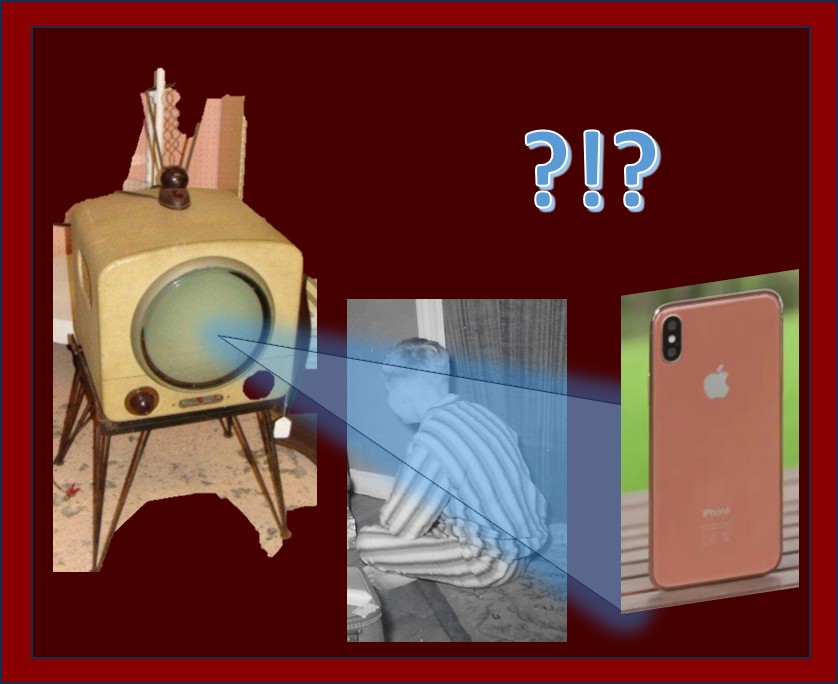
We were the last family in our neighborhood to get a TV. In fact, we didn’t buy one; our neighbors got a new seventeen – inch TV and gave us their old one, a fourteen-inch blond wood box with a nine inch round screen. This was 1957 and the Coopers thought it was a shame that we were missing Gunsmoke, and The Danny Thomas Show. We became a TV household.
My parents watched the news and comedies. I watched westerns, and more westerns.
People in my family are easily sucked into the flickering television. If it is on, we cannot not watch it. I also liked the stories. I loved watching the gunslinger Paladin, (craggy-faced Richard Boone) in Have Gun Will Travel tell the fresh-faced farm boy, “Son, you might not want to challenge a man you don’t know. A gun is a last resort, not the first.”
We had parent/child conflicts about “screen time,” not called that, of course. Saturday morning cartoons? “Tell David, I’ll be out when this is over.” “Alan, you are watching too much TV. It’s a beautiful day. Go outside and play.” Homework? “I’ll do it after.” Bedtime was hard. “Just one more show, puleeze?”
So “The Happy Button” gave voice to those battles and a ten-year-old-boy who wanted to be entertained – all the time. I didn’t consider the larger issues of how television and the entertainment industry were reshaping society until much later.
In the early 1980s, I observed what Neil Postman wrote about in his 1985 book Amusing Ourselves to Death: Public Discourse in the Age of Show Business. Driven by shared technologies (radio and television) the communications and entertainment industries were merging. I called this Comm-Ent; others called it infotainment.
The organizing principle of communications, what Postman called the “media metaphor,” used to be “’Just the facts.’ Is it true?” The entertainment organizing principle is “Does it hold my attention? Can I suspend my disbelief?” During my lifetime, the entertainment questions, won.
I have seen a steady progression of comm-ent technology hardware: transistor radios, black and white and color cathode ray televisions, plasma screens, LED TVs, Mainframes to minis to desktops to laptops to tablets to smartphones, LPs and reel to reels, to 8-track, cassettes Walkmans, to CDs and DVDs to Watchmans to smart watches, video games, virtual reality, and Neuralink.
I have lived through westerns, and sitcoms, game shows, talk shows, and documentaries, blogs, vlogs and podcasts, reality TV, fake news, Photo Shop, artificial intelligence, deep-fake video, and AI singers on You Tube
Yesterday, I walked past a young boy seated on a curb in the shade. He was about ten. I said hello. He didn’t look up. I noticed coppery things in his ears and immediately flashed back to the electrodes behind the boy‘s ears in “The Happy Button.” I soon realized this boy was looking at a rose gold iPhone and had wireless earbuds of the same color. Playing a game? Watching a show?
I said hello again. Again he didn’t respond. I thought of Miss Dixon’s reaction to my story.


Good morning, Alan.
Another great story, good sir.
These words especially resonated with me: “During my lifetime, the entertainment questions won.”
They took me back to the fall of 1971, when I read Understanding Media by Marshall McLuhan. It was assigned by my high school government teacher, Mr. Hairell, who wanted us to understand how television and media would shape politics.
One quote from McLuhan has stayed with me ever since: “The medium is the message.”
All these years later, we are watching that idea unfold right before our eyes. The technology or platform used to transmit information shapes human experience and society far more than the specific content being delivered.
Your last paragraph about the boy with the gold iPhone said it all.
Maybe I am a dinosaur who has not fully realized that the asteroid has already hit the planet and we are all slowly dying off. But I will admit this: I am not comfortable with much of what I see in our modern electronic communication.
At the same time, I suspect the genie is out of the bottle.
Who knows how — or where — this will end?
What a great comment, David!
This trend towards entertainment taking over communications, theatrical truth eclipsing Truth isn’t new. You can trace a through line from Randolph Hearst’s “yellow journalism” sell the Spanish American War through PT Barnham through The Apprentice to the selling of AI Agents.
The McLuhan “Medium is the message” quote calls the game -the underlying infrastructure, hardware and software has turned us into a “watcher species” reducing our agency through spectatorship.
This is old news in that it has been written about and talked about for fifty years or more, but no one seems to want to stop this train.
Thanks again.
Good Morning Alan –
Love what you said about the unwillingness of society to stop this train. Your words are at the heart of the struggle we face…