
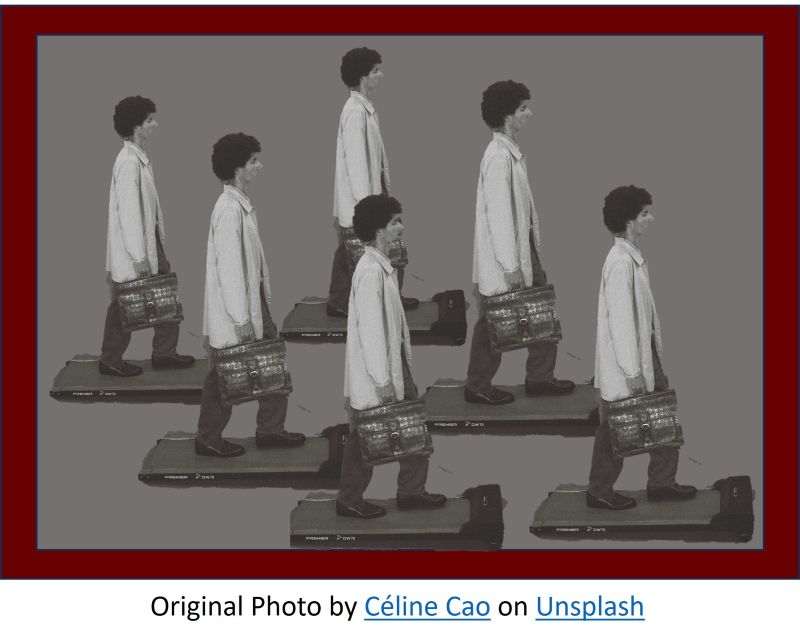

My Tyranny of To-Dos
I’m staring at a yellow 3”x5” index card with a scribbled list of tasks. I have a love-hate relationship with my To-Do list, on balance though, it helps me GSD, get stuff done. (I usually say this less politely.)
Here are prescribed tasks broken down from my goals concerning my new career, a new writer in an old body.
There’s stuff about writing, editing and publishing this blog, and writing on LinkedIn, Medium, and BizCatalyst 360°. There are the tasks around marketing my existing books, email mailings and ads. There are project activities for the publication of my next book of personal essays and memoir stories. There is the fourth book in progress. Then there is the forever procrastinated fiction.
I have two songs awaiting copyright application and the forever put off guitar lessons. I play pretty much every day and am getting slightly better with practice, but I am not practicing technique the way I should, and missing a day or two feels like starting over.
Then there are the maintenance tasks of everyday life, and relationships, and…
Whew! I may need a nap.
So, … this is retirement … How did I ever find time to work?
My Productivity Focus Origins
I look at this index card and wonder to myself, “Where did this come from?” And then I remember the index cards in the top pocket of my dad’s shirt, and exclaim out loud, “oh, my God! I’ve turned into Him!”
I’ve remembered and written a lot lately, about my father’s “teach ‘The Boy’ to work project,” which started when I was about eight and continued till I was fifteen and found my own jobs. His project worked. I turned from someone who never wanted to work to a gung ho, all in fool who would work hundred hour weeks for bosses. I may have been the only person ever who started a solo consulting practice so I could work less.
My sister is eleven years older than me. We talk on the phone, and complain a lot about not feeling “productive.” We mean we’re not GSD, “getting stuff done.” Today, I asked her where that came from.
“Mother.”
I do remember my mother talking about being “productive,” perhaps the outcome of being a working mother, who still cooked all the meals and cleaned the house, and canned or froze the produce from my father’s vegetable garden.
She measured her own output, meaning getting stuff done, and any of her own wheel spinning made her cranky, and slacking on the part of her husband or children made her crankier.
She would talk about her mother, Ola, “the smart one, who taught school from the age of fifteen without the benefit of a college degree, ran a boarding house and restaurant, and raised six children. Ola had no patience for not getting stuff done.”
Today my sister and I agreed we come by our focus on productivity honestly, maybe not genetic, but embedded deeply in our upbringing across multiple generations.
American Productivity
Americans are obsessed with productivity. We have such a weird relationship with work, which comes from our Puritan Calvinist past. John Calvin espoused the values of diligence, discipline and frugality. Hard work and the success that came from it were evidence that God had chosen this worker for salvation.
In 1905, German sociologist Max Weber wrote The Protestant Work Ethic and the Spirit of Capitalism. He attributed the growth of capitalism to the views of John Calvin toward work. He saw that the preaching of work as a calling led to capitalizing labor, mechanizing labor to reduce the cost of inputs and maximizing outputs.
“The Puritan wanted to work in calling; we are forced to do so….Perhaps it will so determine them until the last ton of fossilized coal is burnt.”
Weber could have been reading America’s mail.
Discussion of US productivity for the last hundred and fifty years has centered around a parade of technology, extraction, basic industries, mass manufacturing, transportation systems, energy infrastructure, mass media, computerization, digitization, and now artificial intelligence.
All of this capitalization of labor hasn’t meant Americans work less.
My mother went back to work when I was eight because they moved to an upper class, good schools town and they couldn’t afford it on my dad’s salary. Most of the mothers in my neighborhood didn’t work.
In the 1950s when I grew up, less than 30% of two parent families had two incomes. Today both parents work in 52% of two parent homes, even though much of that extra income is spent on childcare outside the home.
Double income parents I know spend a lot of their “free time” carting their kids to enrichment activities, sports teams, or arts lessons, or cooking classes, etc. Some of that is caused by the guilt of working, and some by the instant gratification culture spawned by the explosion always-on-computer-communications-entertainment-media.
Is any of this productive? Are we getting stuff done? Does that stuff need to be done? Are our lives any better for all this activity, all this busy-ness, all this business?
Whatever Happened to Boredom?
I remember lying on the ground looking at the shapes of clouds, a lion with his mouth wide open.” I never really minded being bored. It taught me to amuse myself. I remember throwing various balls in the air to run and catch them, or bounce them against the house, if no one was home to yell at me.
Boredom is sometimes productive. In the late 1660s, Isaac Newton, home from Cambridge University because of an outbreak of plague, had nothing much to do. Sitting in his mother’s garden at Woolsthorpe Manor, Newton observed an apple fall from an apple tree.
“Why does it always fall towards the center of the earth, and never sideways or upwards?” He mused. Newtons boredom paid off in the theory of universal gravity.
Frida Kahlo started painting because she was bored during recovery from an accident. Percy Spencer, a Raytheon engineer, got bored testing a magnetron tube for radar systems and noticed the chocolate bar in his pocket was all melted. He invented the microwave oven.
I wrote my first piece of creative fiction because I found “What I did on my summer vacation” a topic too boring for words.
It turns out that neuroscience research has documented that boredom, “the mismatch between brain inactivity and the cognitive engagement of your current environment” triggers creative brain activity. Who knew? (I mean besides every kid who ever said “Let’s do a show.”)
Now we have artificial intelligence
I am repeatedly told that AI is “just a tool” to help us be more productive. AI’s job is to GSD, faster, cheaper, if not better than humans. Some say it will obliterate all white collar work, all human work, or all humanity itself.
Ah, just saying, that might be productive, but it doesn’t seem to be a good tradeoff for GSD. Maybe it’s time to be a little less productive, a little less busy, bored even. And see what else we can come up with.
Further reading
Jacob Caxon on X “I resigned from Anthropic today. I spent the last three years doing pretraining research at both OpenAI and Anthropic. Neither company is acting responsibly.”
Dario Amodei, CEO of Anthropic published his plan to slow down AI development through Embedded Evaluators, Democratic Coordination, and Global Coordination.
My blog on Work?


0 Comments