

“Fix or repair guy”
I’m a “fix-or-repair-guy.”
I differentiate this self-description from a “throw-away-and-buy-new-guy.”
Rapid replacement of broken items is, without a doubt, the more efficient course of action. I might spend two to ten hours repairing something that I could reorder from Amazon in under 30 seconds. Silly.
There is evidently some other criterion at play here. Questions of efficiency and pricing my time never rise to the surface. I’d just rather fix it. It’s fun.
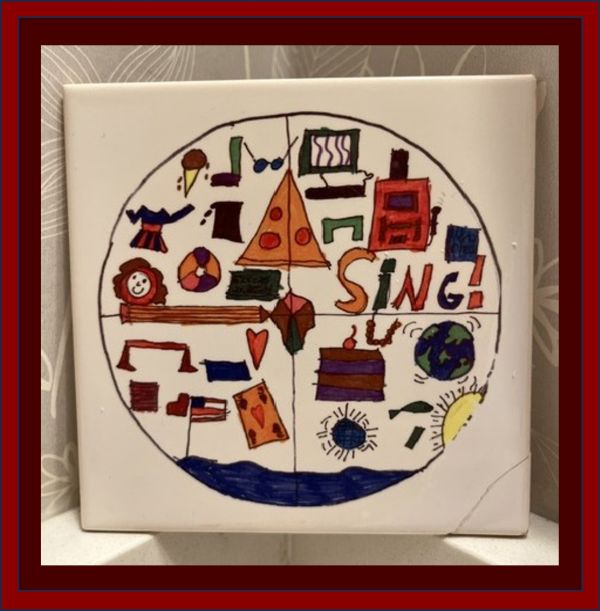
This week, the cleaning ladies dropped a hand painted tile made by Billie’s now thirty-something niece when she was about nine. A corner broke off.
“Don’t worry. I’ll give it to Alan. He likes gluing things.”
This morning I glued the corner back with a gel superglue made by Loctite. I got a sense of satisfaction entirely out of proportion with the size of the task. I felt useful, productive.
My only small regret is the slightly visible crack. I wish I still had “White-Out,” the liquid I used to correct typos in typewritten documents in the 1970s, a more useful crack cover than the paint I may end up using. Being a tad obsessive and a “fix-or-repair-guy” can be a sticky situation.
OK, the tile can’t be ordered from Amazon, and I didn’t spend very long on it so far, and, after all, I’m retired and no longer measuring my life in billable hours. So maybe I can forgive this little guilty pleasure.
“He likes gluing things.” Apparently, it’s a part of my role in my marriage.
But not for everything.
“Don’t glue that.”
“I can use epoxy; it’ll be stronger than a new one.”
“Alan, It was $5.99. It’ll be here tomorrow.”
“OK.”
I didn’t glue the toothbrush holder. I didn’t repair the Dustbuster. (It was ten years old and didn’t work very well anyway.)
In my DNA
I inherited my “fix-or-repair-guy” orientation from my father. Because he knew how to repair the brushes, when he died there were eight repaired electric motors from discarded refrigerators and washing machines in his basement.
Dad was a fan of Duco Cement. He told me several times how Dupont changed the automotive industry by selling Duco lacquer to General Motors in the 1920s ̶ “quick drying color paint made GM. Fords were all black.” Duco lacquer evolved into an acrylic adhesive. “Handyman in a tube,” he called it.
At his direction I used Duco for the plastic model cars I built in my tweener years. The Duco tube made it easier to use than the bottle-‘n’-brush glues that came with models until teenagers discovered glue-sniffing. Duco was stronger and quicker drying, which could be a problem if you made a mistake.
If you used too much glue, Duco didn’t dissolve as easily with a light acetone dilution as did Testor’s Cement, and full-strength acetone melted plastic model parts, a lesson I learned more than once.
Dupont ultimately licensed the Duco brand to other manufacturers. It’s still around today, and I have a tube in my workshop and one on my kitchen repair shelf.
All glues are not the same
My father taught me about different glues. He recommended hide glue for furniture repair. When I worked in the college theatre I learned that hide glue was used for building and sizing stage flats of wood-framed canvas. There was always a foul-smelling gluepot on a hotplate when we worked.
Dad advocated rubber cement for bicycle tube patches, and “bendy stuff.” My first wife and I made a “quilt rug” for our dining room by rubber cementing shapes cut from carpet samples to a canvas backing. It took us an entire winter day. We collapsed on the floor laughing and realized we should probably have opened some windows. This is one of many brain-cell destroying activities that explains my current mental condition.
First and second grade paper projects used “library paste,” which was thankfully water soluble, though not always easily. I remember traumatic experiences having my hands and face hard-scrubbed. “What did you do, take a bath in this stuff?”
By third grade, we had graduated to Elmer’s. That white goo got everywhere. The Borden Chemical Company was forced to produce a more water soluble version, which didn’t stick as well, but didn’t need to be sand-blasted off desks or make you throw out your favorite tee shirt.
Today, I’m a fan of superglue, which wasn’t around when I was growing up. It’s fast drying and sticks everything together in less than ninety seconds. Yes, I have glued my fingers together and occasionally had to either cut them apart or dissolve the bond with nail polish remover, a light solution of acetone and alcohol. Take it from me, superglue and acetone of any strength is not good for nylon, polyethylene, blended fabrics or acrylic eyeglass lenses.
I also use five minute epoxy, when you need a really strong bond. I’ve used five minute epoxy to repair hammer and ax handles, broken wood and plastic parts. I glued a broken antique garage door hinge, which is apparently still holding fifteen years later. I have used it to glue pieces of disparate materials together in a sculpture.
The downside of epoxy is its permanence. If you ever need to get it apart you may be challenged. When epoxy is wet, it is removeable with acetone. In early hardness, there are removers that work. After epoxy really cures, you need a heat gun and chisel.
Gluing halls of fame and shame
If you are reading this you may already know that I’m a weird guy. I regret things I didn’t glue.
When we lived in New York City, a tiny pottery vase my mother made fell off the kitchen table and shattered into more than fifty pieces. It wasn’t a particularly attractive vase. We lived in an apartment and I didn’t have a workshop. It broke in too many little slivers. I deserted my gluing responsibility. I still feel kind of bad about that.
A gluing project I feel good about is “The Head of the Culler Family.”
In his retirement, my father was a volunteer artist model at a town Arts and Crafts Society. One artist sculpted his head in bronze-painted plaster and it had a position of pride in his home. When he died, no one wanted the head, but no one wanted to throw it away. My nephew suggested that Grampy’s head go on a visiting tour. So he “visits” one of us for from three month’s to three years. Then we deliver him to his next home.
People take pictures of him at parties and local attractions. There is a photo album that accompanies the head.
My father loved to travel, but this way no one has an unwanted houseguest for too long.
I shipped him to another nephew across the country. UPS or FedEx dropped him from some unknown height and he shattered. My nephew shipped the thirty or so pieces back to me, and using a combination of epoxy and superglue, I reassembled him. I resculpted missing bits with plaster and repainted him bronze.
I also filled the hollow head with plaster for reinforcement and built a gun-case-foam-lined plywood box for shipping. This means his visits are longer because moving him in his crate takes two strong people and shipping expense has risen to hundreds of dollars.
I don’t think Grampy minds. He has become a fun glue that holds our family together.



Love this story Alan! It absolutely resonated with me and reminded me of my days at Union Carbide and later Dow Chemical.
One of my good friends who was in maintenance used to tell me – “We will fix it with bailing wire and duct tape.” He had a good point – glue, bailing wire, zip ties, string — you name it — all is fair game in the goal of fixing something!
Hi David
I have used my share of duct tape.
https://wisdomfromunusualplaces.com/the-quick-fixll-git-you-ef-you-dont-watch-out/
Maintenance is tough work
Thanks again for your comment
Alan