

“Is the World Ending?”
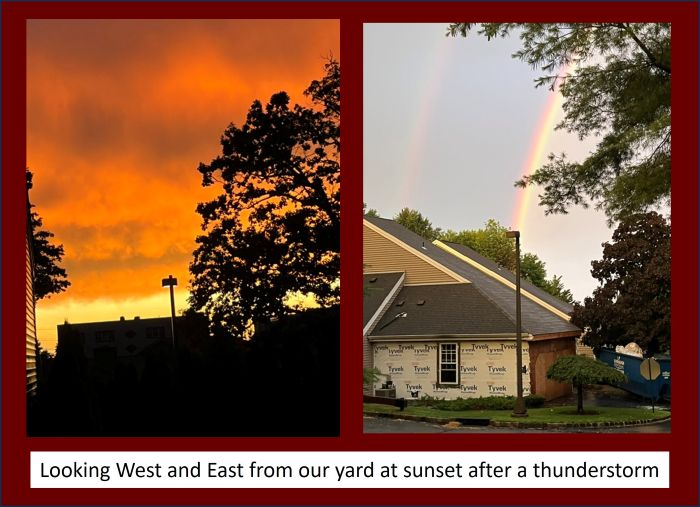
It was midnight dark in the middle of the day. The sky was an almost black gray-green, but the air… the air was the color of a school bus about to vomit.
I called down the hall from my office to Billie’s. “Is the World Ending?”
“What? Oh my God! It sure looks like it.”
We went outside into a between-dimensions scene. The orange-green-glow made everything stand out like we were wearing 3-D glasses. The sky was beyond ominous. We were in a no-wind-before-BIG-WIND-zone.
We live on the Ridge, the first 1500-foot rise west of Newark Bay. Topping the two mile hill on I 280 between East and West Orange, there are 100-foot granite cliffs on either side of the road. At the top of the left cliff, where our condo complex is, we get a steady 8 mile per hour wind with 60 mph gusts in a storm.
We quickly discussed whether or not we should put the car in the garage.
“Probably a good idea.” I went for my keys.
Then horizontal chain lightning flashed across the sky. I remembered the old Farmer’s Almanac test for how close the storm is, five seconds/mile. 1…2…KRAAACABOOOOOOOM!
I’d just gotten the car inside and closed the garage door when I heard it start pouring.
“Are you seeing this?” The end of our 15-foot front walk was hidden behind a silver curtain of deluge.
“Houston rain.”
When I worked in Houston I was shocked by rain that fell so hard you couldn’t see a car length and yet drivers on I 10 never considered whether or not to slow from 70 miles per hour. It seemed like every year a motorcyclist drowned while taking shelter under an overpass, or an SUV driver didn’t consider whether or not that puddle was deep until crashing into a submerged F150.
We don’t usually get “Houston Rain” in New Jersey, but it’s happening more and more. This storm was the first after our roof was replaced, and I wondered whether or not the roof and the bathroom skylight flashing would hold. It did.
“Weather. Isn’t it nice we’re having it.”
When I was a booking agent for celebrity speakers in Boston, Suzy Chaffee, the US Olympic ski racer was one of our clients, and I picked her up at Logan airport on what had been a sunny June day. When we were caught in a light spring shower that neither of us were dressed for, I apologized for leaving my umbrella in the car. Suzy raised her face to the rain and said,
“Weather. Isn’t it nice we’re having it.” What a great attitude.
Now, extreme weather is forcing more whether or not choices, whether to pull over, shelter in place, or push on, oblivious to risk.
We hit 100 degrees Fahrenheit (almost 40 Celsius), and then half that the next day. We are getting more and more rain. There is flooding in the valleys between our Ridge and New York City, and a big tidal storm surge on the Jersey Shore.
We get calls from friends and family around the country asking if we are “treading water,” given the TV news flood reports. Noting our elevation, I reassure them, “If we are underwater New York is gone.” Still, where we live isn’t without risk.
I have always loved thunderstorms. These are a little scary. Recently, I was watching one from safe inside, and I saw a tree-width size lightning bolt strike the field about 200 yards away. “Yikes,” I exclaimed, doing involuntary Kegel exercises. There are disadvantages to the Ridge.
Playing Twister
Recently, during another green-sky-orange-air moment, our iPhones jolted us with a fog horn with squeezed testicles scream, three loud blasts, a pause and three more.
Looking at my screen I read: “Warning! Tornados in your Area! Go to a safe place below ground for the next 45 minutes.”
“What? Are we suddenly in Oklahoma? We don’t get tornadoes in Jersey!”
Our condo has no basement, so I was deciding whether to continue writing in my office on the second floor just below the roofline. Billie, who is considerably more risk-averse than I am (read smarter), said,
“Come-on. Let’s go to the first floor powder room.”
So we spent the next 45 minutes discussing how much we liked “the gray and white flowered wallpaper,” and lamenting that the tile contractor “hadn’t sealed the white grout between the hexagonal tiles.”
Neither of us brought up the Kentucky woman on TV, who marveled at a pristine wedding photo with unbroken frame, retrieved from a pile of splintered wood, the remains of her home just rebuilt after it was destroyed by a tornado last year. She teared up when asked whether she would rebuild again or move.
“Everybody talks about the weather; nobody does anything about it.”
Some years ago, NY Times columnist Tom Friedman said we should stop using the words “Global Warming,” and “Climate Change.” Instead we should talk about “Weather Weirdness.” He maintained that it was more likely to get people to talk about whether or not we should do something about the weather. Then we might fund better emergency management or build pipelines for redistributing water from flood zones to areas rationing water.
“Calling it weather weirdness” might get us to think about whether we should grow our food in the place where they write songs about the lack of rain, “They say it never rains in Southern California.”
And maybe we should talk about whether we could do something for the half the country that now has two seasons, Ice and Fire, other than tariffs on our nice northern neighbors with a bumper crop of smoke.
We might decide whether to try an “all of the above” approach to energy production because with AI we’re going to need whatever we can get. Maybe we should tighten natural gas wellheads and stop flaring methane from oil production and refining. We don’t know whether that would help the weather, but it probably wouldn’t hurt.
My once brilliant math-whiz mother lived in a nursing home in her nineties. Her dementia came and went, but caregivers often missed her moments of lucidity. They’d always greet her with the same faux-cheerfulness.
“And how is Nan on this beautiful (or rainy, or cloudy) day,” not really listening to any response.
She’d get cranky and snarl, “Everyone talks about the weather; nobody does anything about it.”
We don’t need to decide whether we’re going to innovate our way out of weather weirdness or conserve some resources and see whether that affects the weather. We can do both.
We might decide whether to bequeath these choices to our grandchildren and wonder whether they’ll be more prepared to weather whether or not weather than we were.



Good morning Alan. I hope you are doing well. Your story resonated with me, especially these words – And maybe we should talk about whether we could do something for the half the country that now has two seasons, Ice and Fire, other than tariffs on our nice northern neighbors with a bumper crop of smoke.
Your comment about the rain and traffic in Houston on I-10 is so true!! Unfortunately San Antonio is just as bad.
What is disturbing – conversations about climate change have become politicized – one side of the aisle is filled with deniers and the other side wants to shut down all business. The data are clear – things are warming up and having said that – there is great debate on the cause(s). As a country and world – we need to stop debating the cause and instead focus on how are we going to mitigate the impacts of increasing global temperatures? That needs to be the battle. Not arguing with each other about the cause.
Hi David
You are so right. From our work in continuous improvement, we both know that there are often multiple causes for an effect. Things are getting warmer There is an increase in Methane and C02 in the atmosphere. Whether greenhouse gases are the primary cause or whether the shift in climate is primarily human-caused or not, can we try some ideas to reduce extreme weather.
Shutting down all business is suicidal in the shortest term. Putting our collective heads in the sand is suicidal in the medium to long term. But there are things we can do today. Natural gas currently priced very low, but it won’t always be. Does it make any sense to throw it all away by underinvesting in non-leaking wellhead caps. Oil is over $100/ barrel. Does that mean we should flare all the natural gas to pump oil?
Yes, lowering emissions from cars costs money, but isn’t cleaner air worth something too. Aren’t there some healthcare costs associated with particulate matter, C0 and N0.
There are many innovative experiments – carbon capture (Gorgon project), triggering artificial rain by seeding clouds with silver dioxide and salt (India), pumping water from beneath glaciers to refreeze on top to slow the slide (Antarctica) – that are unfunded.
Perhaps extreme weather is a symptom, but it affects us all. Relieving the pain of this symptom might unite us and free us to make improvements. You know, no one knows if chicken soup cures a cold either, but “it wouldn’t hurt.”
Alan, your writing always gets me (in a good way). I was right there with you guys during the storm (been in a few tornadoes myself) but I was able to peacefully enjoy your blow by blow without fear of getting wet or worse. Thanks man.
Thanks, Ed
Glad you liked it. Yeah, reading about extreme weather is always better than experiencing it.
People always say a tornado sounds like a freight train derailing in your living room
That does not sound cool.
A