
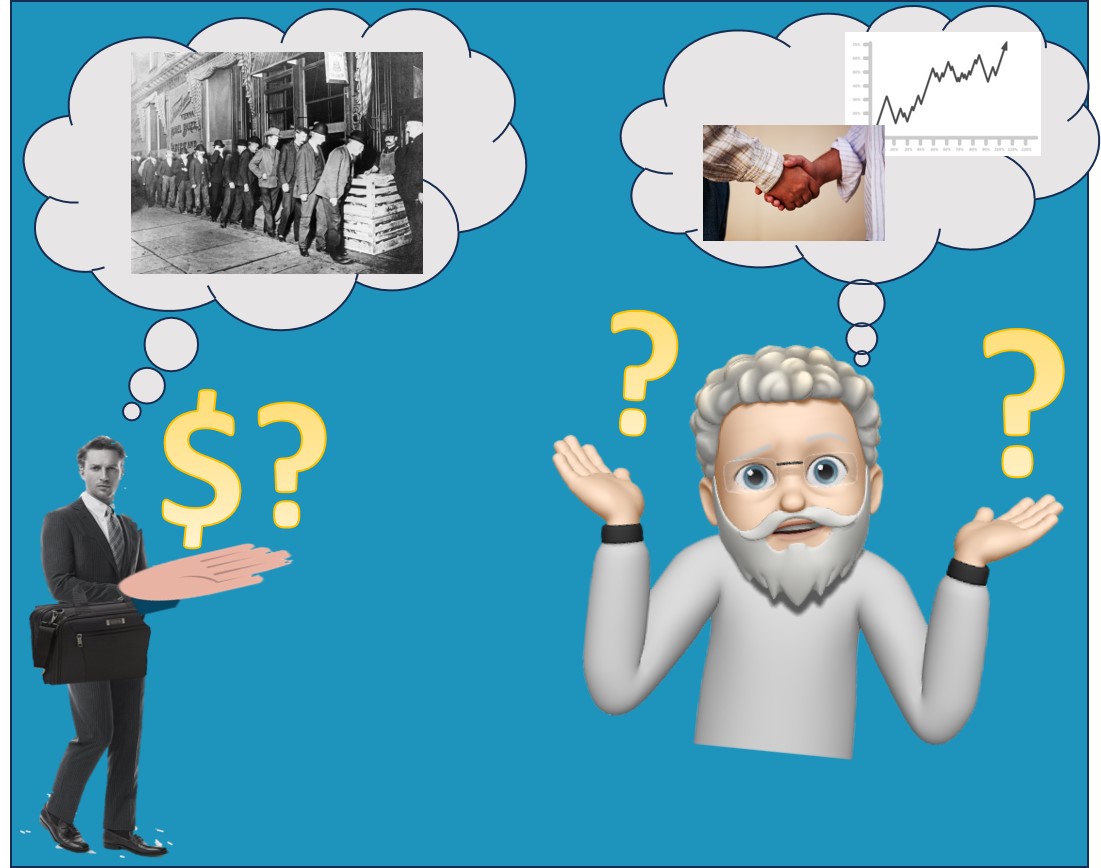

Is consulting having a bad year?
I used to diagnose consulting industry economics by the number of consultants who called me asking “Can I pick your brain?” Despite the unpleasantness of that visual, I usually took the call.
These consultants hadn’t been promoted and were being encouraged to “get on with the value-added part of your career . . . somewhere else.” Their first inclination was to become an independent consultant so they could “keep all the money.” Apparently they said to themselves “I know, I’ll call Culler and pick his brain.” In fairness, I was an independent consultant for twenty-three of thirty-seven years in consulting, so maybe my brain was ripe for picking.
Invariably, the first question these consultants would ask was, “What should I charge?” Sometimes, they’d ask “What do you charge?” ̶ perhaps thinking, “Hey, if Culler can get $X, I can probably get $1.5X.”
Are companies, universities, and government agencies downsizing this year?
When that happened I’d get calls from middle managers who had worked on a consulting project. They liked the work, if not consultants. They said to themselves, “These guys make a bundle, and they’re not so smart. I can do that job.”
These conversations would start differently, but soon get to the same question, “What should I charge?”
So why not just answer the question?
In both circumstances I resisted the urge to spit out a figure, a range, or a formula. When pressed, I’d say something like, “It depends,“ and move to what I thought they should know first.
I’d want consultants to understand that being an independent was wholly different from working at a firm. You did your own selling and client management. You couldn’t just “roll out the partner” if things went sideways. You were the partner and the delivery team. You had to do your own administration, make your own slides, do your own billing and collect when clients managed their cash flow on the back of your business.
To corporate managers, I’d explain consulting basics. It is about having a client, and actually helping that client increase revenue, increase profit, or solve a people issue.
You had to help, and you had to achieve results.
Yeah, I know there are a lot of consultants who don’t do either of those things, but you don’t want to be one of those people. It isn’t behavior that leads to longevity in consulting.
Answering the “What should I charge question?” depends on understanding the consulting industry and the role of independent consultants within it. I wrote Traveling the Consulting Road to explain the industry, and Chapter 34 “Becoming and Independent Consultant” to draw a roadmap for independents.
So what’s the answer?
It depends. On what?
Skills? Nope. Return on Investment.
I was at a neighborhood party and a family therapist poked me in the chest saying, “Look, we have the same skills. Why do you get paid what you get paid and I get paid what I get paid?”
I didn’t tell her that, while we both used incisive questioning, conflict resolution, and facilitation skills to help make change, I had some business skills and she had more training in psychology. I also didn’t say that what she did was much more valuable than what I did.
What I said was,
“If you are Michaelangelo, you have a choice. You can sell your art on the street or you can sell it to the Medici family. The Medici aren’t very nice people, but they do pay better.”
Then I got another beer.
Moving past my snark, what I meant was different clients pay different fees due to the availability of cash and return on investment. I had a business partner once who really wanted to serve companies with annual sales of $5 million. We did some of that. It was a lot of fun and we had huge impact. Then we realized we couldn’t pay ourselves a living wage.
What if you have contacts in the $50 million to $200 million market, and none in the Fortune 500. Resign yourself to a reduced fee structure or think about a fee structure that doesn’t depend on billable hours.
What about charging a percentage of results?
This always sounds like such a good idea. “You have a $500,000 problem. If I save you $500K, or generate equivalent revenue, why not pay me $50K?
Clients run the business. So the best strategy or operational improvement depends on client implementation.
When I worked at Gemini Consulting several partners sold gain-sharing projects. They didn’t work out well. Either the client didn’t take the actions needed to deliver the over-billable-time fee, or argued. “Hey, you got that idea from Bob. I’m not going to pay you for that.”
Still, gain-sharing is a wonderful concept. It’s why Bain Consulting partner Mitt Romney founded Bain Capital, to take an ownership position and share in the benefit delivered. However, private equity firms make money on average. They may lose on any individual deal, or ten individual deals, and then make a huge score. If you have enough money to do that, why on earth are you becoming an independent consultant?
So how much should you charge for real?
First, don’t do this.
Don’t divide your current salary by 260 days and charge that. That leaves no time off for anything. Some clients and consulting firms want to reduce their payroll and benefits costs by selling you on the “gig economy.” “You work when you want to. You get paid by the project.” Some states have passed laws that protect workers from employers who do that.
“Oh, I have severance,” or a “’buy-out’ And they want to pay me to work for them anyway. Why wouldn’t I take it.”
Oh, I don’t know. Have you priced health insurance? COBRA? Private insurance? Please.
I have to tell people who’ve worked for big companies all their lives that the benefits they are used to are outrageously expensive for an individual. I have to tell consultants that the two to four times salary, the multiplier they want to keep, pays for branding, fancy offices, all the things that help you get a meeting with a CEO to sell a project.
A simple formula?
There is no simple formula. “Yeah, but . . . “
OK, let’s assume you have at least one client who will fill 50-75% of your time for six months . . .
And you are aware of the business expenses involved . . . Do you need an office? If you can’t work at home without being distracted, yes. And you’ve got health insurance from your spouse’s job? And you know that you’ll have to pay both sides of FICA, the payroll tax, and create a vehicle to replace your 401K, etc.?
Then take what you want to earn annually . . . after all those expenses . . . and more I haven’t mentioned . . and divide it by 150 days . . . to leave time for marketing, administration, and a host of things you haven’t thought of yet.
Now reality-test that number it with some consultants and finally your client. If it seems reasonable to all, that’s your day rate.
Oh yeah, I know, “There are three 8-hour consulting days in every twenty four hour period.” Yeah, maybe for a while. But always remember what an old hand told me when I was first starting out as an independent consultant:
“You can’t charge clients anything if you’re dead.”
And good luck. You might not get rich, but the diligent make good money. I enjoyed being an independent consultant. Maybe you will too.
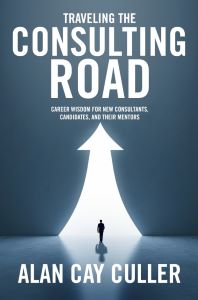
Traveling the Consulting Road: Career Wisdom for New Consultants, Candidates, and Their Mentors is a complete consulting career guide. This book describes what it’s like to become a consultant including how to get hired and promoted, how to start a consulting firm, whether to become an independent consultant, and how to find and serve clients.
The book includes clear descriptions of consulting frameworks, tools and methodologies in the consulting toolkit to master at various points in a consulting career.
Click Here for purchase options



And don’t forget that some clients may want you to carry liability insurance in case your advise get them into hot water… Suddenly you have to foot a 10M D&O yourself.
Very True, Charlotte.
Consulting is a business, whether you are one person or a hundred.