
Do you hate to wait?
“You’re in the wrong line. That line over there is for renewals; this one is for new registrations only. Next!”
“Thank you for calling. We are experiencing greater than normal call volume. Someone from our staff will be with you in a moment…. Did you know that we were rated by J.D. Power as #1 In Customer Service?… you are now caller number forty-three in line….”
“There is a tie-up ahead, expected to last for forty minutes…you are still on the fastest route to your destination.”
I hate to wait.
When you could do this, I thought the perfect travel to and through the airport involved knocking on the closed door of an airplane to get the flight crew to let you on. I missed some planes.
I was once perpetually late, a habit born of underestimating work and travel time, and overestimating my own capability. I’m much better now.
My wife never suffered from this affliction. Shortly after she accepted my proposal, I said,
“Oh no!”
“What?”
“I’m going to be early for the rest of my life!”
It is true.
We never miss a plane. That’s not hard to do when you are at the gate two hours early. We routinely wait for them to clean the movie theatre from the previous showing so we can be the first to be seated, before even the ads are shown. We never miss the previews.
When we do things together, we wait a lot.
But we are not alone. The average American spends 2-5 years of their life waiting. That works out to 35-40 minutes a day. Collectively, we spend 37 billion hours per year…waiting in line.
“Line forms on the right…no cutting…”
We wait in traffic, on hold, for nonexistent customer service, and more and more we wait for healthcare.
Doctors’ Waiting Room
“The first appointment I can give you is in _____”
“That’s four months away!”
“It’s what I have… sorry.”
“The doctor will be with you shortly.”
This situation is exacerbated because I’m old. Old people have more medical patch-up work.
Every annual physical starts a cycle of specialist follow-ups.
“Probably should see the ____ – cardiologist, urologist, gabafracologist “- OK, I made that last one up.
“Just to be safe we should get an X-Ray, MRI, PET scan, CAT scan, stress nukeGBQ with max-contrast” (I made up that last one too.)
For every one of these, you have to deal with “medical groups,” Permanente, Athena, Summit, Optum, etc. Some of these are hospital networks, some are loose confederations of physicians, and some are private equity run corporate rollups. They have systemized healthcare, centralized and optimized scheduling, and worked doctors to death in search of a buck.
What they have in common is one manufactured product: Wait Time.
“They’re not customers; they are patients. They should show some patience”
Waiting for Customer Service
There was a brief magic period in the 1980s and 1990s, after Tom Peters and Bob Waterman lionized companies who were “close to the customer.” Business suddenly found the religion of customer service.
If there was a line at the airline ticket counter there were “queue-combers” to expedite check-in for those with an impending flight. Hotels changed your sheets and towels daily, and provided warm chocolate-chip cookies and concierges at check-in. And real people answered the phone and took your money.
That was before phone-trees, kiosk check-in, online and chip payments, etc. Now a phone tree bot suggests you “manage your experience online at ____.com/support.” Then the site is down, and you wait for a chatbot, wait to chat with a human, wait till we resolve technical difficulties, and are advised to wait and reconnect at a less busy time.
It’s not going to get better. We might have to learn the art of waiting.
The Art of Waiting
I don’t think of myself as an impatient person. My kids say, “Pop’s really patient… until he isn’t.” I am (mostly) patient about things clearly beyond my control, like traffic, or the DMV. However, I haven’t learned the art of waiting.
What do I mean by the art of waiting?
You’ve seen them. People who sit in a doctor’s office, or airport gate, serenely reading a book or doing Sudoku. They anticipated waiting, and brought something pleasant and simple to fill the time.
They are not doom-scrolling the news on their phones. They are not hopping up every five minutes to ask how much longer the wait will be. They are not stress-eating candy bars.
They are also not disturbing others, doing business on cellphones, or raucously laughing like oblivious teenagers, or interrupting someone else’s Zen with a series of complaints or chatterbox tales of Aunt Martha.
I think wait time is great for conversation, if you are with someone interesting. You have to be careful though. My friend Roopa and I once missed our flight to Detroit while sitting at a Newark airport gate. We were so thoroughly engaged that we were oblivious to multiple boarding calls for our flight. We were seated twenty feet from the podium.
David Sedaris, the humorist writer, uses his wait time to fill his diary with potential material, by observing people and listening to how strangers answer his friendly queries. Sedaris has been doing this successfully for years, as evidenced by his many best selling books. I have asked strangers on a bus, “What’s the meaning of life?” That has produced some unusual wisdom as well as some strange looks.
Writing is Waiting
I am a new writer in an old body. Writing has its own unique wait time. Sometimes I wait for ideas. Sometimes I wait for a draft to cure, to let my draft-love dissipate, so I can self-edit; it’s never easy. Sometimes I wait anxiously for Billie to edit. My writing is always better after she has her way with it, but I dread the red ink, perhaps a holdover from less-than-kind English teachers growing up.
Now, I am waiting for an external editorial assessment on my next book, Wisdom from Unusual Places: Reflections on Workin’, Lovin’ and Livin’ Wisely. I am also waiting for a friend to finish transcribing a couple of my songs so I can copyright them. I am waiting out the last remaining specialist follow-ups from my physical. I am waiting for solutions to some tech issues.
It feels a little like the Bardo, the Tibetan transition state between life and death. It is not.
I think the key to the art of waiting is to have something else to do, something that is distracting but can be put down when the waiting abruptly ends.
I have lots of other things I could do. I have a dozen or so projects in my workshop, an unfinished woodcarving, changing the action on two cigar box guitars I built during Covid. I’ve been threatening to take guitar lessons after sixty years of self-taught dabbling. They each are start-up ventures I might be loath to put down.
I could read. I could walk. I could call a friend. I could plan a vacation. Or I could write a post about the Art of Waiting.
How do you practice the Art of Waiting?
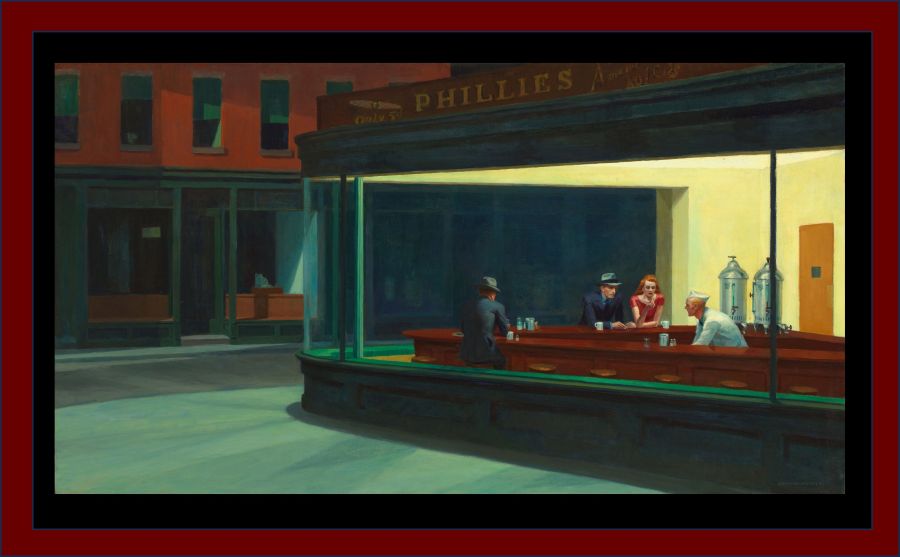
* Note: I chose “Nighthawks” by Edward Hopper to illustrate this post because I love the hard lines Hopper portrays, sharp contrast, light or dark with very little transition space. Are the people in the diner patiently waiting for something?



This is such a timely story Alan!
For me, I have found several activities that seem to help.
The first is using LinkedIn. I spend time with the app open on my iPhone. LinkedIn has topics that I always feel, after reading them, that I have learned something new or have been presented with a differing viewpoint that causes me to challenge my thinking. To me – that is valuable.
Facebook has way too much drama but I keep my account active and post topics – usually related to space flight (in particular the Moon Shot of the 1960s). That seems to drive some interest and comments and I am always pleased with that. If I am in an area such as an airport I will sometimes start a conversation about “safe” topics with the person next to me or near me.
I think we could all benefit from becoming a “Tired of Waiting” Jedi Master and instead of frustration surfacing — use the skills each of us possess to make things better.
Hi David
Great ideas for the Tired of Waiting Jedi Master program.
I’ve never been on Facebook, or Instagram, or X. I spend far too much time on LinkedIn. My conversations, with you, Ali Anani, Biz Cat members, and John Kuzava are valuable, but I also get notified of political drivel, a result of participating in , and responding to rants.
I find taking my Kindle keeps me occupied in airports, but real books feel better. I do talk with strangers and I’m starting to carry a small notebook.
Have you ever met someone who deeply believes that the Moon landing in 1969 was well crafted US propaganda designed bankrupt the Soviet Union? Someone told me how successful that propaganda was, proving not all topics are safe. 😉
Ah, the old, “Hurry up and Wait.” Like David Ford, I too can certainly relate, Alan.
As an old sales guy, I’ve always been early to ensure traffic delays or any unforeseen events will not impact my appointment. Naturally, as you mentioned in your article, I then typically will have to wait for the client/prospect to appear at their leisure.
Same thing with doctors appointments. As previously noted, I either appear early or on time. Only to wait, (along with two or three other patients also scheduled for the same time), for the doctor to appear.
I’ll use my wait time making notes on my phone, replying to emails or texts. I don’t really like reading on a Kindle, (like you, I’m more of a tactile kinda guy). I’ll just have to remember to bring a book.
Now, about remembering . . . that’s a subject for another day.
Thanks, Bob
I appreciate your continued support.
I like real books unless they are huge, then Kindle works so I don’t have an inadvertent weight lifting program.
Of course, histories and biographies with maps and pictures often aren’t readable on Kindle.
Being early has its advantages for sure. I’m much better thought of by my family now that I’m not always keeping them waiting..