


“Mom, you can tell me what to do, or how to do it, but NOT both.”
My wife cracked-up. My stepson had successfully gotten her to back off her “over-management” tendency.
I logged the line for future use. Now all I have to say is “As Gabe once said…” It gets some dirty looks, but often a smile as well. I also hear the line said back to me if lapse into “mansplaining,” but “turnabout is fair play.”
I thought of this today, in the context of leading change. Over my years in consulting, I heard leaders express frustration with their followers:
“Why won’t they just DO what I ask?”
And I heard followers express frustration with their leaders:
“Does he think I’m stupid? I got the direction to lower the pressure. Does he think I need the ‘lefty-loosey, righty-tighty” instruction too?”
For regular readers, I apologize for repeating my simplification of the difference between the roles of leaders and managers.”
Managers:
- thrive in a relatively steady state
- are accountable for getting work done, and
- Developing people to ensure they are capable of getting work done
Leaders:
- thrive in abnormal circumstances such as change, emergencies, war
- are accountable for giving direction, “This way!” and
- attracting followers, “Follow me!”
There is confusion because the two roles often reside in one individual. What changes are the circumstances.
In these days of seemingly constant change, it is easy to blur these roles, and let’s face it, they’re blurry anyway. Isn’t there work to do in change? Well, yeah…. Isn’t one of the ways a leader attracts followers by taking an interest in their development? OK, yeah….
For the sake of this post, let’s stay with the simplification of leading a change initiative, innovation, continuous improvement, post-merger integration, or new organizational structure integration, etc.
What do followers want? To understand the circumstances.
If the leader is a fireman rushing into a burning building, this is easy.
“The building is on fire. The front staircase is in flames. You need to use the back staircase.”
The compelling case for a change is rarely so straight forward. “Why change?” or ’Why can’t we just sell harder, work faster, or lower the price?” To a leader, who has been studying this problem for weeks, who is steeped in the insight driving the change, the answers to these questions seem obvious. To followers hearing this for the first time, maybe not so much. Followers need to understand the ‘Why” and then make the same choice the leader already has, to change.
What do followers want? To understand the direction.
Much of the writing about leadership focuses on direction, vision. Is vision important? Yep. Do great leaders attract followers with “a clear and inspiring picture of the desired future of the organization?” You bet. Is it “spoken in sensory-rich and emotionally-ladened terms so followers can join?” Uh huh.
Is that all there is to direction? Nope.
Leaders might remember that you are asking people to do something different, or differently. They might be slower than you might like in doing that.
What do followers want? Autonomy.
“We fear change.” This is one of the oft repeated bits in the Mike Myers-Dana Carvey Saturday Night Live skit, “Waynes World.” It is a common change misconception, that Myers and Carvey take to the absurd. If people really feared all change, no one would move, get married, have families, or change jobs.
All of those changes involve a choice. People can choose to make life-shaking change when they control the decision.
People don’t fear change; they fear loss, loss of job, loss of status, and mostly loss of autonomy. People aren’t resisting change in general; they are resisting your change, the one you are imposing on them.
Leaders have to give people the information they need to choose to change.
Another of the sayings found in leadership literature is “Leaders shouldn’t create followers; they should create other leaders.”
Clearly any change effort needs people who step up to lead. That distributed leadership exists across levels and geographies.
A leader may help new leaders develop the skills to lead, but first she must give them autonomy to choose to change and empower them to step up to lead.
What do followers want? Constancy and Commitment
As a consultant meeting for the first time with workers, I often heard, “Here comes the flavor of the month.” When I heard that, I knew that the organization had tried to change before and failed. According to some research, seventy percent of change efforts fail. I saw some companies try multiple different continuous improvement methodologies only to give up and try a different framework when improving got hard.
I witnessed companies that thought that innovation was driven by brainstorming. They came up with lots of ideas, but had no process to evaluate, prototype, test, and measure results.
Some companies were incredibly diligent about evaluating acquisitions pre-close. They had detailed plans to justify the purchase price, but had no timelines or accountabilities to deliver on those plans.
Workers, followers in these companies, became understandably cynical. I remember a middle manager in one company I worked with, saying in a workshop, “OK, I’ll sign up one more time, but those guys better mean it this time.”
What do followers want? Empathy and Gratitude
People who successfully lead change initiatives rise quickly. Sometimes, such as in the examples described above, they rise, declare victory and move on.
Sometimes they build distributed leadership that delivers the change and the change is in the thirty percent that succeed.
There is rigorous research on the differences, but, in my personal experience, leaders who succeed at leading change have both empathy and gratitude. They understand what they are asking of people and they are grateful that people both follow and step up to lead.
Often these qualities came from hard-earned experience. These leaders were part of a change effort that failed. My own change epiphany came from comparing change efforts I worked on that succeeded and those that failed. I adopted a You Are Here, three step mode of change:
Insight — Action — Results
I learned that success or failure was visible in the white spaces between steps.
- If a leader underinvested in ensuring internalization of the compelling case for change (Insight) then Action was slow to come or inconsistent
- If a leader viewed Action as a one-and done, with few mid-process measures and contingency plans, then results were few and not sustained.
- If a leader had absorption measures for insight, before-after measures for actions, and an action learning mindset, (Try-evaluate-fix-try again), then followers chose to change and some stepped up to lead.
Some followers still needed to be told what to do and how to do it, but that was much more rare than any of us ever imagined, and for that I am truly grateful.
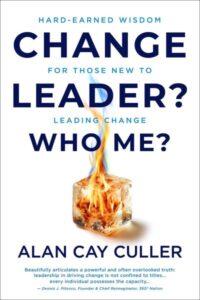
Limited time discounts are available on Amazon


0 Comments