

The Quick Fix’ll Git You Ef You Don’t Watch Out

I’m a “fix or repair” guy.

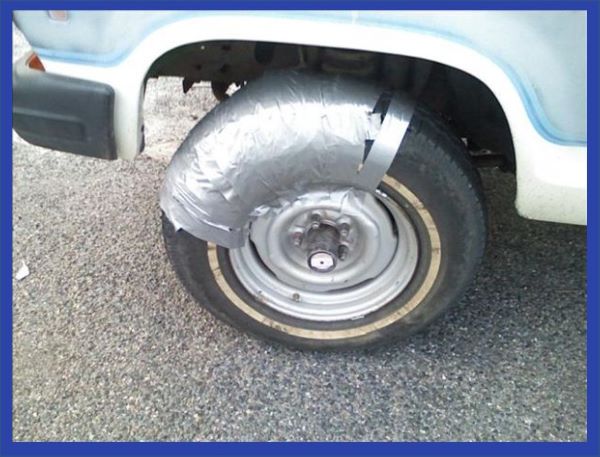
I differentiate myself from “throw away and buy new” guys. I have a tendency to drive cars beyond what others might call “their useful life.” I own too many things held together with twisted wire and duct tape. I get unreasonable pleasure from improvising a solution with available materials in my shop rather than making another trip to Home Depot.

As such, I imagine myself to be a good guy to have on a backpacking trip, because if equipment breaks when we’re in the middle of the woods miles from REI or Eastern Mountain Sports, I can always “jury-rig something up.” I’m proud of this skillset, but it has its limits.

In times of change businesses all-too-often default to the quick fix. “Can you patch the software?” “Do a workaround,”  “I know we really need to hire someone, but give it to Mary she’ll figure out how to get it done.” I understand the allure of the improvised solution, the quick fix, but it isn’t always a good idea.

Years ago, I worked for some clients in oil and gas exploration and production in the western US. I used to hear things like “Time to cowboy up,” or “Git’er done!” You don’t hear that so much anymore – too many process safety incidents have claimed lives.

In VUCA be Agile

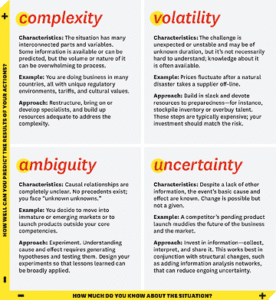
There has been much written about the constant change of the current business environment. It is described as Volatility, Uncertainty, Complexity, and/or Ambiguity  (VUCA). VUCA was coined by Warren Bennis and Bert Nanus in 1987. The US Army War College picked up the term in the 1990s for use in military strategy.[caption width=”276″ id=”attachment_2332″ align=”alignnone”
Bennett and Lemoine what to do in Volatility, Uncertainty, Complexity or Ambiguity,

In 2014  Nate Bennett and G. James Lemoine in a Harvard Business Review article, recommended analyzing which was the dominant condition and acting accordingly. For example, build in slack and redundancy to cope with volatility or collect data and experiment to deal with uncertainty and ambiguity.

Unfortunately the language of VUCA has found greater adoption with many leaders than the solutions that Bennett and Lemoine recommended.

Another sign of the change affecting leaders is the methodology Agile. Agile was originally an idea to speed up the software development cycle. Software development was a serial process  -concept – design- develop- test. This was sometimes called the waterfall process as it flowed down and you had to complete one phase before starting the next, which was time consuming..

Agile was a series of quick design-develop- test loops (sprints) by multidisciplinary teams who met daily (scrums) to get to rapid prototyping. Apparently, it worked pretty well, if you had the right people and were disciplined about the process.

Then Agile was applied to all strategic planning,  innovation and improvement processes.

The words behind VUCA and the words behind Agile entered the business lexicon; the discipline behind the processes not so much.

In a strategy discussion with a senior leadership team on leader kept using the acronym VUCA. This raised everyone’s anxiety level to the point that I finally showed the Bennett and Lemoine diagram and we began to work on what was of most concern, the uncertainty of a new technology introduced by a competitor.

I was in the middle of a continuous improvement project at a diversified financial services company when one division rejected the methodology we were working with. “Agile is much faster,” they asserted.

After three months and a sizeable investment they rejoined the corporate improvement initiative.

“We tried to do everything at once. Nobody was defining what needed to be improved.”

In change be suspicious of “silver bullets” or “quick fixes.” Details are important.

“Time, oh sweet, sweet time”

Another important factor is the time horizon of the change. This is critical when examining cost. There is initial cost, maintenance, and other life cycle costs. A friend is on the board of a townhouse condominium complex. He complained to me recently.

“These places were built in the1980s. It is time for new asphalt shingle roofs. We have two bids one is for 50% more than the other. Everyone wants to go the cheaper contractor. But it’s apples and oranges. The first guy is going to put a course of shingles right over the top of the shingles that are there. The more expensive roofer is going to take off the old shingles, remove the vapor barrier, check the roof sheathing and replace plywood where he has to replace the old tarpaper vapor barrier with newer material before replacing the shingles.”

“Do they last the same amount of time?” I asked.

“Well, the shingles have the same life 20- 30 years. The issue is the vapor barrier. If the tarpaper holds; it’s fine. If not with two layers of shingles you are not going to know where the leak is coming from and with the extra layer of shingles some of the runoff may run across the skylights. That probably won’t cause a problem for five years or so, but if or when it does it will be expensive.”

“Seems like a case of initial cost vs. lifetime cost” I said “Do you have the money to do it right for the long term.

“Yeah, but it is just hard for some to spend 50% more now.”

Some might make the argument that taking the low cost fix is the better deal because many people will move before any maintenance issues arise. Many businesses have short term time horizons, because in a VUCA world, who knows what will happen. But here is a case where it seems like we do know that if we take the short term approach we will be in for some long term problems. What is the cost of unintended consequences? How many roof leaks and leaky skylights would it take for the quick fix to be more expensive?

In times of change consider decisions from multiple planning horizons.

You may decide to go with a quick fix, but at least you will act with awareness of the long term.

“Jeanne is going on maternity leave, can we hire a temp to fill in for three months?”

“We have no budget for that, Paul. You and your team can pick up the slack for three months.”

The team did pick up the slack. Mostly the manager, Paul, picked it up. Unfortunately Jeanne had a difficult delivery and didn’t come back for five months and when she came back it was part-time at first, but she did come back and the team did the additional work without the cost of a temp. However, within a year, Paul and two team members left for other jobs. No one looked at the budget strain of hiring three new staff and rebuilding cohesiveness in the new team.

Sometimes you have to do a quick fix. Sometimes you fix something with duct tape. But remember where the quick fix is and have a plan to fix the consequences. Duct tape doesn’t last forever and using it on people isn’t recommended.

The quick fix’ll git you ef you don’t watch out.


The title of this post comes from combining the title from the book “Beyond the Quick Fix” by Dr. Ralph Kilmann and the Hoosier poet James Whitcomb Riley’s poem, “Little Orphant Annie,” which my parents used to read to us every Halloween.  Annie told “witch stories” with the moral “The Gobble ‘uns’ll git you ef you don’t watch out,”
Please join the conversation by leaving a comment below.

If you enjoyed my writing, please click the button below to subscribe to receive 1-2 posts per week, no ads, no affiliate links and I will never sell, trade or otherwise distribute your information. You can unsubscribe at any time by clicking unsubscribe on the email.

A Friday Some Years Ago:

9:00. Phone rings.

“Hello? Oh, Hi Ken…”

12:00 noon. Phone rings.

“Hi Ken, what’s up?”

4:45 p.m. Phone rings.

“Hi Ken… Say Ken, Are you checking on me?”

“Well, actually, yeah. When I work from home I only get about two hours of work done all day. What with the kids and the dog, trying to work from the kitchen counter, and the TV, and computer games. It’s very distracting. We pay you quite a lot and I was just trying to see if you are actually working.”

“OK, Ken, I get it. But I’m in my office on the second floor of my house. It has a desk, phone, files and computer. There’s no TV. I have no games on my computer. My kids are grown and don’t live with me. The dog is old and goes out before work and after. Besides Ken, I only charge you when I’m actually working. We can review the training I wrote today if you’d like.”

“Well, I’m headed home; can you email it?”

“Sure.”

My client was new to the job and he had inherited a consulting team. To him it was easy to see us working when we were on site, but given his personal experience working from home, he couldn’t imagine us working productively on Friday, when we weren’t on site.

In fact, for certain kinds of head-down individual work, I got a great deal more done on Fridays than I did during the week, when I had to attend meetings with clients and build commitment to change. However, I understood that many managers in offices shared Ken’s experience and the concerns that arose from it.

Then Came Covid

Durin the coronavirus pandemic, workers in factories, healthcare, first responders, retail, and food service risked their lives and office workers learned to be productive “working from home.” Office productivity didn’t suffer as expected and office workers liked the flexibility, the lack of wasted commuting time, and not wearing pants on Zoom calls.

I retired in 2018, so this really didn’t affect me directly. I heard about it from my kids. One time consulting colleagues called to ask how I worked as an independent consultant. People asked about my home office and what the IRS required to deduct the set-up of a home office, (dedicated space, documented use, and expense receipts). I started to see jobs advertised as “remote,” or “hybrid.”

Some people figured out they could work from anywhere and you saw magazine articles of people working from the deck of their beach house. I was always jealous of that because I didn’t have a beach house.

Some people complained about the isolation of Covid-time. As the pandemic died down, some people reminisced about standing on balconies of city apartments banging pots in support of first responders and healthcare workers. Covid was something that affected us all, a unifier after a time of division.

Then Covid was (finally) over

Well, not really over. Covid is still around. We’re just done with it, over it; Covid is so four years ago. For the last four years, there has been a discussion building.

“OK everybody, it’s time to return to work.”

That one pissed off all those workers in factories, healthcare, first responders, retail, and food service who risked their lives.

“We never stopped working.”

So R-T-W became R-T-O, “return to office.”

Some were enthusiastic; some were less so. Sure, there would be less isolation, but more colds and flu (and Covid whispered the risk averse). And then there is wasted commute time. And then there is the flexibility of working when I want. And then there is the fact that I don’t have to stay late because Mary bent my ear about her mom, and Ted just had to relive the highlights of the big game, etc.

“OK, well, what about two days per week?”

“Maybe.”

“Three?”

“I don’t know.”

It’s been a long four years.

This conversation has been slowly accelerating. I must admit that, Boomer dinosaur that I am, I wasn’t particularly won over by the Gen X, Y, Z, Alpha whines about commuting costs and cleaning bills for the pants they would now have to wear. I also thought that some workers were being clearly unreasonable in their demands.

My nephew runs a retail food business and told me about job applicants who asked if they could “do the retail floor job remotely.” Some jobs require face time.

Culture is built by being together. Teams function best if they actually know each other. I began to hypothesize that introverts would want to work at home but extraverts would want to return to the office. It turns out there is no evidence of that.

I have had more and more conversations recently with office workers, people I respect for their intelligence and projected competence, who say, “If they insist on 5-days-in-office, I will leave.” Or “OK, I’ll come in for 9:00 and leave at 5:00, but there is no working till 7:00 and no calls on nights and weekends.”

There have been some famous CEOs who have gone public “R-T-O or else!” At a recent cookout, huddling under a canopy during an inconvenient downpour, I was engaged in conversation with the manager of administration for the board of directors at a money center bank.

“My CEO is friends with another CEO who has drawn a very public line in the sand, but my colleagues, my boss and three quarters of my staff will walk if he enforces the RTO mandate. Most of the board are off site and 90% of my work is email and phone. I have to be here for board meetings and two or three days a week is reasonable. Five is a hard “No!”

I began to think that managers, even CEOs, who insisted on a 5-day RTO mandate, might be driven by their own convenience  ̶  “I want to turn around an give someone a job directly. I don’t want to find out they’re ‘shirking from home’ and have to call them.”

Then, in today’s New York Times, I came upon an article by Adam Grant, et al, at the Wharton Business School, that quotes research, that demonstrates that:

“ One: Return-to-office mandates don’t increase profits by weeding out people who lack commitment. They motivate the most talented people to jump ship. Two: As long as people are together for half the week, remote work isn’t isolating. And three: Hybrid work isn’t bad for performance, innovation or connection. “

Grant et al go on to describe how adamant RTO mandates are most often pushed by narcissistic managers that require constant attention, as demonstrated by the size of their pay packages, offices, and their photos in the annual reports.

So where does that leave RTO?

It depends. There are clearly some jobs that require presence, just like first responders, and retail workers, if your job has a face to the public, well, you gotta face the public. If your job has more individual than team work, you might have more of an argument for remote or hybrid work.

If you are a manager, who just can’t get over the fact that, “Hey, I got up every day and went into the office. I sucked up to my manager and now its my turn,” then maybe look in a mirror. Get over yourself, and see how you can lead change three days a week or on Zoom without any pants.

You may also like. . .

Sacrifice

Sacrifice

My Memorial Day verse was not published the first time I tried, seems I’m cursed by technology’s worst. Here’s hoping this remembrance burst makes it now.

read more

Please contribute your thoughts in a comment. The author will be notified, but may not respond to every comment. The site reserves the right to delete comments it deems off topic, offensive, or spam.

2 Comments

  1. Bob Musial

    Sounds like there’s a lot to that “patience is a virtue” thing. Excellent points, Alan. Something I learned a gazillion years ago that to some degree echoes your article, was the impact on decision-making with regard to the FUD factor (Fear, Uncertainty, and Doubt). While it primarily applies to marketing and sales, I believe it can also be applied to most situations.

    Reply
    • Alan Culler

      Hi Bob thanks for your continued support.
      Fear, Uncertainty, and Doubt are often the basis for objections in a sales process, but they are also rational responses that shouldn’t be blown apst with a “quick fix”
      What concerns do you have?
      What are you unsure of?
      What are you not sure you believe?
      All questions to surface unspoken objections, could also be used to test whether a quick fix is a good idea..
      Thanks for continuing the conversation.

      Reply

Submit a Comment

Your email address will not be published. Required fields are marked *