
“I’m late, I’m late, I’m late”
“Alan is someone for whom the clock has yet to be invented.”
So said Royal to Billie, the woman who became my wife, when we were all just neighbors and friends. I was habitually late in those days, not for work nor client meetings, but on weekends with friends and family.
Some of that tardiness habit, was because I underestimated how much time To-Do tasks would take. I still think I can get a week’s work done in two hours. I am also motivated by completions, so when chasing the checkmark I frequently lost track of time.
I am easily distracted, which eats time and makes tasks run longer than they should.
That is balanced by a laser-focus when I’m interested in something. I’ve not infrequently heard, “Where do you go? I couldn’t get your attention until I put my hand between you and what you’re working on.”
That trait also makes “keeping track of time” a challenge.
I’m much better about being late than I used to be. I credit Billie, who is always early, and has no patience with people who aren’t good with time. I kid her about being the first ones in the theatre when we go to the movies, or getting to the airport gate two hours before flight time. We do get good movie seats and I can’t remember the last time I missed a plane.
Billie might say I’m “better, but still not great,” at time management. It’s our source of creative conflict.
I earned my living as a consultant based on billable hours and ever shorter project cycle time. I’m a tight deadlines, “last minute” junkie. Witness the fact that I’m writing this post hours before guests arrive for the weekend.
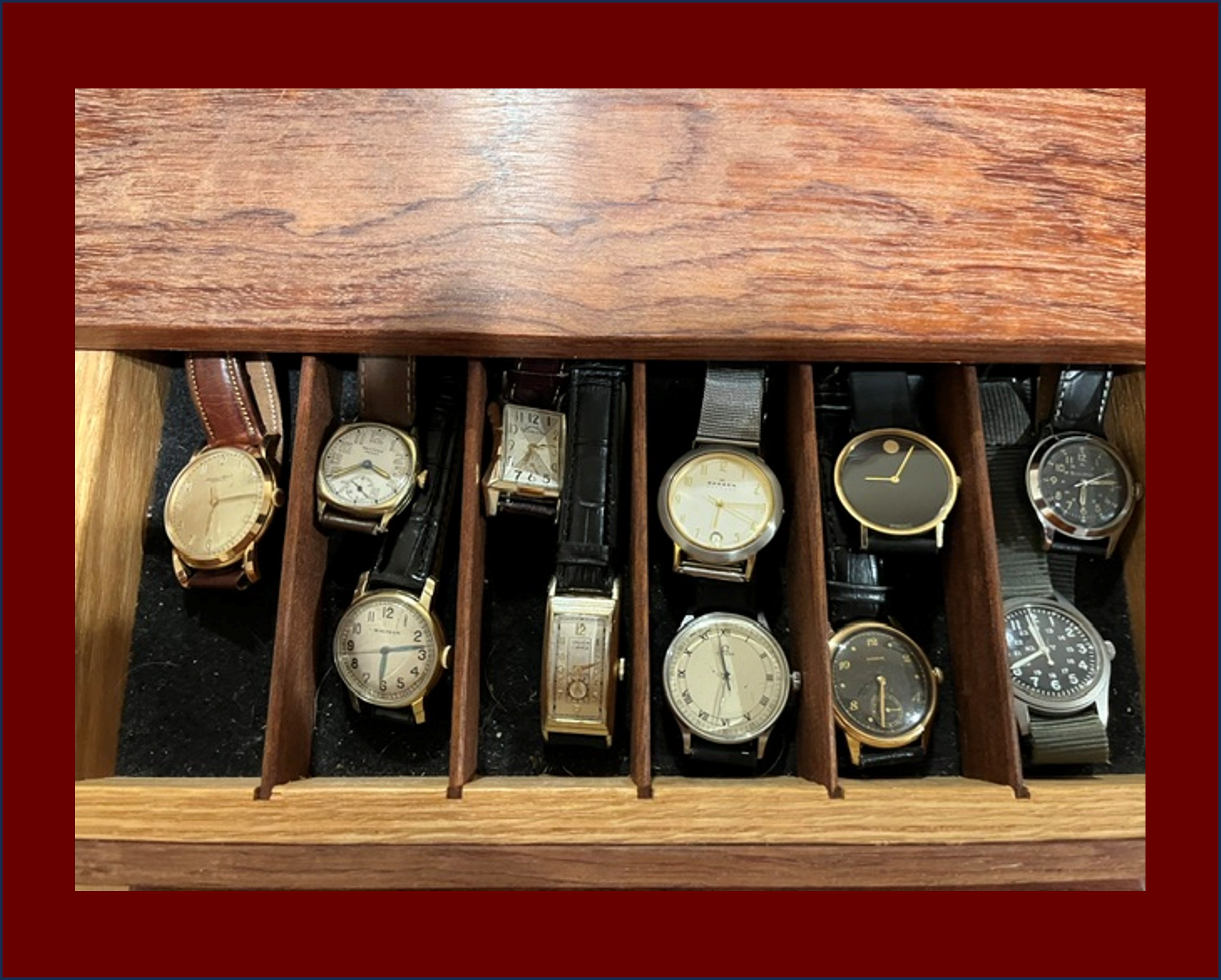
It may seem appropriate then that I have a small collection of mechanical wind-up wristwatches. Most are American watches of 1940-1960 vintage. These aren’t expensive – no $10,000 Rolex or Phillipe Patek timepieces here. Most came from eBay at less than $100.
I wear them all in rotation and am religious about keeping them in working order, thanks to Aaron, the watchmaker.
Aaron
“Alan! Did you break something again? Why do you always break things?”
“So I can see you, Aaron. And keep you in business.”
“For which I am most grateful.”
Aaron grew up in the Soviet Union.
“My Grandfather died in Leningrad in World War II. My father left when I was six. My mother died when I was ten. I was bad boy. No jail, but they threw me out of school when I was twelve. Only four hours I could work because I was little. I work twelve hours. I could drink six ounces of vodka and still work.
“Then, when I was a young man, in the 70s they said I could leave. I am Jew. They didn’t want me. So I went to Israel. I didn’t like it there. I was raised in the Soviet Union; I didn’t have much religion. There, everybody is religious. My cousin was going to America and I thought ‘why not?’
“Here I lived in Bayonne. I lived in Elizabeth. I was always tinkering. I meet people. I meet my wife. Soon I am fixing watches in a jewelry store in Manhattan. Then we buy this business.”
Aaron says my simple windup watches are easier to repair than the fancy watches with self-wind, day-date, split second chronograph, repeater chimes, moon-phase, and perpetual calendar. “Funny all that stuff is called ‘complications;’ it should be called ‘confusions.’”
All this sounds like I’m obsessed with time and its measurement. Maybe I am. I did a lot of continuous improvement work and used stopwatches, both mechanical and quartz to measure cycle time. When I ran marathons, I had a Casio running watch to track splits.
What is Time?
Some people say humans invented time. Why would we do that? Time has been our master ever since.
Today, I picked up a watch after Aaron replaced the crystal and straightened the hands.
“Now, you don’t break it this time, Alan. Be careful.”
“OK, Aaron. You know, I’m writing a piece now. Can I ask you a question?” He nodded. “What is Time?”
“What a question? I never think. It is something we measure….”
“Yes, but what is it? What is time.”
“It moves. We call the insides of a watch a movement. The wheels and the spring move the same way. We say a watch keeps time. It doesn’t keep time really. It moves at the same speed so we know how fast or slow time moves.
The quartz watch vibrates, when you remember to replace the battery. It vibrates, back and forth and back and forth; we say that vibration is timed. It’s not; we just compare that back and forth to the movement of time.
“What is time? I don’t know. You know I don’t watch the news. It’s either lies or just stuff to make you feel bad, but I watch Nova, Discovery. The Mayans, they compared the movement of the stars to time three thousand years ago. They built a calendar and a kind of clock. How did they do that? They didn’t have telescopes.
“What is Time? I don’t know, Alan, but you give me too much to think about. I just wish I could stop time. Well maybe not stop it but slow it down a little. All the best to your family.”
“Bye, Aaron. Say hello to Sonya for me.”
Slowing down time
Aaron and I are in the last quarter of our lives and old people often talk about slowing time. It does seem to go by so quickly and we would just like to make it slow down.
Kids don’t do that. Last night at one granddaughter’s birthday, her sister was a little jealous of the gifts.
“Don’t worry. Christmas is coming.”
“That’s forever!”
It’s four months.”
“Forever!”
Time slows down for the young and speeds up for the old. Ah, I can’t be forever young, forever immature maybe.
Another way time slows down is called “Flow.” Sports champions talk about being “in the zone.” I have sometimes experienced flow in writing, or carving, or running, or playing guitar. Those experiences, which are rare for me, happen when my practice muscle memory takes over my overthinking brain and I do without thinking. These are not completely unlike when my periods of intense focus makes me forget that time exists until someone, or my bladder, brings me back into the present.
In the 1970s, Mihaly Robert Csikszentmihalyi, a Hungarian-American psychology professor at Claremont Graduate University, described Flow as a state of concentration where the ego recedes and people become uniquely open to creativity and optimum performance.
Csikszentmihalyi’s research, showed that this merging of action and awareness depends on skill developed through practice and challenge, and intrinsic motivation, which comes from doing what you love.
Maybe, that’s the secret to slowing down time as we age. I wonder how to…


0 Comments