
Change Leader? Who Me? Published

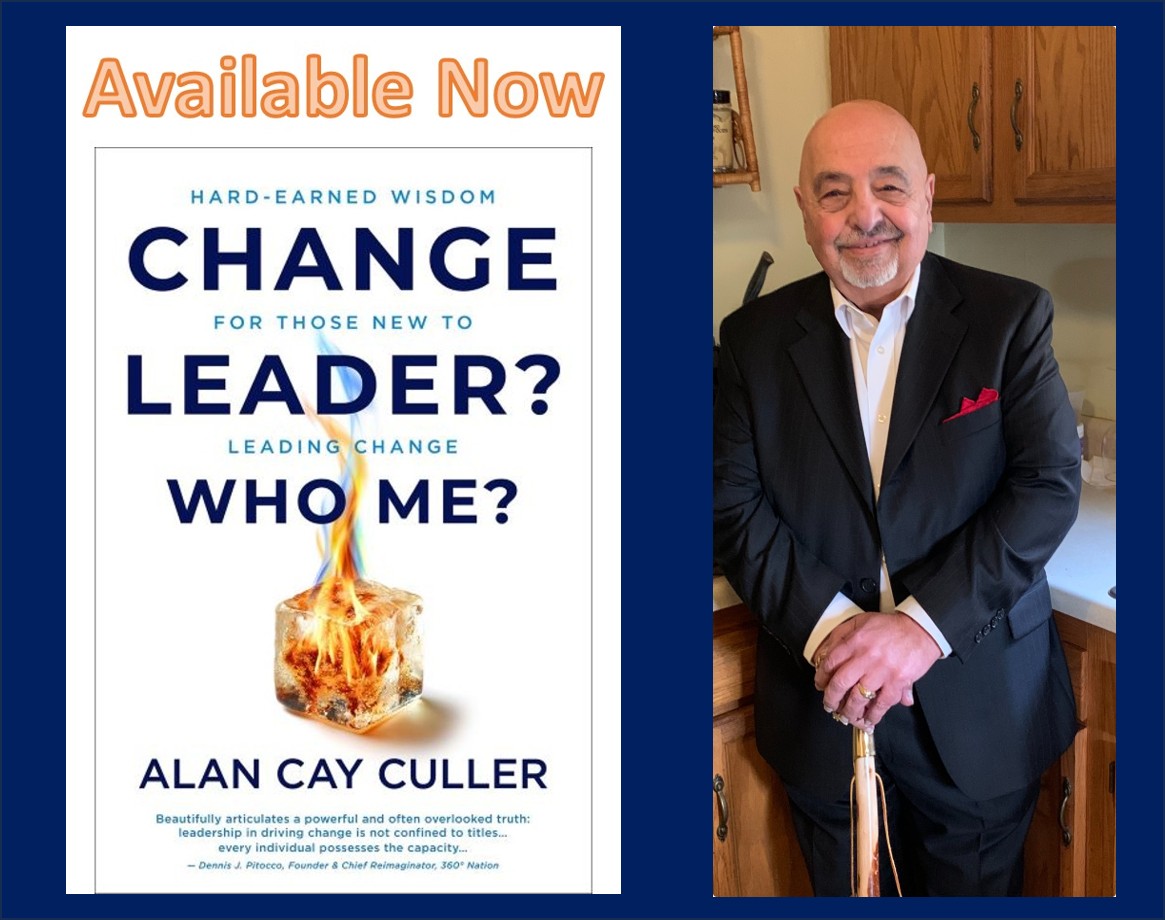
Change Leader? Who Me? Hard-Earned Wisdom for Those New to Leading Change is finally published. Here is the preface and opening story.

Preface

When I say ”change,” I’m talking about behavioral change, basically an individual doing something different or doing a familiar task differently. Behavioral change may require a new insight, new knowledge, and/or different skills. But what is important is that doing something different or differently happens because people choose to change. They understand the reason, the “why” of change.

Change in business starts with individual change, but it involves a group of people collectively understanding the why and acting together to change.

I spent thirty-seven years as a consultant, trainer, and facilitator of groups of leaders in business. When I started, I wouldn’t have said that my chosen third career (actor, booking agent, consultant) had anything to do with leading change. I thought that I was a hired problem solver, a researcher who provided new data upon which business managers could make decisions and act.

Even as a trainer, I saw myself as a communicator of new information, not someone who helped people change. I certainly didn’t see myself as a leader or think that I would change as a result of that work. I was wrong.

When I say leader, I’m not elevating the exemplary individual, the man or woman with such admirable traits that we enshrine them with a positive regard akin to hero worship. If such an individual exists, he or she might be good at leading change, or not.

Rather, I am spotlighting the individual to whom others listen, who can help others understand the why of change, and who gets people to follow through on the change effort.  Leading change requires a change mindset – understanding “the why,” the “why now,” and the penalty for not changing.

I wrote this book to synthesize what I learned over my years as a change consultant, helping leaders make strategic change, and perhaps consultants might get some value from it.  However, I wrote the book for the person inside an organization who has just been asked to lead the implementation of a new strategy, or an innovation or improvement initiative, or post-merger integration. Suddenly, you hear yourself asking, “Change leader? Who, me?”

Here you will find context for change (why does it feel like we are in a period of constant change?), core traits of change leaders, and helpful change levers or tools. I have also included stories of leaders, ordinary people I’ve met, who embodied some aspect of leading change. There are stories of my Boy Scout Troop Leader, a classic booking agent, an Italian haircutter, my mom, and Bruce Springsteen. These are not collectively exhaustive case examples of leadership, but stories that may help you shape your values as a change leader, as they helped shape mine.

This book begins with one of my earliest stories, told to me by Mico, pictured above, now my treasured friend.


The Change Mindset

I have a passion for things Italian.  I don’t know where this comes from; it’s strange in a Celt-WASP hybrid like me.  I first noticed this penchant as a very small boy, loving trips to Boston’s North End where I was pinched on the cheek by the round lady in the black dress at Mama Bertelone’s.  Later, in Rome for the first time, I relished the terra cotta dust on white marble and was amazed at the drivers to whom even the sidewalk was a rush-hour roadway. A warm smile grew in my heart.  I used to get that feeling on Sunday mornings at La Prima Espresso in Pittsburgh’s Strip District, listening to the old men roll the beautiful Italian language off their tongues.  Vowels and soft tones make swearing sound like Puccini.

One of my Italian vices was my haircutter.  He was good at cutting hair, but, in truth, I also went to him because I liked to hear him talk.

“‘Mico’ is sort of a nickname, short for Domenico.  It was my father’s nickname, and now it’s mine.  I inherited it, you could say, a family legacy.  It’s all right, but I would have rather had some money, say, five or six million dollars.”

“Mico,” I asked, “What would you do with five or six million dollars?”

“Hey, Alan, with five or six million dollars, I wouldn’t have to do anything!  I’d have enough money.”

We mutually decided that, really, our lives could be immeasurably improved by the “injection of a mere $250,000 in spare cash” and laughed.  The laughter was good.

Our conversation skipped lightly through politics, the arts, and food, and then swung to our ancestors: my mother’s grandfather, Pleatous McCaghren, and Mico’s grandfather, both immigrants.

“You could wonder how they did it,” I mused aloud.  “How they gave up everything to come here, eh, Mico?”

“Yeah,” Mico replied.  “You could wonder.  People say, ‘How could they do that?’  I’ll tell you how.”

I sat back and waited, realizing that day’s story was beginning.

“They could do that because they didn’t know any better. My grandfather and your mother’s grandfather didn’t know about all the things that could go wrong. They didn’t say ‘what if the boat sinks?’ or ‘what if we get sick?’ or ‘what if I can’t work or fit in?’ They didn’t know about those things.  They just did it.” Mico went on with a tale about his grandfather, as it had been passed down to him.

“First of all, they had nothing there, so what were they giving up?  Then . . . then somebody they knew went, and wrote letters home: ‘America.  America.  There’s opportunity under every brick in the sidewalk.’  They said, ‘The streets are paved with gold.’  They said, ‘Come and make your fortune.’  They didn’t know any better, so they went.”

Mico’s skin is the color of pecan shells; his eyes are shiny black coals, and they were twinkling almost Leprechaun-like with mischief. “Now, I’m not saying that my grandfather and your great-grandfather were stupid.  No.  It’s not that they couldn’t imagine all kinds of things that could go wrong.  But they didn’t know that they’d go wrong.  They didn’t know about trouble, didn’t accept it in their hearts.  They didn’t let it stop them.  They said things like ‘we’ll cross that bridge when we come to it,’ or ‘it’ll work out,’ or ‘we’ll find a way.’”

“You see, they had the dream: America!  Opportunity!  And the dream kept them from knowing any better.  The dream kept them from stopping or being stopped by anything. The dream made what they had in the old country seem like nothing. The dream made it easy to give it up because it was nothing compared to what they could have. The dream kept them from knowing any better, and they just did it.  They left, came to America. They did it because they didn’t know any better.”

Mico finished cutting my hair.  He had no other customers, so we walked to our cars together.  We talked about the old men at La Prima and wished each other well.

That was years ago, and today Mico’s words still linger. In my work, I helped people and companies who were struggling with new strategies, and Mico had given me a blueprint for how to succeed at life-altering change:

  • “They had the dream . . . .” Hold an inspiring vision of what will be after the change.
  • “The dream made what they had . . . seem like nothing. . . .” Say goodbye to the past and focus on the future.
  • “They didn’t know any better. . . .” Don’t accept obstacles in your heart.  Go around them.
  • “They just did it.” Take action, in big steps or many small ones.   ACTION, not thinking, not trying, but DOING, is what makes change happen.


I didn’t know it then, but recording Mico’s stories started my career as a writer.  Now my second book available here.
Please join the conversation by leaving a comment below.

If you enjoyed my writing, please click the button below to subscribe to receive 1-2 posts per week, no ads, no affiliate links and I will never sell, trade or otherwise distribute your information. You can unsubscribe at any time by clicking unsubscribe on the email.

A Friday Some Years Ago:

9:00. Phone rings.

“Hello? Oh, Hi Ken…”

12:00 noon. Phone rings.

“Hi Ken, what’s up?”

4:45 p.m. Phone rings.

“Hi Ken… Say Ken, Are you checking on me?”

“Well, actually, yeah. When I work from home I only get about two hours of work done all day. What with the kids and the dog, trying to work from the kitchen counter, and the TV, and computer games. It’s very distracting. We pay you quite a lot and I was just trying to see if you are actually working.”

“OK, Ken, I get it. But I’m in my office on the second floor of my house. It has a desk, phone, files and computer. There’s no TV. I have no games on my computer. My kids are grown and don’t live with me. The dog is old and goes out before work and after. Besides Ken, I only charge you when I’m actually working. We can review the training I wrote today if you’d like.”

“Well, I’m headed home; can you email it?”

“Sure.”

My client was new to the job and he had inherited a consulting team. To him it was easy to see us working when we were on site, but given his personal experience working from home, he couldn’t imagine us working productively on Friday, when we weren’t on site.

In fact, for certain kinds of head-down individual work, I got a great deal more done on Fridays than I did during the week, when I had to attend meetings with clients and build commitment to change. However, I understood that many managers in offices shared Ken’s experience and the concerns that arose from it.

Then Came Covid

Durin the coronavirus pandemic, workers in factories, healthcare, first responders, retail, and food service risked their lives and office workers learned to be productive “working from home.” Office productivity didn’t suffer as expected and office workers liked the flexibility, the lack of wasted commuting time, and not wearing pants on Zoom calls.

I retired in 2018, so this really didn’t affect me directly. I heard about it from my kids. One time consulting colleagues called to ask how I worked as an independent consultant. People asked about my home office and what the IRS required to deduct the set-up of a home office, (dedicated space, documented use, and expense receipts). I started to see jobs advertised as “remote,” or “hybrid.”

Some people figured out they could work from anywhere and you saw magazine articles of people working from the deck of their beach house. I was always jealous of that because I didn’t have a beach house.

Some people complained about the isolation of Covid-time. As the pandemic died down, some people reminisced about standing on balconies of city apartments banging pots in support of first responders and healthcare workers. Covid was something that affected us all, a unifier after a time of division.

Then Covid was (finally) over

Well, not really over. Covid is still around. We’re just done with it, over it; Covid is so four years ago. For the last four years, there has been a discussion building.

“OK everybody, it’s time to return to work.”

That one pissed off all those workers in factories, healthcare, first responders, retail, and food service who risked their lives.

“We never stopped working.”

So R-T-W became R-T-O, “return to office.”

Some were enthusiastic; some were less so. Sure, there would be less isolation, but more colds and flu (and Covid whispered the risk averse). And then there is wasted commute time. And then there is the flexibility of working when I want. And then there is the fact that I don’t have to stay late because Mary bent my ear about her mom, and Ted just had to relive the highlights of the big game, etc.

“OK, well, what about two days per week?”

“Maybe.”

“Three?”

“I don’t know.”

It’s been a long four years.

This conversation has been slowly accelerating. I must admit that, Boomer dinosaur that I am, I wasn’t particularly won over by the Gen X, Y, Z, Alpha whines about commuting costs and cleaning bills for the pants they would now have to wear. I also thought that some workers were being clearly unreasonable in their demands.

My nephew runs a retail food business and told me about job applicants who asked if they could “do the retail floor job remotely.” Some jobs require face time.

Culture is built by being together. Teams function best if they actually know each other. I began to hypothesize that introverts would want to work at home but extraverts would want to return to the office. It turns out there is no evidence of that.

I have had more and more conversations recently with office workers, people I respect for their intelligence and projected competence, who say, “If they insist on 5-days-in-office, I will leave.” Or “OK, I’ll come in for 9:00 and leave at 5:00, but there is no working till 7:00 and no calls on nights and weekends.”

There have been some famous CEOs who have gone public “R-T-O or else!” At a recent cookout, huddling under a canopy during an inconvenient downpour, I was engaged in conversation with the manager of administration for the board of directors at a money center bank.

“My CEO is friends with another CEO who has drawn a very public line in the sand, but my colleagues, my boss and three quarters of my staff will walk if he enforces the RTO mandate. Most of the board are off site and 90% of my work is email and phone. I have to be here for board meetings and two or three days a week is reasonable. Five is a hard “No!”

I began to think that managers, even CEOs, who insisted on a 5-day RTO mandate, might be driven by their own convenience  ̶  “I want to turn around an give someone a job directly. I don’t want to find out they’re ‘shirking from home’ and have to call them.”

Then, in today’s New York Times, I came upon an article by Adam Grant, et al, at the Wharton Business School, that quotes research, that demonstrates that:

“ One: Return-to-office mandates don’t increase profits by weeding out people who lack commitment. They motivate the most talented people to jump ship. Two: As long as people are together for half the week, remote work isn’t isolating. And three: Hybrid work isn’t bad for performance, innovation or connection. “

Grant et al go on to describe how adamant RTO mandates are most often pushed by narcissistic managers that require constant attention, as demonstrated by the size of their pay packages, offices, and their photos in the annual reports.

So where does that leave RTO?

It depends. There are clearly some jobs that require presence, just like first responders, and retail workers, if your job has a face to the public, well, you gotta face the public. If your job has more individual than team work, you might have more of an argument for remote or hybrid work.

If you are a manager, who just can’t get over the fact that, “Hey, I got up every day and went into the office. I sucked up to my manager and now its my turn,” then maybe look in a mirror. Get over yourself, and see how you can lead change three days a week or on Zoom without any pants.

You may also like. . .

Sacrifice

Sacrifice

My Memorial Day verse was not published the first time I tried, seems I’m cursed by technology’s worst. Here’s hoping this remembrance burst makes it now.

read more

Please contribute your thoughts in a comment. The author will be notified, but may not respond to every comment. The site reserves the right to delete comments it deems off topic, offensive, or spam.

0 Comments

Submit a Comment

Your email address will not be published. Required fields are marked *