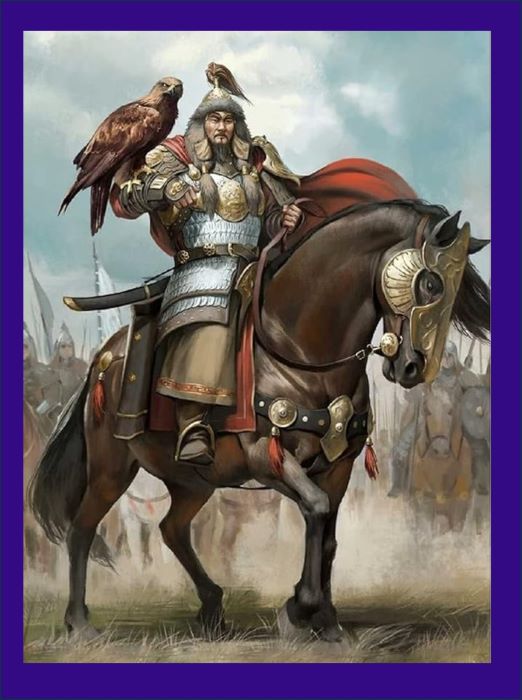

Learning from Genghis

“I am the Scourge of God!  If you had not committed great sins, God would not have sent a punishment like me among you.”

Bellowed Genghis Khan from horseback outside the sacred Mosque of Bukhara, moments before he ordered the wealthy town elders to surrender gold and jewels, razed their homes and slaughtered them, leaving peasants “scattered to the winds to tell the tale of the horror they witnessed here.”

Not a very nice guy.

My first wife described my political transformation, after going to the London Business school when Margaret Thatcher was Prime Minister:

“Alan went from Ché Guevara to somewhere to the right of Genghis Khan.”

Most people don’t think of Genghis Khan as a positive model of leadership.  Perhaps he isn’t. He was a conqueror, driven only by territorial acquisition and theft. He was often merciless to his enemies. Genghis Khan has been held up as the archetypal barbarian throughout much of history.

Voltaire described him as “this destructive tyrant . . . bred to arms and practiced in the trade of blood . . . who lays the fertile fields of Asia to waste.”

Karl Marx blamed the Tsars cruelty on him “The bloody mire of Mongolian slavery forms the cradle of Muscovy” (principality around Moscow).

The writer in a 1990 article in The Economist railed:  “Unlike other conquerors, he brought no ideology, no Napoleonic Code, no Roman Law.  His simple fanatical aim was to amass huge areas of territory…Genghis’ empire, if that’s what it was, fell to pieces after his death….”

In 1990, I was working for a propeller aircraft manufacturer in Northern Ireland. I interviewed many people in preparation for the offsite where the CEO intended to win everyone over to an integration plan with the Canadian jet manufacturer acquiring them..

Virtually everyone described my client as “ a really warm supportive guy, who can also be Genghis Khan.” Evidently he had an explosive temper and angry verbal sharpness that people described as “Mongol beheadings.” I was very nervous about the feedback session.

He laughed. ”Yeah, I know. I’m working on that. Hey, let’s have some fun with this. I bet old Genghis was nicer to his people than he was to his enemies.”

I did some research and wrote a whitepaper,  and an exercise for the group to decide what they could learn from Genghis.

I was surprised to learn that Temujen, Genghis Khan, was an extraordinary leader.

A hunted outcast on the steppe from the age of ten until the age of seventeen, he rose in four short years to be elected Genghis Khan (rightful ruler) of the Mongols.  After defeat and desolation two years later, he rose to be Khan again and later to be Emperor of the Steppes and the World Conqueror. In twenty-five years he amassed territory that stretched from the China Sea to the gates of Vienna, from Moscow to South India. His descendants ran the Golden horde in Moscow, the Mughal empire in India, the Ilkhanate in Persia and Iraq, and the Yuan dynasty (Kublai Khan) in China that opened trade with Europe (Marco Polo).

The Mongols before Temujen’s rise were a collection of nomadic tribes: Tatars, Merkit, Kerait, Naiman, and hundreds more.  He took these scavenging, raiding clans, struggling for survival in a forbidding land of extreme hot and cold, and turned them into one of the greatest armies the world has ever known.  The gigantic scale and speed of these Mongol operations were incredible in an age before firearms, mechanized transport and modern communication.

He inspired extraordinary loyalty, even among former enemies, through two-way trust. He divided booty equally. If a soldier was injured Genghis might personally carry his share to his tent. If a soldier was killed, the booty share was transported to his first wife.

Genghis Khan was illiterate. I was shocked to learn that he travelled with Uighur scribes. They wrote propaganda that exaggerated his massacres to soften up the next enemy. Many towns surrendered without a fight. The scribes also recorded the Secret History of the Mongols, only recently translated, and “Bilik and Yasa, the leadership maxims and laws of Genghis Khan,” which was the title of the whitepaper.

The Great Yasa (laws), a few examples:

  • Love one another;
  • Respect wise men of all peoples;
  • Do not steal;
  • Share all food to be eaten; never eat in front of another lest you offer to divide your meal.
  • Never eat offered food before he who offers it first partakes;
  • Consider all sects as one and do not distinguish one from the other. Nor interfere with a man who speaks with his God if he keeps the Khan’s law;
  • Whoever becomes bankrupt thrice is put to death after the third time;

Genghis Khan’s Leadership Maxims (Bilik), examples:

  • Mongols shall not give their nobles laudatory names like other nations. He who sits on the throne shall be called Khan, and swear his allegiance to the Great Khan. (Khan was an elected position.)
  • Ambassadors, emissaries, and messengers, whether of the Khan or his enemies, are protected under the Khan’s law.
  • At the council speak your mind without fear of reproach, but when the wine is poured the council has ended. Debate no more.
  • Any word on which three well-informed men are agreed may be spoken anywhere; otherwise by no means speak them;
  • In council or when accepting a man into your service speak last.
  • When meeting a stranger or a friend, no matter what your troubles, inquire first after the other’s circumstances.  Interest creates friendships.

Learning from Genghis

Genghis killed about forty million people. I don’t glorify his brutal war-lord behavior. However, Genghis Khan did create an organization with several admirable characteristics:

  • A sense of identity. They became Mongols, not a collection of clans.  The word “Horde,” which originally meant “camp with corral for horses,” became synonymous with thundering blitzkrieg cavalry.
  • Discipline. They trained in maneuvers relentlessly until they “moved as one man.”
  • Absolute reward. These Mongols were guaranteed an equal share of plunder, which the Khan might personally deliver to them if they were wounded.
  • Absolute accountability. Clear expectations and punishment were the norm.  Merit promotion was given for loyalty, honesty, and excellent performance.  Death was ordered for deceit, lack of discipline, disobedience, and gluttony.

Since I wrote “Bilik and Yasa” much additional research on Genghis Khan has emerged. Anthropologist Jack Weatherford published several books starting with, Genghis Khan and the Making of the Modern World (2005). In this book Dr. Weatherford describes Temujen’s mastery of logistics and infrastructure. The Khan invented siege engines, rapidly built bridges and canals to transport troops and supplies. Weatherford lays out the internationalism of Genghis Khan, including his respect for alliances, diplomacy, and trade and his esteem for philosophy and his protection of religious freedom.

In The Secret History of the Mongol Queens: How the Daughters of Genghis Khan Rescued His Empire (2010), Dr. Weatherford shows the crucial role that women played in the Mongol Empire, and, while I doubt the Khan was a feminist, he evidently valued the expertise of his wives.

So maybe, even in a negative example like Genghis, there are lessons for leaders to learn.
Please join the conversation by leaving a comment below.

If you enjoyed my writing, please click the button below to subscribe to receive 1-2 posts per week, no ads, no affiliate links and I will never sell, trade or otherwise distribute your information. You can unsubscribe at any time by clicking unsubscribe on the email.

A Friday Some Years Ago:

9:00. Phone rings.

“Hello? Oh, Hi Ken…”

12:00 noon. Phone rings.

“Hi Ken, what’s up?”

4:45 p.m. Phone rings.

“Hi Ken… Say Ken, Are you checking on me?”

“Well, actually, yeah. When I work from home I only get about two hours of work done all day. What with the kids and the dog, trying to work from the kitchen counter, and the TV, and computer games. It’s very distracting. We pay you quite a lot and I was just trying to see if you are actually working.”

“OK, Ken, I get it. But I’m in my office on the second floor of my house. It has a desk, phone, files and computer. There’s no TV. I have no games on my computer. My kids are grown and don’t live with me. The dog is old and goes out before work and after. Besides Ken, I only charge you when I’m actually working. We can review the training I wrote today if you’d like.”

“Well, I’m headed home; can you email it?”

“Sure.”

My client was new to the job and he had inherited a consulting team. To him it was easy to see us working when we were on site, but given his personal experience working from home, he couldn’t imagine us working productively on Friday, when we weren’t on site.

In fact, for certain kinds of head-down individual work, I got a great deal more done on Fridays than I did during the week, when I had to attend meetings with clients and build commitment to change. However, I understood that many managers in offices shared Ken’s experience and the concerns that arose from it.

Then Came Covid

Durin the coronavirus pandemic, workers in factories, healthcare, first responders, retail, and food service risked their lives and office workers learned to be productive “working from home.” Office productivity didn’t suffer as expected and office workers liked the flexibility, the lack of wasted commuting time, and not wearing pants on Zoom calls.

I retired in 2018, so this really didn’t affect me directly. I heard about it from my kids. One time consulting colleagues called to ask how I worked as an independent consultant. People asked about my home office and what the IRS required to deduct the set-up of a home office, (dedicated space, documented use, and expense receipts). I started to see jobs advertised as “remote,” or “hybrid.”

Some people figured out they could work from anywhere and you saw magazine articles of people working from the deck of their beach house. I was always jealous of that because I didn’t have a beach house.

Some people complained about the isolation of Covid-time. As the pandemic died down, some people reminisced about standing on balconies of city apartments banging pots in support of first responders and healthcare workers. Covid was something that affected us all, a unifier after a time of division.

Then Covid was (finally) over

Well, not really over. Covid is still around. We’re just done with it, over it; Covid is so four years ago. For the last four years, there has been a discussion building.

“OK everybody, it’s time to return to work.”

That one pissed off all those workers in factories, healthcare, first responders, retail, and food service who risked their lives.

“We never stopped working.”

So R-T-W became R-T-O, “return to office.”

Some were enthusiastic; some were less so. Sure, there would be less isolation, but more colds and flu (and Covid whispered the risk averse). And then there is wasted commute time. And then there is the flexibility of working when I want. And then there is the fact that I don’t have to stay late because Mary bent my ear about her mom, and Ted just had to relive the highlights of the big game, etc.

“OK, well, what about two days per week?”

“Maybe.”

“Three?”

“I don’t know.”

It’s been a long four years.

This conversation has been slowly accelerating. I must admit that, Boomer dinosaur that I am, I wasn’t particularly won over by the Gen X, Y, Z, Alpha whines about commuting costs and cleaning bills for the pants they would now have to wear. I also thought that some workers were being clearly unreasonable in their demands.

My nephew runs a retail food business and told me about job applicants who asked if they could “do the retail floor job remotely.” Some jobs require face time.

Culture is built by being together. Teams function best if they actually know each other. I began to hypothesize that introverts would want to work at home but extraverts would want to return to the office. It turns out there is no evidence of that.

I have had more and more conversations recently with office workers, people I respect for their intelligence and projected competence, who say, “If they insist on 5-days-in-office, I will leave.” Or “OK, I’ll come in for 9:00 and leave at 5:00, but there is no working till 7:00 and no calls on nights and weekends.”

There have been some famous CEOs who have gone public “R-T-O or else!” At a recent cookout, huddling under a canopy during an inconvenient downpour, I was engaged in conversation with the manager of administration for the board of directors at a money center bank.

“My CEO is friends with another CEO who has drawn a very public line in the sand, but my colleagues, my boss and three quarters of my staff will walk if he enforces the RTO mandate. Most of the board are off site and 90% of my work is email and phone. I have to be here for board meetings and two or three days a week is reasonable. Five is a hard “No!”

I began to think that managers, even CEOs, who insisted on a 5-day RTO mandate, might be driven by their own convenience  ̶  “I want to turn around an give someone a job directly. I don’t want to find out they’re ‘shirking from home’ and have to call them.”

Then, in today’s New York Times, I came upon an article by Adam Grant, et al, at the Wharton Business School, that quotes research, that demonstrates that:

“ One: Return-to-office mandates don’t increase profits by weeding out people who lack commitment. They motivate the most talented people to jump ship. Two: As long as people are together for half the week, remote work isn’t isolating. And three: Hybrid work isn’t bad for performance, innovation or connection. “

Grant et al go on to describe how adamant RTO mandates are most often pushed by narcissistic managers that require constant attention, as demonstrated by the size of their pay packages, offices, and their photos in the annual reports.

So where does that leave RTO?

It depends. There are clearly some jobs that require presence, just like first responders, and retail workers, if your job has a face to the public, well, you gotta face the public. If your job has more individual than team work, you might have more of an argument for remote or hybrid work.

If you are a manager, who just can’t get over the fact that, “Hey, I got up every day and went into the office. I sucked up to my manager and now its my turn,” then maybe look in a mirror. Get over yourself, and see how you can lead change three days a week or on Zoom without any pants.

You may also like. . .

Sacrifice

Sacrifice

My Memorial Day verse was not published the first time I tried, seems I’m cursed by technology’s worst. Here’s hoping this remembrance burst makes it now.

read more

Please contribute your thoughts in a comment. The author will be notified, but may not respond to every comment. The site reserves the right to delete comments it deems off topic, offensive, or spam.

2 Comments

  1. Bob Musial

    Wow. Who wulda thunk it.

    Like you, Alan, I am not a supporter of the 40 million people he and his buddies killed.

    Reply
    • Alan Culler

      Yeah, Genghis wasn’t a nice guy even if he treated his soldiers better than any opposition.

      Reply

Submit a Comment

Your email address will not be published. Required fields are marked *