

On the Horns of a Dilemma

“I know I should . . . , but I really want. . .”

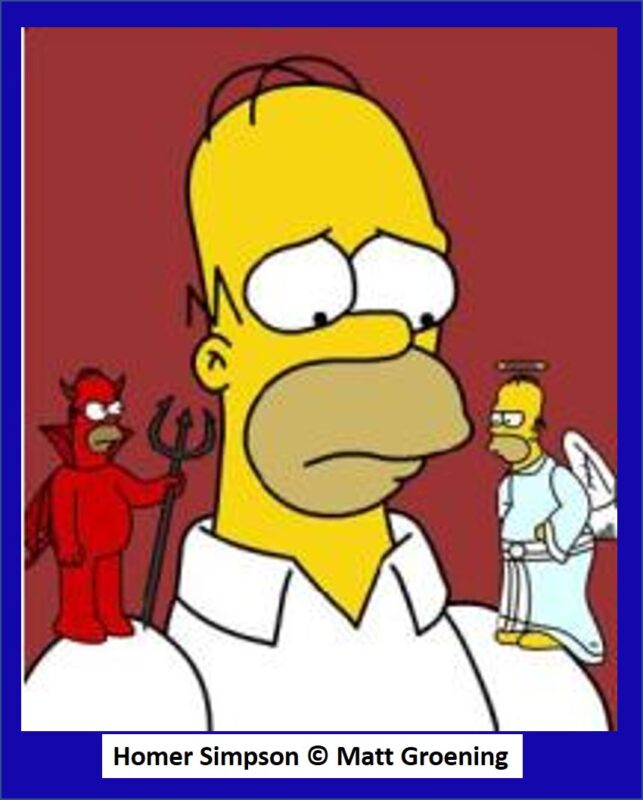
The angel on one shoulder, the devil on the other is a common visual device in cartoons: Tom the cat chooses whether to eat Jerry the mouse, Sylvester the cat struggles with a similar dilemma with Tweety Bird or as is pictured above Homer Simpson struggles with eating another jelly doughnut. (Spoiler alert: for Tom and Sylvester the devil may win short term but the prey escapes, but for Homer the doughnut always wins.)

We all face temptations. Some are better than others at resisting their devils. Me? My angel won on alcohol, and speeding. My devil wins too often on exercise and the devil and angel are tied on ice-cream.

Business leaders may face such obvious ethical decisions, whether to tell a customer that you’ve discovered that they paid you twice or wait and see if they notice. Some make the wrong choices. However, most difficult decisions are not a good versus evil, angel or devil, “I know I should, but I really want….” They are more often trade-offs, greater good or least harm..

What do we want from our leaders?

We want them to know where they are going.

We lead toward something or away from something. We followers depend on leaders for direction. In times of change, the end destination may not be absolutely clear, but the leader must communicate that which is clear.

“We seek the land of milk and honey,”  – a place we can call our own where we can raise goats to have kids and keep bees. That is the vision Moses communicated to nomads wandering the desert for forty years.

“Pipes, people, profit, in that order,”  an oil field leader’s values as guideposts.

We want them to inspire us.

Leaders attract followers. They may do it with an exciting vision.

“I have a dream that my four little children will one day live in a nation where they will not be judged by the color of their skin but by the content of their character.”

We want leaders to express our shared values.

Ray Dalio, founder of Bridgewater Associate, the world’s largest hedge fund and Bob Chapman, CEO of Barry-Wehmiller, a global supplier of manufacturing technology and services, may be entirely different as men. They do have one thing in common. They each designed consistent organizational cultures based upon their values.

Ray Dalio and Bridgewater Associates (BA), believe in “radical truth and transparency.” The culture, as described in Dalio’s book Principles,” insists on open, honest feedback, at any time by anyone to anyone. BA keep data on individual success and failure available to all, and has created systems of real-time evaluation of people, in meetings for example. They use data to drive emotion out of the workplace.

Bob Chapman and Barry-Wehmiller (BW) believe in “the extraordinary power of caring for people like family.” The culture, as described in Chapman’s book Everybody Matters, also values direct and honest feedback and doesn’t tolerate gossip, but they strive to do it with emotion, caring.

Stock trading and manufacturing equipment are different business. Dalio and Chapman are likely different men. Each company hires people and leads them based upon the leader’s values. The values are different and likely the people they hire are as different as the leaders.  Both leaders understand the importance of shared values.

We want decisive leaders.

We say we “trust a leader’s judgement” (or we don’t). That doesn’t mean we agree with every decision. That means the leader has made the facts and the process transparent, so we understand how the leader came to the decision.

Decisiveness isn’t always what we want. “He is frequently wrong, but never in doubt,” doesn’t describe a leader that many would follow.

Sometimes we want leaders who allow us to make decisions.

We want leaders who share all the information we need for us to decide even when we ask for them a decision. I once had a boss who used to say, “I’m of two minds on this subject. . .”

“. . .  on the one hand a low introductory price may clinch the deal. On the other hand it sets the tone for future business and we may lose out in the longer term.”

Making the trade-offs explicit helped me make the decision.

I tried this with my kids with less than ideal results “OK, Pop, what does Mind #1 say. . . And Mind #2? Any other minds in there?” (One of the downsides of being a wiseass is that you inspire the same quality in others.)

What about the true dilemma?

These may be ethical decisions. Or they may be decisions where there are no good choices. Or they may be decisions that will change everything and from which there is no going back.

To make tough decisions, I have been known to write balance sheets  or weighted priority matrices. This is especially useful for joint decision making.

It is worth knowing that some people dislike this mechanistic form of fact-based decision making.  To folks who make decisions by comparing outcomes to their deeply held values, writing down values, or worse applying quantitative weighting one against the other, seems like trivializing their values..

Sometimes discussion about the greatest good or least harm or greatest equity with notes not a matrix, overcomes this objection. Sometimes you just have to ask, “How would you make this decision.”

Dilemmas, decisions with equally good or equally bad outcomes, are hard. Intractable conflicts are hard, manufacturing vs. sales, activists vs. business, economic safety net supporters vs. those who believe that a safety net encourages indigence. Framing those differences as cartoon angels and devils isn’t helpful. The implied value judgement escalates the situation and makes the decision harder. But is their something such a simple dilemma might teach us?

“I know I really should. . . , but I really want to . . . “

There’s the voice that wants the ice cream and the voice that hates the number on the scale the next day. Some would say this is an easy ethical dilemma,

“You definitely should not eat the ice cream.”

“Come on! You’re 75 years old. Enjoy yourself!”

Two voices, not an angel and a devil on opposite shoulders, they are both me

Acceptance of each voice is the first step to integration or unification. I mostly have this dilemma in a unifying equilibrium. Ice cream two days a week.

Is this how we get off the horns of the dilemma? Acceptance, integration, compromise?

The horns of the ice cream dilemma are goring only me. Two voices. “I’m of two minds.” Other dilemmas, business ethics, political conflict, international diplomacy, have multiple voices. How could we decide until we have heard and accepted them all? “Any other minds in there?”

We expect our leaders to have the wisdom of Solomon.

“It’s my baby!”

“No, It’s my baby!”

“Cut the baby in half!” decrees the king.

“No! No! No! You take the baby!” cries the real mother.

Is expecting the reincarnation of Solomon an abdication of our own responsibility to discuss, accept, integrate, unify, and compromise?

 

“I don’t know?”

What do you think?

Please join the conversation by leaving a comment below.

If you enjoyed my writing, please click the button below to subscribe to receive 1-2 posts per week, no ads, no affiliate links and I will never sell, trade or otherwise distribute your information. You can unsubscribe at any time by clicking unsubscribe on the email.

A Friday Some Years Ago:

9:00. Phone rings.

“Hello? Oh, Hi Ken…”

12:00 noon. Phone rings.

“Hi Ken, what’s up?”

4:45 p.m. Phone rings.

“Hi Ken… Say Ken, Are you checking on me?”

“Well, actually, yeah. When I work from home I only get about two hours of work done all day. What with the kids and the dog, trying to work from the kitchen counter, and the TV, and computer games. It’s very distracting. We pay you quite a lot and I was just trying to see if you are actually working.”

“OK, Ken, I get it. But I’m in my office on the second floor of my house. It has a desk, phone, files and computer. There’s no TV. I have no games on my computer. My kids are grown and don’t live with me. The dog is old and goes out before work and after. Besides Ken, I only charge you when I’m actually working. We can review the training I wrote today if you’d like.”

“Well, I’m headed home; can you email it?”

“Sure.”

My client was new to the job and he had inherited a consulting team. To him it was easy to see us working when we were on site, but given his personal experience working from home, he couldn’t imagine us working productively on Friday, when we weren’t on site.

In fact, for certain kinds of head-down individual work, I got a great deal more done on Fridays than I did during the week, when I had to attend meetings with clients and build commitment to change. However, I understood that many managers in offices shared Ken’s experience and the concerns that arose from it.

Then Came Covid

Durin the coronavirus pandemic, workers in factories, healthcare, first responders, retail, and food service risked their lives and office workers learned to be productive “working from home.” Office productivity didn’t suffer as expected and office workers liked the flexibility, the lack of wasted commuting time, and not wearing pants on Zoom calls.

I retired in 2018, so this really didn’t affect me directly. I heard about it from my kids. One time consulting colleagues called to ask how I worked as an independent consultant. People asked about my home office and what the IRS required to deduct the set-up of a home office, (dedicated space, documented use, and expense receipts). I started to see jobs advertised as “remote,” or “hybrid.”

Some people figured out they could work from anywhere and you saw magazine articles of people working from the deck of their beach house. I was always jealous of that because I didn’t have a beach house.

Some people complained about the isolation of Covid-time. As the pandemic died down, some people reminisced about standing on balconies of city apartments banging pots in support of first responders and healthcare workers. Covid was something that affected us all, a unifier after a time of division.

Then Covid was (finally) over

Well, not really over. Covid is still around. We’re just done with it, over it; Covid is so four years ago. For the last four years, there has been a discussion building.

“OK everybody, it’s time to return to work.”

That one pissed off all those workers in factories, healthcare, first responders, retail, and food service who risked their lives.

“We never stopped working.”

So R-T-W became R-T-O, “return to office.”

Some were enthusiastic; some were less so. Sure, there would be less isolation, but more colds and flu (and Covid whispered the risk averse). And then there is wasted commute time. And then there is the flexibility of working when I want. And then there is the fact that I don’t have to stay late because Mary bent my ear about her mom, and Ted just had to relive the highlights of the big game, etc.

“OK, well, what about two days per week?”

“Maybe.”

“Three?”

“I don’t know.”

It’s been a long four years.

This conversation has been slowly accelerating. I must admit that, Boomer dinosaur that I am, I wasn’t particularly won over by the Gen X, Y, Z, Alpha whines about commuting costs and cleaning bills for the pants they would now have to wear. I also thought that some workers were being clearly unreasonable in their demands.

My nephew runs a retail food business and told me about job applicants who asked if they could “do the retail floor job remotely.” Some jobs require face time.

Culture is built by being together. Teams function best if they actually know each other. I began to hypothesize that introverts would want to work at home but extraverts would want to return to the office. It turns out there is no evidence of that.

I have had more and more conversations recently with office workers, people I respect for their intelligence and projected competence, who say, “If they insist on 5-days-in-office, I will leave.” Or “OK, I’ll come in for 9:00 and leave at 5:00, but there is no working till 7:00 and no calls on nights and weekends.”

There have been some famous CEOs who have gone public “R-T-O or else!” At a recent cookout, huddling under a canopy during an inconvenient downpour, I was engaged in conversation with the manager of administration for the board of directors at a money center bank.

“My CEO is friends with another CEO who has drawn a very public line in the sand, but my colleagues, my boss and three quarters of my staff will walk if he enforces the RTO mandate. Most of the board are off site and 90% of my work is email and phone. I have to be here for board meetings and two or three days a week is reasonable. Five is a hard “No!”

I began to think that managers, even CEOs, who insisted on a 5-day RTO mandate, might be driven by their own convenience  ̶  “I want to turn around an give someone a job directly. I don’t want to find out they’re ‘shirking from home’ and have to call them.”

Then, in today’s New York Times, I came upon an article by Adam Grant, et al, at the Wharton Business School, that quotes research, that demonstrates that:

“ One: Return-to-office mandates don’t increase profits by weeding out people who lack commitment. They motivate the most talented people to jump ship. Two: As long as people are together for half the week, remote work isn’t isolating. And three: Hybrid work isn’t bad for performance, innovation or connection. “

Grant et al go on to describe how adamant RTO mandates are most often pushed by narcissistic managers that require constant attention, as demonstrated by the size of their pay packages, offices, and their photos in the annual reports.

So where does that leave RTO?

It depends. There are clearly some jobs that require presence, just like first responders, and retail workers, if your job has a face to the public, well, you gotta face the public. If your job has more individual than team work, you might have more of an argument for remote or hybrid work.

If you are a manager, who just can’t get over the fact that, “Hey, I got up every day and went into the office. I sucked up to my manager and now its my turn,” then maybe look in a mirror. Get over yourself, and see how you can lead change three days a week or on Zoom without any pants.

You may also like. . .

Sacrifice

Sacrifice

My Memorial Day verse was not published the first time I tried, seems I’m cursed by technology’s worst. Here’s hoping this remembrance burst makes it now.

read more

Please contribute your thoughts in a comment. The author will be notified, but may not respond to every comment. The site reserves the right to delete comments it deems off topic, offensive, or spam.

0 Comments

Submit a Comment

Your email address will not be published. Required fields are marked *