
Pirates and Outlaws

An attractive archetype

Americans are a scrappy lot. We’re “cussedly independent.” After all, the United States was founded by “embattled farmers” who broke the rules of war by wearing buckskins and hiding behind trees to shoot at soldiers marching in lines wearing bright red target-coats.

So it isn’t surprising that we love the “pirate” and the “outlaw,” those who “disrupt,” break the rules, or “stick it to the Man.” You can see it in our literature, Tom Sawyer and Huck Finn,  our movies, Pirates of the Caribbean  and The Godfather and TV shows, The Sopranos  and Breaking Bad. We idolize business leaders like Henry Ford, Steve Jobs and Elon Musk.

Fashions change, but the pirate’s earring, the outlaw’s bandanna mask, the gangster’s pinkie ring perpetually resonate.

It is a romantic archetype, daring Outlaw, passionate Revolutionary, swashbuckling Pirate, Maverick, Outsider, Rebel. We cheer Zorro and Batman, rich men turned thieves and justice warriors for the poor.

Americans didn’t invent this archetype. The British have Robin Hood; the French have Cartouche. The Germans have Schinderhannes and the Australians have Ned Kelley, The Keralans in Southern India have Kayamkulam Kochunni, the Irish have Gráinne O’Malley, and the Chinese have Song Jiang. Outlaws with a heart are a global phenomenon.

There are brands that promote themselves as outlaws, Harley-Davidson, MTV, Apple. Some celebrities style themselves  bad-boys, like Erroll Flynn, who famously played Robin Hood, or Charlie Sheen  or bad-girls, like Madonna or Milie Cyrus. Country singers Willie, Waylon, and Kris were called outlaws because they resisted album strings tracks. Hank Williams Jr, and Chris Stapleton carry on the outlaw-country tradition.

Some leaders strike an outlaw pose, which, I guess, is OK until they start breaking actual laws or behaving in toxic ways. Then maybe it becomes a little less romantic and a lot less cool.

The Law is the law . . . except . . . maybe . . .

The United States was founded in the tradition of English common law. Before the Norman conquest of 1066 England was ruled in Anglo-Saxon legal tradition. Crimes were personal. Victims were entitled to compensation. If I killed your cow, I paid you for it. If I killed your wife I paid you, maybe more or less depending on the wife and the cow. If the parties could agree on compensation, great; if not, the chief or a jury of locals decided the crime price.

The feudal Normans built stone castles with square towers and keeps on hills overlooking thatch covered villages. The Normans, a colonial power, needed to keep the peace, so there were rules of accepted behavior. Crimes became less individual, and more crimes “against the community.” Adjudication of the law was centralized, conducted by clerks, literally clerics, literate clergy. These clerks’ knowledge of law came from Cicero, Virgil and the Vatican and was described as flowing from the Divine Right of the King. It’s tough to make exceptions to God.

The outermost rim of an Anglo-Saxon village was called the pale. If someone’s behavior was wild and uncontrollable it was described as “beyond the pale,” outside village acceptable behavior that might get you banished. The Normans expanded the concept of outlawry, to be outside the community and protection of the law.

Everyone had to follow the rules, even Kings. Henry II discovered this when his knights murdered Thomas á Beckett,  Archbishop of Canterbury. Royals were slow to learn.  King John’s barons spelled out the rules in the Magna Carta in 1215.

This is what the Adams, Jefferson, Franklin crew were upset about; George III was not following the rules. So they built a government to ensure “life, liberty, and the pursuit of happiness.” It was a representative republic, which, despite visionary words, wasn’t all that representative, and we’ve been trying to grow into the words they used ever since.

The founders broke the rules to break away, but they were rule based folks. Sam Adams, the firebrand of the Son’s of Liberty, was an outlaw to the Crown and a patriot in our history books. So Americans had this dichotomy from our beginnings. We love “law and order,” a “government of laws not of men,” “the rule of law.” We also love the Outlaw and the Pirate. Maybe everyone does.

Unintended consequences

I have been rebellious for much of my life. I rebelled against my parents, my teachers, against bosses, against anyone who had the smallest bit of power over me. I broke some laws. I’m not proud of that, but fortunately I never hurt anyone or went to jail. I loved the pirate image; I even once contemplated an earring.

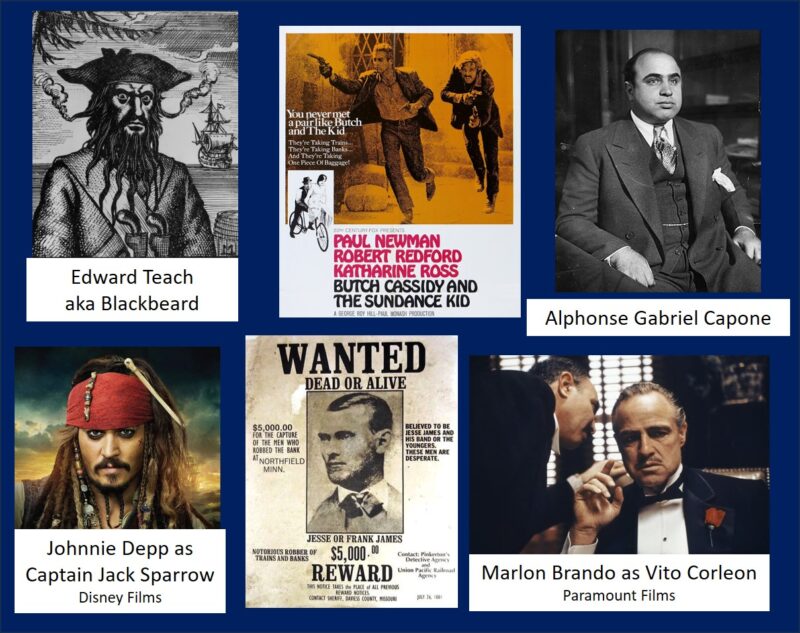
Disney’s Pirates of the Caribbean is a fun romp. Captain Jack Sparrow meets up with Edward Teach, Blackbeard. The real Edward Teach was captured and beheaded after a career of capturing ships, killing their crews and marauding coastal communities. Maybe the earing isn’t so cool.

One filmmaker shows the horrific consequences of outlaw behavior. We laugh as Vito Corleon (Marlon Brando) in Francis Ford Coppola’s The Godfather talks about an “offer he can’t refuse.” Then we wake with the man who discovers a severed horses head on his bloody satin sheets.

Jesse James, Butch Cassidy and the Sundance Kid have been lionized in books and movies, but you rarely hear from the families of Pinkertons guards or Bolivian federales they killed. Al Capone, the bootlegger operator avoided getting caught by becoming a local folk hero. The victims of the St. Valentine’s Day Massacre didn’t get a say. Capone was put away by the IRS for tax evasion.

People talk blithely about tax evasion a “victimless crime.” This is the Anglo-Saxon view of crime. The victim isn’t one person or one company, it is a crime against the community.

Some admire how drug dealers “beat the system” until your brother dies of a fentanyl overdose or your little sister is caught in a gang crossfire. We call terrorists “freedom fighters” until they commit an unspeakable crime in the name of “liberation.” The Pirate and Outlaw are too wrapped up in ”rules don’t apply to me” to care about anything but themselves.

But that earring, bandana, and pinkie ring sure are cool.
Please join the conversation by leaving a comment below.

If you enjoyed my writing, please click the button below to subscribe to receive 1-2 posts per week, no ads, no affiliate links and I will never sell, trade or otherwise distribute your information. You can unsubscribe at any time by clicking unsubscribe on the email.

A Friday Some Years Ago:

9:00. Phone rings.

“Hello? Oh, Hi Ken…”

12:00 noon. Phone rings.

“Hi Ken, what’s up?”

4:45 p.m. Phone rings.

“Hi Ken… Say Ken, Are you checking on me?”

“Well, actually, yeah. When I work from home I only get about two hours of work done all day. What with the kids and the dog, trying to work from the kitchen counter, and the TV, and computer games. It’s very distracting. We pay you quite a lot and I was just trying to see if you are actually working.”

“OK, Ken, I get it. But I’m in my office on the second floor of my house. It has a desk, phone, files and computer. There’s no TV. I have no games on my computer. My kids are grown and don’t live with me. The dog is old and goes out before work and after. Besides Ken, I only charge you when I’m actually working. We can review the training I wrote today if you’d like.”

“Well, I’m headed home; can you email it?”

“Sure.”

My client was new to the job and he had inherited a consulting team. To him it was easy to see us working when we were on site, but given his personal experience working from home, he couldn’t imagine us working productively on Friday, when we weren’t on site.

In fact, for certain kinds of head-down individual work, I got a great deal more done on Fridays than I did during the week, when I had to attend meetings with clients and build commitment to change. However, I understood that many managers in offices shared Ken’s experience and the concerns that arose from it.

Then Came Covid

Durin the coronavirus pandemic, workers in factories, healthcare, first responders, retail, and food service risked their lives and office workers learned to be productive “working from home.” Office productivity didn’t suffer as expected and office workers liked the flexibility, the lack of wasted commuting time, and not wearing pants on Zoom calls.

I retired in 2018, so this really didn’t affect me directly. I heard about it from my kids. One time consulting colleagues called to ask how I worked as an independent consultant. People asked about my home office and what the IRS required to deduct the set-up of a home office, (dedicated space, documented use, and expense receipts). I started to see jobs advertised as “remote,” or “hybrid.”

Some people figured out they could work from anywhere and you saw magazine articles of people working from the deck of their beach house. I was always jealous of that because I didn’t have a beach house.

Some people complained about the isolation of Covid-time. As the pandemic died down, some people reminisced about standing on balconies of city apartments banging pots in support of first responders and healthcare workers. Covid was something that affected us all, a unifier after a time of division.

Then Covid was (finally) over

Well, not really over. Covid is still around. We’re just done with it, over it; Covid is so four years ago. For the last four years, there has been a discussion building.

“OK everybody, it’s time to return to work.”

That one pissed off all those workers in factories, healthcare, first responders, retail, and food service who risked their lives.

“We never stopped working.”

So R-T-W became R-T-O, “return to office.”

Some were enthusiastic; some were less so. Sure, there would be less isolation, but more colds and flu (and Covid whispered the risk averse). And then there is wasted commute time. And then there is the flexibility of working when I want. And then there is the fact that I don’t have to stay late because Mary bent my ear about her mom, and Ted just had to relive the highlights of the big game, etc.

“OK, well, what about two days per week?”

“Maybe.”

“Three?”

“I don’t know.”

It’s been a long four years.

This conversation has been slowly accelerating. I must admit that, Boomer dinosaur that I am, I wasn’t particularly won over by the Gen X, Y, Z, Alpha whines about commuting costs and cleaning bills for the pants they would now have to wear. I also thought that some workers were being clearly unreasonable in their demands.

My nephew runs a retail food business and told me about job applicants who asked if they could “do the retail floor job remotely.” Some jobs require face time.

Culture is built by being together. Teams function best if they actually know each other. I began to hypothesize that introverts would want to work at home but extraverts would want to return to the office. It turns out there is no evidence of that.

I have had more and more conversations recently with office workers, people I respect for their intelligence and projected competence, who say, “If they insist on 5-days-in-office, I will leave.” Or “OK, I’ll come in for 9:00 and leave at 5:00, but there is no working till 7:00 and no calls on nights and weekends.”

There have been some famous CEOs who have gone public “R-T-O or else!” At a recent cookout, huddling under a canopy during an inconvenient downpour, I was engaged in conversation with the manager of administration for the board of directors at a money center bank.

“My CEO is friends with another CEO who has drawn a very public line in the sand, but my colleagues, my boss and three quarters of my staff will walk if he enforces the RTO mandate. Most of the board are off site and 90% of my work is email and phone. I have to be here for board meetings and two or three days a week is reasonable. Five is a hard “No!”

I began to think that managers, even CEOs, who insisted on a 5-day RTO mandate, might be driven by their own convenience  ̶  “I want to turn around an give someone a job directly. I don’t want to find out they’re ‘shirking from home’ and have to call them.”

Then, in today’s New York Times, I came upon an article by Adam Grant, et al, at the Wharton Business School, that quotes research, that demonstrates that:

“ One: Return-to-office mandates don’t increase profits by weeding out people who lack commitment. They motivate the most talented people to jump ship. Two: As long as people are together for half the week, remote work isn’t isolating. And three: Hybrid work isn’t bad for performance, innovation or connection. “

Grant et al go on to describe how adamant RTO mandates are most often pushed by narcissistic managers that require constant attention, as demonstrated by the size of their pay packages, offices, and their photos in the annual reports.

So where does that leave RTO?

It depends. There are clearly some jobs that require presence, just like first responders, and retail workers, if your job has a face to the public, well, you gotta face the public. If your job has more individual than team work, you might have more of an argument for remote or hybrid work.

If you are a manager, who just can’t get over the fact that, “Hey, I got up every day and went into the office. I sucked up to my manager and now its my turn,” then maybe look in a mirror. Get over yourself, and see how you can lead change three days a week or on Zoom without any pants.

You may also like. . .

Sacrifice

Sacrifice

My Memorial Day verse was not published the first time I tried, seems I’m cursed by technology’s worst. Here’s hoping this remembrance burst makes it now.

read more

Please contribute your thoughts in a comment. The author will be notified, but may not respond to every comment. The site reserves the right to delete comments it deems off topic, offensive, or spam.

2 Comments

  1. Bob Musial

    Had a lot of flashbacks as I read this one, Alan, and could relate on many levels.

    Harley, long hair, a full beard. Somewhat rebellious.

    Never did get an ear pierced or a tattoo.

    Still try to side with the “good guys” whenever possible.

    Reply
    • Alan Culler

      Would like to have seen the hair and beard, Bob 😉
      Siding with the good guys is important.
      Thanks for your engagement and support.

      Reply

Submit a Comment

Your email address will not be published. Required fields are marked *