
“What’s My Motivation?”

“Fits and starts of motivation”

In the fourth grade, Mrs. Keshan described the early stages of my declining interest in academics. “Alan read early and is obviously very bright, but is overly sensitive to criticism, and plagued by fits and starts of motivation for any work outside the classroom.” I hated homework, which in fourth grade was a lot of mimeographed pages of word problems and sentence diagrams, and I still don’t like being dressed down in public. Was I unmotivated?

Motivation seems to be something Americans obsess about. When an athlete breaks some seemingly unattainable record, she is asked, “On all those early morning work-outs, what kept you motivated?” Whenever there is a horrific mass shooting, the news media immediately begins to speculate about the “motive.” Managers and leaders are seen as somehow responsible for “motivating their people.”

Sometimes managers and leaders are partially let off the hook by a description of intrinsic versus extrinsic motivation. What that means is, “you need to hire people with the internal drive to be productive,” intrinsic motivation. Then you won’t have to waste so much money on pay-for-performance systems, designed by the muleskinner who dangled a carrot in front of the mule, while whacking him with a stick on the hindquarters (extrinsic motivation).

“What’s my motivation?”

I first heard this from a freshman actor in a college production. All the upper-class students in the production cringed. We knew that our director, Dr. Hill, had little use for “method” acting.

“Don’t ask actors to “think.” The best ones learn the lines and “feel,” but they don’t know what they do.”

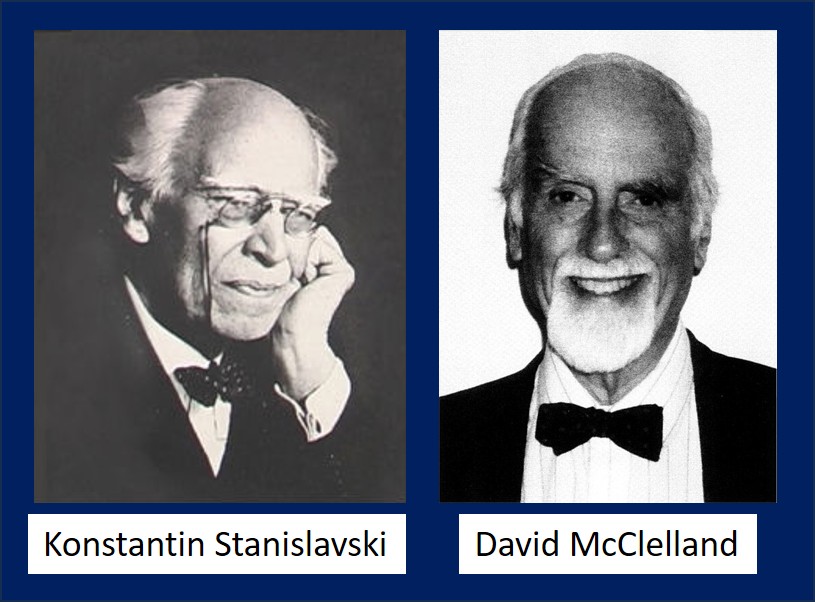
 “The Method” is a system of preparation that helps an actor understand his character’s motivation, what makes him or her behave the way they do in the play. The Method was created by Konstantin Stanislavski, a Moscow Art Theatre actor and director in the 1920s and 30s. It was later expanded by Lee Strasberg, a director at The Actor’s Studio in New York City.

Like many acting students I read Stanislavski’s An Actor Prepares. I idolized many of the actors and directors who used the method, Marlon Brando, Elia Kazan, Paul Newman, Julie Harris, Arthur Penn and Marilyn Monroe. Like all my cast mates in this play, I kept my method preparation to myself and didn’t use the “motivation” word in front of Dr. Hill.

“Miss Seitz, do you know the line?”

“Yes, Dr. Hill.”

“Then I suggest you say it or be motivated to get off my stage.”

Still, I think that most leaders today would benefit from Stanislavski’s seven questions:

  • Who am I? Consider your background, parentage, experiences, everything that gives you self-definition that others see, and your strengths and weaknesses.
  • Where am I? Geography, place, culture that drives yours and others’ behavior.
  • When am I? What is my place in the history that came before, and its impact on the present and future.
  • What do I want? Clarity of goal and the ability to see the benefit to others, and communicate it, that is a defining moment for anyone leading people.
  • Why do I want it? There may be benefits to the leader from the vision, and the ability to be transparent about anything not purely altruistic is a foundation of trust.
  • How will I get it? The law of reciprocity, give to get, is something many leaders could learn. Neither leading nor following is a transaction, but it may start there.
  • What do I need to overcome? For Stanislavski, this tension is the central conflict that drives the play. For today’s leaders, it is the competing demands on followers’ time, energy, and actions that must be overcome for them to choose to change and follow your leadership.

McClelland’s Motive Needs

It is useful for a leader to think deeply about the factors driving their own motivation and also of those they lead.

Early in my career as a consultant, I worked for people who were influenced by psychologist Dr. David McClelland, when he taught at Harvard University. McClelland’s motivation research identified three personal motive needs that he said all humans possessed to some degree:

  • Need for Power (N-Pow), the drive to influence one’s surroundings,
  • Need for Affiliation (N-Aff), the drive to build close relationships,
  • Need for Achievement (N-Ach), the drive to succeed, to excel in relation to a set of standards.

McClelland said we all have all three of these motive needs that arise in different circumstances. Some people have a dominant need. For example, he noted that many entrepreneurs were N-Pow dominant, but had strong secondary N-Ach drive. And he noted that many institutional managers appealed to N-Aff, “We’re a team,” while setting N-Ach individual goals.

One of the ways that McClelland’s theory plays out in organizations is in goal setting. N-Pow people, driven by status, tend to set “stretch goals,” goals that will impress others by their “big, hairy, audacity.” N-Aff people tend to set “team-goals” focused on contribution to a greater whole. N-Ach people tend to set goals a little higher than average, but one that they will be able to make. N-Ach folks are all about the check-mark. Some of us, when we do something not on our to-do list, will actually write it down so we can check it off.

Another organizational circumstance where personal motive needs come into play is in receiving feedback. N-Pow people often like to be acknowledged publicly to increase their status. N-Aff people often like to share credit. N-Ach people may prefer private acknowledgement against the known standard.

Remember, we all have three needs, so if you want to know how someone wants to receive feedback, ask them.

Organizational Climate

One of McClelland’s disciples that I worked for was Dr. George H. Litwin. In 1967, he and his research assistant Bob Stringer conducted an experiment. They created three organizations using these motive needs as primary management styles, British (N-Pow), Balance (N-Aff), Blazer. In the simulation, these companies all manufactured identical products. Managers were told to appeal to these needs in managing the company. (See Motivation and Organizational Climate, George H. Litwin and Robert A. Stringer Jr, 1968; Harvard University Press.)

The N-Ach company substantially out-performed the other two, but began to show signs of stress over time. The N-Pow company started strong, but imploded. The N-Aff company, started slow, but came on strong at the end. These results have been replicated several times including a training exercise I was involved with building, used at British Airways, First Republic Bank and other clients.

The organizational climate research shows that management practice can relatively quickly change business results by appealing to motivation. McClelland maintained that because we all contain all three needs, balance was called for.

All behavior is motivated

Climate Change and clean tech, Artificial Intelligence and quantum computing, gene manipulation, CRISPR, biotech, Connectivity of everything, everywhere, all of the time, – the twenty-first century seems to be about change. We need people to do more of some things, less of some things, and some things differently. Leading change is likely to be a critical skill to develop.

“What’s my motivation?” I dunno. Help others learn to lead change or get off the stage?


Cover Change Leader? Who Me?

Please join the conversation by leaving a comment below.

If you enjoyed my writing, please click the button below to subscribe to receive 1-2 posts per week, no ads, no affiliate links and I will never sell, trade or otherwise distribute your information. You can unsubscribe at any time by clicking unsubscribe on the email.

A Friday Some Years Ago:

9:00. Phone rings.

“Hello? Oh, Hi Ken…”

12:00 noon. Phone rings.

“Hi Ken, what’s up?”

4:45 p.m. Phone rings.

“Hi Ken… Say Ken, Are you checking on me?”

“Well, actually, yeah. When I work from home I only get about two hours of work done all day. What with the kids and the dog, trying to work from the kitchen counter, and the TV, and computer games. It’s very distracting. We pay you quite a lot and I was just trying to see if you are actually working.”

“OK, Ken, I get it. But I’m in my office on the second floor of my house. It has a desk, phone, files and computer. There’s no TV. I have no games on my computer. My kids are grown and don’t live with me. The dog is old and goes out before work and after. Besides Ken, I only charge you when I’m actually working. We can review the training I wrote today if you’d like.”

“Well, I’m headed home; can you email it?”

“Sure.”

My client was new to the job and he had inherited a consulting team. To him it was easy to see us working when we were on site, but given his personal experience working from home, he couldn’t imagine us working productively on Friday, when we weren’t on site.

In fact, for certain kinds of head-down individual work, I got a great deal more done on Fridays than I did during the week, when I had to attend meetings with clients and build commitment to change. However, I understood that many managers in offices shared Ken’s experience and the concerns that arose from it.

Then Came Covid

Durin the coronavirus pandemic, workers in factories, healthcare, first responders, retail, and food service risked their lives and office workers learned to be productive “working from home.” Office productivity didn’t suffer as expected and office workers liked the flexibility, the lack of wasted commuting time, and not wearing pants on Zoom calls.

I retired in 2018, so this really didn’t affect me directly. I heard about it from my kids. One time consulting colleagues called to ask how I worked as an independent consultant. People asked about my home office and what the IRS required to deduct the set-up of a home office, (dedicated space, documented use, and expense receipts). I started to see jobs advertised as “remote,” or “hybrid.”

Some people figured out they could work from anywhere and you saw magazine articles of people working from the deck of their beach house. I was always jealous of that because I didn’t have a beach house.

Some people complained about the isolation of Covid-time. As the pandemic died down, some people reminisced about standing on balconies of city apartments banging pots in support of first responders and healthcare workers. Covid was something that affected us all, a unifier after a time of division.

Then Covid was (finally) over

Well, not really over. Covid is still around. We’re just done with it, over it; Covid is so four years ago. For the last four years, there has been a discussion building.

“OK everybody, it’s time to return to work.”

That one pissed off all those workers in factories, healthcare, first responders, retail, and food service who risked their lives.

“We never stopped working.”

So R-T-W became R-T-O, “return to office.”

Some were enthusiastic; some were less so. Sure, there would be less isolation, but more colds and flu (and Covid whispered the risk averse). And then there is wasted commute time. And then there is the flexibility of working when I want. And then there is the fact that I don’t have to stay late because Mary bent my ear about her mom, and Ted just had to relive the highlights of the big game, etc.

“OK, well, what about two days per week?”

“Maybe.”

“Three?”

“I don’t know.”

It’s been a long four years.

This conversation has been slowly accelerating. I must admit that, Boomer dinosaur that I am, I wasn’t particularly won over by the Gen X, Y, Z, Alpha whines about commuting costs and cleaning bills for the pants they would now have to wear. I also thought that some workers were being clearly unreasonable in their demands.

My nephew runs a retail food business and told me about job applicants who asked if they could “do the retail floor job remotely.” Some jobs require face time.

Culture is built by being together. Teams function best if they actually know each other. I began to hypothesize that introverts would want to work at home but extraverts would want to return to the office. It turns out there is no evidence of that.

I have had more and more conversations recently with office workers, people I respect for their intelligence and projected competence, who say, “If they insist on 5-days-in-office, I will leave.” Or “OK, I’ll come in for 9:00 and leave at 5:00, but there is no working till 7:00 and no calls on nights and weekends.”

There have been some famous CEOs who have gone public “R-T-O or else!” At a recent cookout, huddling under a canopy during an inconvenient downpour, I was engaged in conversation with the manager of administration for the board of directors at a money center bank.

“My CEO is friends with another CEO who has drawn a very public line in the sand, but my colleagues, my boss and three quarters of my staff will walk if he enforces the RTO mandate. Most of the board are off site and 90% of my work is email and phone. I have to be here for board meetings and two or three days a week is reasonable. Five is a hard “No!”

I began to think that managers, even CEOs, who insisted on a 5-day RTO mandate, might be driven by their own convenience  ̶  “I want to turn around an give someone a job directly. I don’t want to find out they’re ‘shirking from home’ and have to call them.”

Then, in today’s New York Times, I came upon an article by Adam Grant, et al, at the Wharton Business School, that quotes research, that demonstrates that:

“ One: Return-to-office mandates don’t increase profits by weeding out people who lack commitment. They motivate the most talented people to jump ship. Two: As long as people are together for half the week, remote work isn’t isolating. And three: Hybrid work isn’t bad for performance, innovation or connection. “

Grant et al go on to describe how adamant RTO mandates are most often pushed by narcissistic managers that require constant attention, as demonstrated by the size of their pay packages, offices, and their photos in the annual reports.

So where does that leave RTO?

It depends. There are clearly some jobs that require presence, just like first responders, and retail workers, if your job has a face to the public, well, you gotta face the public. If your job has more individual than team work, you might have more of an argument for remote or hybrid work.

If you are a manager, who just can’t get over the fact that, “Hey, I got up every day and went into the office. I sucked up to my manager and now its my turn,” then maybe look in a mirror. Get over yourself, and see how you can lead change three days a week or on Zoom without any pants.

You may also like. . .

Sacrifice

Sacrifice

My Memorial Day verse was not published the first time I tried, seems I’m cursed by technology’s worst. Here’s hoping this remembrance burst makes it now.

read more

Please contribute your thoughts in a comment. The author will be notified, but may not respond to every comment. The site reserves the right to delete comments it deems off topic, offensive, or spam.

2 Comments

  1. Ali Anani

    you focused Brother Alan on your academic challenges and the significance of motivation in sports and workplaces. You rightly contrasted intrinsic and extrinsic motivation, referencing concepts from Konstantin Stanislavski and David McClelland regarding the Need for Power, Affiliation, and Achievement. An experiment by Dr. George H. Litwin demonstrates how management styles influenced by these motives affect organizational performance. You concluded by underscoring the necessity of acknowledging and balancing motivational needs for effective leadership in a dynamic environment.

    Brilliant post. Thank you

    Reply
    • Alan Culler

      Thank You Brother Ali

      I appreciate your continued support.

      Reply

Submit a Comment

Your email address will not be published. Required fields are marked *